Americana; 121; Thomas Hart Benton's "The sources of country music"
- Transcript
Wh... . . . . . . Presentation of this program is made possible in major part by grants from the Kansas City Life Insurance Company and the National Endowment for the Arts and by an additional grant from the Corporation for Public Broadcasting. .
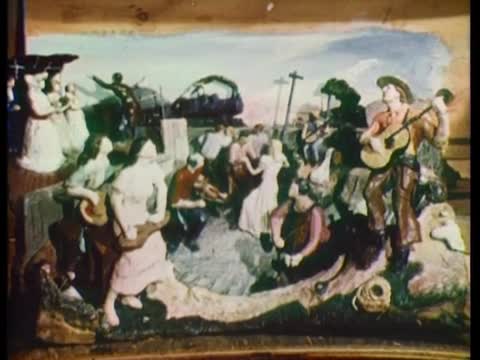
Today we are adding a major artwork by one of the most important American artists to the collection of the Company Music Hall of Fame. And we do so with great pride and enthusiasm because we are convinced that the presence of this work will increase the ability of this institution to communicate with patents. Thomas Hart Benton was, of course, one of the great visual interpreters of the American scene. He put much of himself into the painting. He knew the subject and he loved the music. And all of a sense this work had a special meaning for him. He liked the idea that the painting would be here and not in an art gallery. . . I started out with the original drawing and pen and ink plus the drawings which I have made from real life.
And combining these, something slightly different comes out. I then make a clay model representing the whole picture. The clay model simulates at the three-dimensionality of life. That is, it's no more just an imaginary thing but it's real air in this clay. I don't think it would be possible unless I made the study in clay to project the figure three-dimensionally in the way in which I do. But as long as I have projected them three-dimensionally in the clay model, the next step is simply to get the same effect on a flat surface if I got in the model itself. . .
. . . . .
. . . . . . . . .
. . . . . Well, I had had considerable interest in the folk music of the United States very times in my life. As a matter of fact, I remember it from my childhood because I was raised down in South West Missouri and the only music we had was country music. So I was fairly pretty familiar with it.
I was familiar with the songs and with the good deal of the literature on the subject. Now, good deal of this folk song originally came from the countries where the early settlers came from. And in our own, the most of them are English and Scottish Irish, but they can naturally were modified in the American environment and took on their peculiar character and their peculiar content. . Well, this is an interesting thing about country music. Until very late, they used no percussion, not even a banjo or a guitar. Everything was either fiddle or singing. A singing was sometimes part singing, two and three, generally three parts. But there was no kind of percussion instrument, say like a banjo, which has some of the attack that a percussion instrument would have. They were not used. I don't remember any guitar playing in my youth in the Ozark country at all.
In my early youth, nor the only banjo that were ever played were those in the old mistral chills. And from there, apparently the banjo got into the hill countries somewhere probably in this century. . So I didn't have to do any research. I knew all that stuff. The problem was merely to get it together in my own mind about how I could represent these things in the canvas. And not necessarily in their relative importance, but sure them all, but I did keep thinking of the relative importance.
It would be impossible to think of country music without thinking of the country dances. They played dances. They were around in square dances. And even the pocuses and ulcers, they were danced in these times. So I put that dance form in the middle of a picture. But not as important as the singers in the foreground. Because the singers, what certainly were equally important to any of the old fiddle players and dance music people. . Well, anyhow, then the him singers are gospel singers. The old fashioned hymns of the country churches. Now, there were some sects in these southern hills who believed in no musical instruments at all. Some looked upon fiddle as devil's music, but nearly all of them did some singing. And the bandjos came in from the south summers. I don't know where.
And then later, they steamboat songs and the railroad songs. The railroad songs, as far as I know, only began after the turn of the century. And most of those were written rather than true folk songs. Such songs as that of Casey Jones, the well known, or the Rackle Old 97. These were written songs, but became folk songs because they were simply adopted by the folk. But they had to be included because the railroad songs became a very important factor in the country scene, especially in this century. But anyhow, these were the kind of things on which all country music is based, where it started just by folk singing. There is a difference between a mural and what we call an easel painting.
Generally, a mural theme, the subject matter, probably has more diversity and you're likely to find in most easel paintings. The elements come into the mural, and you have to so arrange that these diverse elements may be united, not only in terms of their subject matter, but in terms of the form of the mural. Ordinary small painting can be seen at one crack of the eye, you can grasp it at one moment. But with a mural, you can't generally do that. Your eye has to explore it before you know it. For that reason, we have to design a mural, knowing that the eye is going to be moving all the time over these spaces.
You have to arrange it so that the eye will follow certain lines, and still so that you will have a sense of unity when you get through it. Music Music Music Music Music
Music Music Music Music
Music Music Music Music
Music Music Music Music
Music Music Music Music
Music Music Music Music
Music Music Music Music
Music Music Music Music
Music Music Music Music
Music Music Music Music
Music Music Music
Music Music Music
- Series
- Americana
- Episode Number
- 121
- Producing Organization
- Pentacle Productions
- Contributing Organization
- Library of Congress (Washington, District of Columbia)
- AAPB ID
- cpb-aacip-02ad90e6b39
If you have more information about this item than what is given here, or if you have concerns about this record, we want to know! Contact us, indicating the AAPB ID (cpb-aacip-02ad90e6b39).
- Description
- Episode Description
- No description available.
- Created Date
- 1977-04-14
- Asset type
- Episode
- Media type
- Moving Image
- Duration
- 00:27:58.038
- Credits
-
-
Producing Organization:
Pentacle Productions
- AAPB Contributor Holdings
-
Library of Congress
Identifier: cpb-aacip-767a7cfcad8 (Filename)
Format: 2 inch videotape
Duration: 00:30:00
If you have a copy of this asset and would like us to add it to our catalog, please contact us.
- Citations
- Chicago: “Americana; 121; Thomas Hart Benton's "The sources of country music",” 1977-04-14, Library of Congress, American Archive of Public Broadcasting (GBH and the Library of Congress), Boston, MA and Washington, DC, accessed May 5, 2026, http://americanarchive.org/catalog/cpb-aacip-02ad90e6b39.
- MLA: “Americana; 121; Thomas Hart Benton's "The sources of country music".” 1977-04-14. Library of Congress, American Archive of Public Broadcasting (GBH and the Library of Congress), Boston, MA and Washington, DC. Web. May 5, 2026. <http://americanarchive.org/catalog/cpb-aacip-02ad90e6b39>.
- APA: Americana; 121; Thomas Hart Benton's "The sources of country music". Boston, MA: Library of Congress, American Archive of Public Broadcasting (GBH and the Library of Congress), Boston, MA and Washington, DC. Retrieved from http://americanarchive.org/catalog/cpb-aacip-02ad90e6b39