News in Perspective; 82
- Transcript
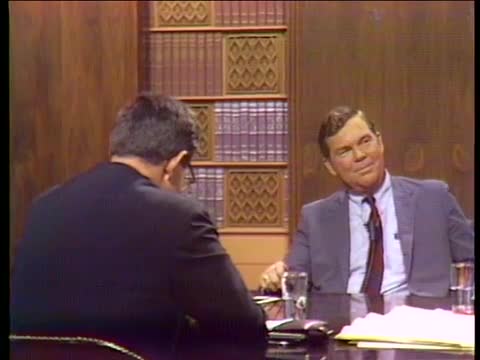
The following program is from NET, the National Educational Television Network. The National Educational Television Network and the New York Times present news in perspective with Lester Mark Hill, Tom Wicker, and Max Prankle. Once more, we endeavor to analyze and synthesize the outstanding news of the past month to bring events in a perspective. I am Lester Mark Hill, Associate Editor of the Times, most tolerant moderator of the proceedings. My companions are those two doubty regulars, Tom Wicker, head of the Washington Bureau of the Times, and the Frankl of commentators.
And Max Prankle, roving Washington reporter, and the Wicker, of correspondence. It has been a month of two resounding happenings, the Russian-led invasion of Czechoslovakia and the two presidential conventions. The repercussions of both events continue, and are likely to continue for many months to come. We begin with the drama Czechoslovakia, which developed with breathtaking speed. Unless to Prankle, would you please set out the Swift Acts of that drama? Well, it was a rather heavy month, eight months this year, for the Czechoslovaks. Unrest had been building up among their intellectual economists and young people who wanted more freedoms, and it looked for a while this summer as though the liberals there had went out over the Orthodox Communists.
The break first came last January, when you recall the Stalinist party leader, Antonin Novutni. The man at the microphones there was ousted, replaced by a reform-minded fellow Alexander Dubchek. Dubchek, later supported by President Ludwig Svaboda and others, led and perhaps even more responded to demands for civil rights and other freedoms for the population. The Russians, seeing a threat to their hold on all of Eastern Europe and perhaps even on their own people, came visibly alarmed and massed their troops. President Tito of Yugoslavia, Eastern Europe's original dissident communist rallied to Dubchek's support, and so did Romania's leader, Chalkescu. But the conflict deepened, and Dubchek was finally forced into a meeting with the Soviet leaders, Kasegan and Brezhnev at Cherna, and then with the other leaders of the Walloyo Warsaw Pact members at Brada Slava.
Yet even then he appeared for a time to have held their troops at bay. Then East Germany's Walter Ulbrich, the mainstay of communist orthodoxy visited Prague, and they occurred what was described as a rather angry dialogue of the death. He especially felt threatened on his vulnerable Western flank and perhaps accidentally perhaps not nine days later Soviet troops and tanks, along with token forces from East Germany, Bulgaria, Hungary, and Poland, invaded. They arrested Dubchek and many of the other liberal leaders. President Svaboda then flew to Moscow to try to save his associates and salvage at least something of Czechoslovakia's sovereignty, Dubchek, though a prisoner was allowed suddenly to participate in these talks and he was finally released, went back to Prague and tried to become his countrymen, saying that he would retain the leadership, but that new freedoms
would have to be curbed and at least some Soviet troops would have to remain in the country. Soviet power has obviously prevailed, but the Czech resistance has also obviously been felt and the conflict inside the Soviet block and perhaps inside the Soviet Union has really widened. The big question for the long run is whether Moscow will ever realize that happy and prosperous neighbors may be a more secure defense than conquered ones. Thank you, Max, before we talk about why the Russians decided they had to move for exactly what had Prague done in the way of so-called reformation. Prague had very rapidly changed the internal face of communism. The best way to summarize it is that they had suddenly made the rule of the Communist Party regarding, in all of the Communist countries, as unbeknownst question, subject
to public opinion, subject to the controls of public opinion and even more to the daily pressures and criticism of public opinion without censorship. Simultaneously, they were launching a major economic reform which would have embedded these political changes in the life of the country and in the economic system of the country. There was almost no way back from it. There was nothing approaching capitalism. Oh, no, no, no, although there were elements in the economic system that went far from the classical Soviet-style socialism, but I think more upsetting to the Russians were the political changes that accompanied this and the whole idea that a Communist Party should somehow subject itself to the check of public opinion and perhaps ultimately there were already demands heard to a multi-party system or at least a multi-choice system within the Communist framework.
That was one part of it. The other was perhaps more in the Russians' minds than, in fact, a disposition to reorient some of Czechoslovakia's economy toward the West, which was necessary. They claim for economic reasons, but again, which was over-larded with political motivations that made the Russians suspect that a very key geographic area stretching from the Ukraine all the way over to West Germany was going to begin to get itself tied to and not just involved with diplomatically the Western world and therefore taking a very important hunk right out of the middle of the Warsaw Pact. And thirdly, I think the obric thing, whether or not obric is the double of this piece, we don't really know as many people suspect so. But as I think we've mentioned before, the fear that this was something like this was ultimately going to happen in East Germany itself when obric departs, when East Germany being not just a separate country, but only half a country with all these additional
pressures that exist there, the lure of West Germany. If East Germany were to turn Westward even to that limit of degree the Czechoslovakia was going to, then the whole post-war arrangement the Russians had built up was in danger of crumbling. The two moves that apparently upset the Russians most were the abolition of censorship and the possible movement towards some sort of relationship with West Germany. The Russian fear was based of course first on effect on the satellites and second the possible effects on Russia itself, let's talk a bit about the satellites. You go Slavian Romania, a virtually independent and supported Prague, but the situation in East Germany as you pointed out that there's a key country is pretty shaky, is it not? Well, it's shaky and it isn't shaky, that's the, that's the, what do you mean by not shaking? It is now the most successful economic system in the Soviet block, they're producing
very well ever since they put up the wall and stopped the drain on their population. They've got a quite viable economic system going, but it's shaky because it has not come into the post-Stalin era politically and it's shaky because there's West Germany sitting right across the border, it's television programs, books and cultural attractions, daily bombarding the population and of course just the natural nationalistic drive in both haves of Germany towards some kind of reunion sometime on some terms. All of this makes for always a highly unstable situation and the Russians know that and they've kept three four hundred thousand troops constantly stationed in East Germany and Mr. Obert is in his seventies and he's going to have to give up power one of these days and how that will play itself out must be a major concern to them. Now, before we go further into this question of what the satellites mean to Russia and vice versa and what really happened and what is happening now, I think it's useful to
take a look at the situation in Eastern Europe which is still in a state of flux and there are, as we pointed out, still too canned, so glaring at each other and supporting Czech oslovakia and resisting Moscow have been Yugoslavia and Romania and supporting Moscow have been East Germany, Poland, Hungary and Bulgaria. And of course one of the great years motivating Russia as you've indicated Max is out of the United Germany and under the new agreement as indicated by the heavy line on the map Warsaw Pact troops will be stationed on the Czechoslovak border as well as in East Germany as a bulwark against German expansion. And of course in addition to the Russian fear of political military might, Moscow is concerned about trading between East Europe and West Germany.
Well, what does the satellites mean to Russia and vice versa, Tom, you can get into this anytime you want to defer to Max, so all right it would be too. The satellites obviously mean a great deal to them, I think we've seen the best demonstration of how much they mean to the Soviet Union in terms of security and in terms of its whole post-war system, 10 years ago they were willing to hold Hungary in that system of the cost of considerable Hungarian blood and terrible ignominy in the world. This year they've been willing to do it again, fortunately at least this time not with so much bloodshed, so much violence. I suppose it seems to me that it must be a curious mixture and we can't really quite assign percentages of security feelings, just direct military security, erect a barrier of states there and on the other hand I'm actually trying to construct a world order or
an order of society and I was wondering, I would like to defer or ask Max about this, does it the Czechoslovak thing, Slovak thing, indicate a sort of really a built-in and insurmountable contradiction here, because if the ultimate sin in the communist system is to submit the authority and decisions of the party, even the intellectual authority of the party, to public opinion and if at the same time the communist system, like any other system that we're like, I would like everybody else, is attempting to better the lives of its people materially, economically, in terms of their education, in terms of everything, sooner or later, it seems to me that these two things just inevitably come into conflict because as long as you're dealing with an ignorant peasantry or ignorant factory workers who are hurted around like sheep, the authority that the party can be unchanged, but the minute you begin to have a well-educated population living well in material terms, it seems to me that becomes impossible.
Absolutely. It's a central culture. Except Max who talked about East Germany where there's probably the strongest hand sort of old-brushed of any of the dictators and yet the state production there has moved ahead and it's right, well, how do you claim that? It's done by police power, but no, it's not better than that. You talk to Germans and they'll tell you, well, in fact they're proud of it, perversely, because they're divided by the spies old brick, but we're Germans and we can do with this system more than even the Russians can do with their system. That's quite common. The Russians rape us and cartered our factories away while you people pump money and supplies and manpower into West Germany, and we're doing at least half as well as they are and that shows you something about the potential here and what German characters, like et cetera, et cetera. That national feeling and just the sheer drive for efficiency and productiveness that was always visible in Germany can shine through even the system like this. But the more philosophical point that you raised, absolutely true, the Communist world
is in a profound and prolonged philosophical uproar over what they call the dictatorship of the proletariat, which is nothing but shorthand for the absolute authority of the Communist Party. And the more that there are centers, power centers in each Communist society that really exist outside the party, so that a party politician can no longer really pretend to tell a factory manager or an economic planner or anybody else what to do, that the others know really no better than even the Communists who brought in all the concepts of economic planning and rigorous control and whatnot. Then there's more and more challenge to them even on that level before you can get public opinion. And then finally, as you say, you get a public opinion that is arrested and saying, all right, the party wants to run the entire factories. That doesn't mean they have to tell us what to read and write, you get that pressure.
And then finally, the party system itself simply because it emulated Western democratic systems, their empty shells for the most part, but they've got legislatures, they've got prosodyate, they do, they have made a pretense for their own sake of having a conditioned public opinion, pretend that they had to play a role in the political process. Well, as the conditioning becomes more and more difficult, those processes are still at work. And if somebody really wants to make a move within the Communist Party to challenge the leadership and eventually maybe even within their legislatures, it will happen. And you may get at least a multi-party system within the party framework. And Czechoslovakia is very close to that, the Yugoslavs are now very close to that. And looking out from their camp as they often refer to it to ours, it seems to me that we've had really a tough and disappointing object lesson in the fact that no matter how much it may seem inevitable, and it has seemed inevitable, for instance, that the two worlds
hours and the years were inevitably just as the product of natural forces moving, creeping towards each other, simply as the world learned more about itself, technology and so forth. And as the lot of peoples everywhere began gradually and so maddeningly slowly to improve that our societies were bound to creep towards each other in a sense, it seems to me that this becomes at some point a real stumbling block here. It does. And maybe in all of us in saying that we're moving close to each other have kind of created the wrong hope and expectation. Maybe another way of describing the same phenomenon is that both systems realize that they are inadequate into a certain degree irrelevant to the problems. And therefore they're both changing, and it so happens that economically, geographically, and politically, the problems are related so that we're both groping and trying to tackle similar problems, and that makes us look alike, but there's some very profound and fundamental difference.
I don't want to interrupt this deeply philosophical discussion, but I think we ought to complete the picture of what's happened in Czechoslovakia, and then Mr. Wicker, we can get back to your philosophy. Oh, I doubt it. Why, Max, did Czechoslovakia surrender was an only military power with economic factors? Well, many people were surprised that the Russians did not try to use, and as they thought they could have used effectively their economic power over Czechoslovakia, which relies heavily and could not easily escape from Soviet control and pressure. And obviously why they chose to do it militarily rather than economically is that's a function of the politics and the Kremlin around the subject about which we know so far very little. But sure, if you've got the two 250,000 troops descending upon a tiny country of 10 million with no pair of help, even enough to stop the Russians, but even to restrain them, what do you do?
As it happens in the event, the Czechs found that the passive resistance was not only the best that they could do, but that it was reasonably effective, at least to save their own sense of spirit and dignity in this thing, plus the lives of Mr. Jibchek for a time. And it's still far too early to come in with a final judgment here, I think that it is even the Russian intention to leave the Czechs with something better than what they had when they started this mini-revolution, although clearly they thought that they'd gone too far between January and July, so that they'd wind up somewhere in the middle as the Hungarians did. Well, I had the feeling that they thought economic sanctions would take too long, and I saw, I saw a alarm at the situation that they thought they'd move in with the military and the hope they could set up a conservative regime, and they made an effort and this didn't happen. So they had to reach some sort of compromise as a result of the outcry. I, we just don't know enough about the sequence of events. Obviously, the Russians decided collectively and therefore perhaps in divided vote somewhere
in the spring that they would try, Mr. Jibchek, that he himself probably was okay and maybe he could keep the lid on and they'd let this go on and on and on. At some point their perception of the situation changed, and therefore probably the boat among them, so to speak, changed as a result of that, and it might have been just two or three key people saying, we were wrong, this guy won't do or he can't manage it or whatever. We don't know. We don't know what interpretation they put on the various meetings and pledges between the two, they may have expected Dubchek to take certain actions or certain attitudes even after Jiren, that he did not understand that they expected him to take, I could have been in a little bit. It seems to me that Dubchek has gone pretty far inside, it's trying to satisfy the Russians and still the Czech-Iranian, and it's still under attack by Prague and the Russian press generally. Well, sure. But the attack continues.
Now you've got a new situation, once the troops landed and the Russians couldn't find a decent kind of a sign, quiseling regime, if indeed that's what they wanted, and we still don't know for sure that so, but let's assume that. When they appeal to the patriotism, first of Mr. Svabode, and then Mr. Dubchek can say, now look, we've done this and we're there and we're going to take over this country unless you want to play ball and save your countrymen the ultimate agony of a really foreign and imposed regime, and Mr. Dubchek has been all his life, a good communist, and in fact the friend of the Soviet Union, and he saw the road of patriotism, if not a glory and bowler, and I can't help but remember Max, not to draw too fine analogy, but you and I, once interviewed a very high government official in the aftermath of the Dominican intervention. And our troops had landed there and had the situation hands, so to speak, militarily but not politically.
And I recall in his words, he said in a rather despairing tone of course, he said, we have to come out of this with a liberal democratic regime. Well, the Russians have seen me have got to come out of that with something that can be lived with by the Czech people. There are many differences between Dominican and Czechoslovakia, but there are also many similarities in China. I mean, this is clearly one of them, this is clearly one of them. Let's talk about the international repercussions, and I think the confrontation between Prague and Moscow has had important international repercussions, and also on impact on the internal situation in Russia, must track all the rules again, take the floor. Well, as we said, the Czechoslovakia episode seemed to say of Russia that the more things change, the more they really stay the same, at least that's how also some of the cartoonists saw it. Here's the formidable Russian tank portrayed by the Dutch cartoonist Baron to with Stalin and the driver's seat recalling the Russian takeover in Czechoslovakia in 1948, and the
caption reads back in town. And to that figure of Stalin, her block adds the figure of Hitler, who invaded Czechoslovakia in 1939, two spirits out of the past that inspired the present invasion, and the caption reads on to the past. Out of these events, they've merged, of course, distrust and dissension in the communist world, and in Moscow. Baron has portrayed what he calls a summit meeting of communist leaders behind the smiling masks are the concealed animosities. But I still think that 68 is not 48 or even 58, and things certainly have not changed this rapidly over there, as many of us here had hoped and dreamed or in Russia itself. But I think the very fact that Prague could in the end somehow negotiate its own surrender terms, and retain Mr. Dubchek, and that it probably come out with what we call a better regime than they started with, shows that we have come some distance, and how far in the
evolution of the entire Eastern European system remains to be seen. Well, I feel that the little question of he's still alive, and on the old days he would have been eliminated. I think that that's about the state of Mr. Dubchek. But to carry Max's point further to see me, I find myself unable to understand those people in this country and in other countries around the world who say, well, this shocking event, and it is a shocking event, shows that there's no business to be done with the Soviet Union, and we've got to pull back into the old Cold War confrontation. It seems to me that what it really shows is that it's a good deal harder than we thought to reach those agreements that are still as necessary as they ever were before. And I find it, the Johnston administration, for instance, appears to have every intention of this point of going ahead just as hard as it is, hopefully, and not as hopefully, but as strongly, and as sincerely as it did before in trying to reach some arms limitation
agreement with the Soviets. I see it seems to me that if anything, the events in Czechoslovakia have made showing how far we are apart and what the difficulties in the world are, has made that kind of an agreement all the more desirable and after the necessary, and so far from thinking that we should drop that kind of contact with the Russians, it seems to me that the lesson of this is that we just, we can't be optimistic about that kind of agreement as optimistic as we were, but even more do we need such agreements? Right. Well, it depends on perspective. Now, from Prague, this is obviously a vicious and cruel aggression for which there should never be any condoning of what has happened here or the kind of interstate relationships the Russians have imposed on these people. But from outside Prague, from a worldview in general, what has also happened is that far from demonstrating its strength or its aggressiveness, Moscow is stuck with a paranoid sense of defensiveness and weakness. That's the only thing that ultimately would require it to go through the routine like this.
This is hardly a sense of confidence. This is hardly a drive to across Europe. This is hardly a threat to conquer us. It's saying that these four 10 million people who we've got in our pocket economically because they want to produce a few films and write a few books, we've got to stand them out. Well, this is the posture of the Russian system today, and they're afraid for their very own system and their very own people. And in that sense, if that is all in the context of still nuclear peace, if that's where 10, 12 years of opening doors and having more and more interchange with the Russians has led us, then whirl as it is to the Czechs. Then we ought to take at least that much satisfaction out of the situation. That's what we mean by six to eight, or not 48. Well, our Tom, the real question, it seems to me, is the question not of the desirability of an arms agreement as to whether you can expect the Russians to move toward it now. I don't see how Prague, I don't see how the events in Prague change what must be the
realization at the top of these two super governments, super powers, the United States and the Soviet Union. What must be the realization between them of the terrible dangers, sort of crouched being crouched, glaring at one another, nuclear weapons in hand. This doesn't have any likelihood with Czechoslovakia. Now, I think it makes it politically more difficult in this country to make whatever concessions are going to be required in our part. For instance, we already see in our political campaigns heating up now, there's apparently going to be an issue as to whether or not A, we have enough missiles vis-a-vis the Soviet Union, although everybody knows that we have enough missiles to destroy the world, Venus, Mars, the Moon, the Sun, and the stars. And secondly, whether or not we should have an anti-ballistic missile system in this country, because they've got anti-ballistic missile systems. These are our political issues. They know that there are, to the extent that you have that kind of issue in the Soviet Union among their leaders there. So I'm not going to suggest it all, it's going to be easy to get this kind of agreement.
I'm simply suggesting that somewhere in control of national policies on both sides and must be people who realize how desperately some kind of accommodation here is needed. Well, of course you've got about us, but by them. Yes, but we talked about the weak divide and leadership in Moscow, the fact that the Czech oslovakian thing was a lead out of weakness rather than strength. And it seems to me it's characteristic of weak men of flex their muscles, and I think you're going to see this. And Max is the top of the line. But what do you mean flex their muscles? Well, I just think they're going to flex their muscles for high-to-weekness. Oh, well. They're going to have a tough foreign policy to show how strong they are. Tough sounding foreign policy has nothing to do with the ultimate necessity of a regime to survive. And it was at the moment of greatest weakness in the last five years when they were reeling from the Cuban Missile defeat that they came around on the test ban. And it was precisely for that.
Well, it was precisely for that. Well, it was precisely for that. Well, it was precisely for that. Well, it was a command now. The test ban was an effect to keep China down. Well, but what is the point? That's what I'm saying. It is precisely an irrational Russian interest. Thank you. That's all I'm trying to say. That they have interests and that even at a moment of great weakness, and perhaps especially at a moment of weakness, it is to those basic interests that they will look. And there is no more basic interest than the rest of all the people responsible for the survival of Russia. Oh, for what? There is. They represent the people? No. No. They do not represent the people. They represent. They represent an oligarchy that has two motives. One is to keep itself in power, and second is to keep itself alive, and to keep itself in power. What do you do? Stay alive. And the first thing you have to do to stay in life is make sure that you in the United States don't slip into nuclear war. But there is no more fundamental interest in Russia. And one of these days they're even going to realize that defending Czechoslovakia is guarding is winning second world war, and not the next one. Tom, why does all this abuse you look like? I just, I sat back with just great admiration, listened to Max, destroy your argument.
I thought it was... Oh, come on, now. In what respect, now that you've heard the two arguments, in what respect did he destroy it? He says you've got an oligarchy in ten on staying in power, and an oligarchy in ten staying in power is likely to take any move. That's what's happened here. It happens in capitalist countries. You've written this about certain administrations here, and it happens in communist countries. Well, anyway, I should have asked the question. Oh, you should have got the wrong answer. Finally, is this going to have any effect on the Russian attitude towards Vietnam? Are they going to put me pressure on him away? I don't know how much they can make any difference one way or the other. I think different, the only difference it makes is that to the extent that President Johnson and others in Washington thought that the Russians may have been on the verge of trying to help us out of that situation for whatever reasons, whether or not they're able to
remain a question, but clearly the Czechoslovak thing in their own politics and in their own nightmares took such precedence that nothing else mattered at that point, and it may still not now. Having gone through this humiliation and confusion and backtracking still every second day on whether Duke-Jik is a traitor or a loyal agent or whatnot, I can't imagine that they now don't have to sort out their own leadership, and that may take months. So I don't think they're in much shape to worry about him, really. But would you agree as a final word, I should never say would you agree, because that immediately provokes you, that the daytime about what you've been speaking so often on these programs may be just a bit further off. Yes, except that all in the larger sense, I think that Czechoslovakia is the consequence of date hunt and such a glorious consequence that the Russians tried desperately to roll the clock back in the phrase of Mr. Russian, and I think that's exactly what has happened.
Yes. I think I'd better keep still at this point, Mr. Wicker. Yeah. All right. So much for a bit. Number one of the month, now for a vet number two, the two conventions, the men of the name campaign was underway, today we're going to make an attempt to analyze the possible strategy to be employed by the two candidates, and Mr. Wicker will you indulge in some possibly wild speculation. Wow, that's the word. This election in terms of electoral votes could be one of the closest in years, and fortunately for us, two possible sets of strategies have been worked out already by Louis Harris, the poster, and so we can use his predictions, which often appear in Newsweek magazine. He thinks it might go this way. Nixon has been busily engaged in trying to work out a strategy in consultation with a host
of experts. The race in 1960, he ran against Kennedy was so close that Nixon feels that a slight shift on his slight shift will bring him victory. Now, in 1960, Nixon won 26 states, but he lost the electoral vote to John Kennedy, 303 to 219, with Harry Bird of Virginia taking 15 votes. Nixon's strength was mainly in the Midwest, the Rocky Mountains and the West, but did not include much in the northern industrial states with their large cities. At this time, three of Nixon's 1960 states are doubtful, and marked here with axes, Washington, California, and Wyoming. They have a total of 52 votes. But to compensate for these losses, Nixon might well concentrate on the nine states shown here in the darker shades. These are the mountain states of Nevada and New Mexico, the New South border states of Texas, Missouri, Arkansas, West Virginia, and Maryland, plus Delaware and New Jersey. At these, added to the so-called sure states would give Nixon 264 electoral votes just
six short of the needed 270, in that case of South Carolina, with strong Thurman, strong GOP organization, might well be the swing state to put Nixon over the top, with its eight votes. Now, Humphrey has also been actively planning his strategy. He's been consulting with members of the Democratic Committee in his own group of crystal gazers and political mathematicians. He figures that his job is much tougher than Kennedy's was in 1960. And here's at least one possible Humphrey strategy. He'd start from the Democratic base that gave Kennedy 23 states, and his 303 to 219 victory over Nixon. The Kennedy territory in 1960 consisted mainly of the vote heavy Eastern and Northern industrial states, plus some southern and mountain states. Now these states, because of populations shifts, now have only 299 votes. Alabama, shown here in stripes, was split between Kennedy and Bird in 1960. But Humphrey might well lose some of the states that Kennedy won, particularly those
marked with exes, Nevada, Texas, Arkansas, Louisiana, West Virginia, Delaware, South Carolina, North Carolina, Georgia, Alabama, and Prince West. These represent 97 electoral votes, and if they were lost, the Humphrey total would be only 268 short of victory. Some had offset these losses, Humphrey very well might concentrate on the states marked here with Indarcha Shades, for whether the Democrats lost in 1960, California, Washington, Wisconsin, Maine, plus the District of Columbia, which did not vote in 1960. Now these together have a total of 68 votes, which would bring the Humphrey total exactly to the 270 needed for election, but of course, because without saying there are many ifs in this speculation for both Nixon and Humphrey and always a great deal can happen between now and the election, that's to get off the prediction hook. Yeah, well of course, Mr. Harris, Mr. Wicker, emphasizes that this is sheer speculation
on his point. That's right. In the moment that he does not even take into account any states go to George Wallace, which is I would think that Wallace would be almost literally certain to carry Alabama, if nothing else. And George would probably carry a good deal more than that. Well, do you want to be on the ballot? Right down to the speculator. You would not quite agree with this. With the Harris speculation, well, I think that probably would be, you know, Lou Harris a very successful fellow, and those are great deal about politics, and I think that would be a pretty good way to look at it if Wallace were not in the race. There are certain aberrations between 1968 and 1960, however, that would be taken into account. One thing we do not have a religious issue this time, or so little is to make no difference. For another thing, there was no third party then, the Wallace County. There was no fourth party then, which we may well have at least in some states this time. Secondly, while I think that the race issue has been underlying in American politics for some time now, it does not seem to me that it was quite so, quite so strong a question as
it was in then, as it is now. And finally, to refer back to something Max said while I go in the Czechoslovakian discussion, I think that both sides of the world are coming aside and outside, things are changing greatly. They're changing at a pace of very few hours can grasp. I don't think any of our parties has fully grasped what's happening yet. But I certainly think that the pace of change, the direction of change, the very immensity of it, is considerably greater than it was in 1960. So I would make those disclaimers, nonetheless, if you just word gaming the states, I think that the Lou Harris outline there is actually, I could certainly. Well, in other words, he's talking about mathematics and not move, which is not. Exactly. Exactly. So both of you gentlemen have been after conventions reporting objectively, what, in your view, Mr. Wicker, did the conventions reveal the importance of contrast between the two?
The contrast between the two? No. Well, I think they reveal what has been true for a good many years now, that there is a good deal more of just intellectual ferment within the Democratic Party, which I must say rather surprised me this time, because I had felt in the last few years roaming around the country and observing more isolated political events, I had rather felt it go in the other way. But the Republican convention really was rather dull, well controlled, strictly in harness all the way, without, I thought, a single spark of excitement, without anything other than perhaps a somewhat more dirty splank on Vietnam than might have been expected, that anything related to give you a feeling of excitement and motion and to, well, the Democratic convention from which, out of which we're all over there, lucky to be alive, was quite the opposite of this, and it seems to me that you had evidence in Chicago, and I'm not
talking down the streets, I'm talking about in the convention hall, you had evidence of really volatile sentiments within the party, certainly no one was that much in control. For instance, I suppose the classic test there was the voting of Vietnam Plank, which came out about three to two in favor of the, I think it'd be fair to say, wouldn't match the establishment forces in the party, and the establishment ruled by only three to two, substantial and margin as that is, nonetheless, I think that makes the establishment very uncomfortable, as it was in a satchel page that don't look back, something may be dangerous. Especially since much of that establishment is southern, which has no real electoral strength. Interesting to note, just while we're comparing the two column, interesting to note that at this late date, in American life, the two nominees had absolutely a rock-like support out of the southern states, and then neither of them had any, had any support to speak of in the two great population states, New York and California, and that in Mr. Nixon's case, he didn't have any support to speak of in Pennsylvania, Ohio.
I'm talking about delegate support, which is not, I hasten to add, as we all should know by now, not directly translatable in the popular opinion, but nonetheless, at the convention to the extent that the delegates did represent those states accurately, Mr. Nixon and Ohio, and they were that, any support to speak of, is that New York and California out of the mainstream of American politics? Well, I think it probably does, except that to the extent that the country of getting sort of, like if you pick it up and all the people slide out to both sides, New York and California, maybe New York and California are the mainstream in the middle of the country or not. I don't know how you figured this in white, but that seems to me to be the trend, but it's certainly true that New York and California, when the evidence so far this year, do not seem to be in step with the rest of the country. And accordingly, or maybe this is part of the country, the reason, isn't it, that the parties, both parties in both those states are in considerable turmoil and shambles, really. Great stresses and I should say great sort of kinetic energy within a kinetic energy, of
course, not always constructive, but I don't know that it is neither of those parties, but far more so than say in some state, but I suppose the exact opposite would be the performances staged in Miami Beach by Governor Rhodes of Ohio, who held his Douglas in an iron grip right to the end, and Governor Mayor Daley in Illinois in Chicago, who held his Douglas in an iron grip, nothing like this in our two largest states, any of the states, Max, have you anything to add in a way of comparison of the two conventions? No, I think Tom did it very well. I think the one thing that I sort of came away with is the impression that the Democrat troubles is just a case of overweight here. I think the reason everybody is taking his troubles to the Democratic Party and creating this tension is because for so long they've been everything to everybody and they've become kind of the having been in power for so long, 28 out of 36 years in the White
House alone and more than that in terms of the Congress, that we're darn close to a one party system where everybody's got a real gripe and who really wants to influence the policy of the country has gone to the Democrats to fight out his problems rather than Republicans, and I think that ability to encompass everybody of the Democratic Party is their ability to do that is now fading and it's collapsing from here. I think that was the root of the trouble in Chicago, I mean the root of the entire troublesome in the city as well as in the convention hall, and I think that this is the, I don't know, I'm not enough of a student of our history to know precisely what all this portends, but it seems to me, it seemed to me to be evident that neither of the two major parties today really, in a sense, is in tune with what's happening in the country now, it assumes a great deal on my part to think that I'm in tune and they aren't and I don't mean to suggest that, but it seemed to me that both conventions, there was a real area of unreality
in many ways of what was being said in the platform and what the delegate seemed to think and how they voted in the long run, as compared certainly in Chicago to the events in Grand Park in front of the Conrad Hilton, and in Miami Beach to three miles away where the ghetto in Miami was going up in flames, it seemed to me there was a gap here of some kind, I don't want to talk too much about gaps, but it's there and I'm not sure what the precedents may be in the past that got us, where parties really slipped out of, slipped out of, not out of command of people, they come in, people, but they slipped out of touch with rising sentiment and I can't think of an exact analogy to draw here, but I feel that probably what is happening here is what is going to happen, let us say, within the next four or five years, events move so rapidly nowadays, is that one of the parties and one would think on the basis just of their performances in the past, in the past a month, probably the Democrats, one of the parties really is going to be transformed in some way, as the Democratic Party was in 32, the Republican Party I think probably grew
out of some such period as this out of the weak party and I don't at all want to make any predictions or suggest how it's going, but I really feel that one of our parties has to adapt itself more fundamentally and directly to what I feel is the atmosphere in the country. Well, I've been able to do it either these conventions. Of course, U-chaps belong to the intellectual community and I think the elections are decided not by liberals and intellectuals and the other side-hand, the centers of extremists, but a great middle group of Americans and I just wonder whether the two conventions didn't represent these levels? I think what we were talking about this in the Soviet Union, I think that great middle group of Americans slowly but surely is becoming much more nearly like I'll accept the conflict, the intellectual, educated group, how do you want to call them? I don't think it doesn't the McCarthy campaign show this, that more and more there is getting to be a really large body of well-educated American voters.
The idea that the idea that I'm not meaning to suggest for one moment that the well-educated college-educated person, let us say, was not necessarily well-educated, is the majority of the elected. I'm saying that it's moving in that direction. Well, let's have some barely literate fellow in the majority, I think it's fine. Well, I agree with Tom, I don't think that you have a lot of people disagree with Tom. No, no, no. Well, I'm about as about to, you're almost driving the point out of my mind. I agree that you don't have to be an intellectual or have an intellectual party who's represented to foreclose intellectual analysis, but I'm wondering whether maybe the Democratic Party isn't trying, and I'm not sure if we know yet whether we can say that they'll succeed or fail, as so often in the last 35 years, to absorb yet another new trend, whether I don't know what you call it today, whether it's a more thoughtful and intellectual
independent voter or whether it's the youthful activist or whatnot, but this party has so incredibly thrown its arms around the racists and the Negroes, the union men and then Johnson comes along and grabs big business, and the hogs and the doves, and here comes another great cleavage in the society, and by God if these magicians aren't going to try to swallow it again, that is to somehow take the McCarthy's and the Johnson's and whoever whichever way you want to set up the equation, and somehow still embrace it in a successful measurement. I'm not sure if it's too early to count them out, they've done so much. I like to admit one comment, you see, you talk about the McCarthy movement as a great upsurge of intellectuals, the McCarthy movement, and you use that phrase, I didn't, I just said people would say, well I think the McCarthy movement without the Vietnam issue wouldn't have been nothing, most of the support of the McCarthy movement is just it, all I was trying to say was that surveys in every state
where he ran well, he didn't run well in every state, but where he did run well, showed and he himself made a political point of it, which the Kennedy people probably took him up on, that a group by well educated people were supporting McCarthy, so well I decayed the people I was about, but the well educated people were also against the Vietnam policy, indeed they were, by and large. I'd like to, well something you said, provokes a footnote, you said you were lucky to be alive after Chicago, and I was suggesting that maybe Mayor Daley is responsible for your safety. Well I find that suggestion so ridiculous I'm not even going to come in on it, Mayor Daley is responsible for, I won't say, I don't want to go in that, but I deny, I'm happy, I'm willing to give him equal time that Mayor Daley is responsible for my safety. Well, Mayor Daley had a tough job to do, to keep it, you see, you're taking an editorial position, I'm trying to be objective, go ahead, come on, you want to argue, Mayor Daley,
let's go ahead and do that. I just think Mayor Daley overreacted, I think he had a very difficult situation, I think he had a group there and tent on breaking up the convention if possible, and demonstrating. I think the police all over, I've had a pretty shabby deal, what are they supposed to do when somebody throws stuff out of them, throw flowers back, and I just think the police ought to have equal time in some of the newspapers, possibly in the New York Times. Shall we go on from there? We're going to drop it, are you making Mayor Daley the symbol of all policemen every last time? I think he overreacted, but I'm saying that the police want general, or under attack, and I think there's something that he said, I don't know where it'll propel this argument, but let me say in the first instance that Mayor Daley had enormous force available to him, not only his own police force, but armies by the tens of thousands, and he had a largely
peaceful congregation of demonstrators in the middle of which were some people who, as you say, were bent on trouble, and regardless of what happened after the trouble started, the overriding factors that Mayor Daley and his enormous forces failed, failed to keep order in the city of Chicago. They let things get out of hand that they could have easily controlled, they rose to whatever provocation there was, and as the statistics show, they, and largely otherwise innocent people, the only ones who got hurt, and all of us looked pretty foolish. Now, if you want to start from what I regard as incompetence to what was probably something much worse after it started, that's the argument that he made off the ferry. He said was easily the fact that the fact is that they failed. They had advanced notice, they had advanced preparation, they had more army than any other demonstration ever had, and they didn't work, right?
Well, you use the phrase easily controlled, and people, or they broke them off. I thought my dear sir, you were keeping out of this. Well, I just thought I would put that in. All right, we'll pass on, shall we? And talk about the two candidates and the sort of memoir, and how would either of them perform in those fight-offs? And Conrad portrays the two men and their problems, and then if cartoonist and Nixon is saying to Mr. Nixon, I'd like to see you on the ticket with me. And here is Mr. Humphrey pondering his own particular scar, and wondering when and if it will disappear. Tom, what is your picture of Nixon? Is the image wrong, cold, fish, total, the compound, I don't ask you about Humphrey,
I'm going to ask Max, about Humphrey. Nixon is an enigma to me, because out of frequent, but some contact with him in the past couple of years, and out of close observation of what he was doing, and as well as anyone can study a campaign and so forth, I must say that I had arrived at a notion of the direction in which Mr. Nixon's thought was moving and the kind of president he might be, that I found then confounded by his acceptance speech and so forth, and I don't blame him for that. I was just wrong in my particular analysis of what he was like to do, but it seems to me at the moment that he stands in considerable danger in the coming campaign, it must be profound temptation to him as a political candidate who wants to win, and who is sincere in his desire to lead the country, must be a tremendous temptation to him at this point to win in such a way that he would be very difficult, I think, for him to govern later on.
For instance, it's clear that without it all arguing your views at this moment on the police and on the matter of that, it's clear, I think, I would concede in today, that that probably was a majority point of view. Well, I think that majority point of view or a no majority point of view, one could take that stand in such a fashion, as let us say, I think George Wallace certainly will do, one could take that stand in such a fashion as related to Aida, Aida, and Aida, the good part of the country who thinks, who thinks differently, and be to commit oneself to a course of action that might, in many cases, just to make things worse. I think Nixon, I say, stands in danger of being drawn by political pressures or forced by political pressures into that kind of a campaign, for instance, he is already very sharply attacked the courts. Well, once he becomes president, I'm sure he knows this, he's a lawyer, once he becomes president, the courts are going to be one of his main reliance.
And it seems to me that this is a very dangerous tact for him to take, although I don't deny, it's political, it's political, the political prophet that's probably there. Max, what about a picture you have of Humphrey? No more certain at this stage than Tom's, I hesitate about that, too, because I think every guy who's got, when he's running for this job, has got a right to play the string out, but what's already obvious is that he is personally a very personable and open kind of a man who's made a lot of friends and who has politically, over the last four or five years, developed enormous liabilities tied in with the Johnson administration that is alienated precisely the people that he used to appeal to so much, both politically and personally. In that situation, even he is now, I would say, terribly eager, almost hungry, visibly hungry for this job, and is just jumping from one foot to the other, I think, trying to do the right thing and not the wrong thing to get himself elected.
This is every candidate does this, but it's just a little more obvious, I think, in Mr. Humphrey than most of the moment, and so I'm not yet sure as to really what line he will pursue, down which road he'll go here, he's the underdog, he's going to talk fast and loud to try to run essentially against the old Nixon, as he remembers him, counting on his own election as sort of the lesser of two evils, now that's an extraordinary tact to try to take, especially for a man who does have a positive reservoir in him, but I think he feels that the last five years have either erased so much of that image or make it impossible to express now in the 60 days that remain for the campaign, that that's going to be his essential appeal to this. If he's going to be able to get rid of the score that Conrad showed, the Vietnam, well, basically he's saying, put me in there, and on January 20th I'll prove it to you, and if it's between me and Nixon, how can you possibly have any doubts as to where real
future lies and where real liberalism lies, and I saw vote against Nixon and put me in there and I'll prove to you that I would just add this to this, that it seems to me that both of these candidates, Humphrey and Nixon, personify what I was saying a while ago, that neither the party is really at the moment, are just quite in touch, quite square with the trend of things, and both of these fellows have seen me running a little bit behind. They have figures out of the past, both. I would like to add to this profile of Humphrey something, Mrs. Humphrey has reported to have said to a husband, remember Daddy, the speech does not have to be internal to be immortal, and I end this on a quote which follows it as strange, how just tasteful, the choice seems, and this is from Mr. Wicker and I don't see how he can quarrel with Mr. Wicker.
Did Chicago, was it kind of a deal by fire, a bit of blood but Moscow seems to be having him a long run and much tougher time, and the quotation of the Montes from George Baller, U.S. Ambassador to the UN, who said in the course of the debate of the Czechoslovakia, quote, the Soviet representative and his government dwell in a strange land of dim lights and dark shadows, which bears only a distant relationship to the reality with which the rest of us are familiar. For the dark forest of the Soviet night is apparently filled with strange and grotesque figures, quite unrecognizable to men who live in freedom. These are not figures drawn from Russian history or literature, but are apparently conjured up out of illogical fantasy. In this next edition in two weeks, news and perspective were moved to Chicago, to the
middle of the west, to so-called heart of the country, to plumb the mood of the nation. The panelists will be four times correspondence who report regularly from the four corners of the nation. And we trust, as always, we earnestly trust that you will be with us. It was in perspective, has been presented by the National Educational Television Network and the New York Times, with Lester Markell, Tom Wicker, and Max Prankle. For New York Times correspondence, join Lester Markell and Chicago for our next news and perspective, two weeks from tonight. Assessing the mood of the nation will be Richard Whitton from the east, Walter Rogabber from the south, Douglas Neeland from the Midwest, and Wallace Turner from the far west.
This is N-E-T, the National Educational Television Network.
- Series
- News in Perspective
- Episode Number
- 82
- Producing Organization
- National Educational Television and Radio Center
- Contributing Organization
- Thirteen WNET (New York, New York)
- Library of Congress (Washington, District of Columbia)
- AAPB ID
- cpb-aacip/75-150gb778
- NOLA Code
- NWIP
If you have more information about this item than what is given here, or if you have concerns about this record, we want to know! Contact us, indicating the AAPB ID (cpb-aacip/75-150gb778).
- Description
- Episode Description
- A film sequence on Czech Communist Party Leader Alexander Dubcek precedes an analysis of the Soviet invasion, the current status of the military occupation, the United Nations' reaction, the effect on satellite nations and on Soviet-American relations. The second segment of the program focuses on the Vietnam peace talks in Paris - speculating on the possibility of Soviet intervention and on the effect on the talks of the US bombing of North Vietnam. A discussion on domestic politics analyzes the strategies of both parties, evaluates the candidates, and assesses the issues between the Democrats and Republicans. The panel examines the issue of "law and order," and reviews the record of racial violence in this country. A discussion will center upon the switch of the Negro viewpoint - demands for integration now turning toward advocation of a separation of the races to form a black community in perpetuation of the "black-is-beautiful" theme. In the final segment on domestic politics, the discussion concludes with a review of the world response to the actions of Chicago police against the anti-war demonstrations during the Democratic convention. There is speculation on the possibilities and the effects of a fourth-party splinter from the Democratic Party. NEWS IN PERSPECTIVE #82 is a production of National Educational Television, produced through the facilities of WNDT/Channel 13, New York City. (Description adapted from documents in the NET Microfiche)
- Series Description
- This series of hour-long episodes goes behind the headlines of the past month and looks briefly ahead - at the places, people, and events that are likely to make headlines in the coming weeks. A distinguished team from The New York Times summarizes and interprets the major news developments throughout the world and provides a back ground for better understanding of probable future events. Each NEWS IN PERSPECTIVE episode is designed particularly to clarify the complexities of current history. Lester Markel is the editor-moderator of episodes 1 - 89. Clifton Daniel took over for Mr. Markel for the remainder of the series. Max Frankel, diplomatic correspondent for The Times in Washington, DC, and Tom Wicker, White House political correspondent for The Times, are guests on many episodes. Starting with episode 38, the switched switched from monthly to bi-monthly. One of the month's episodes would follow the standard format, with a host and usually Frankel and Wicker commenting on current events. The other episode would be focused on a particular topic and feature subject experts in addition to Times reporters. Throughout each episode maps, photographs, cartoons and slides are used to illustrate the topics under discussion. NEWS IN PERSPECTIVE is a production of National Educational Television, in cooperation with The New York Times. Episodes were frequently produced through the facilities of WNDT, New York. The facilities at WETA, in Washington DC, were used at times, in addition to other international locations. This series was originally recorded on videotape, sometimes in black and white and sometimes in color.
- Broadcast Date
- 1968-09-04
- Asset type
- Episode
- Topics
- Race and Ethnicity
- Media type
- Moving Image
- Duration
- 00:59:36
- Credits
-
-
Associate Producer: Holtzman, Boris
Director: Myers, Bud
Executive Producer: Cherkezian, Nazaret
Host: Markel, Lester
Producing Organization: National Educational Television and Radio Center
- AAPB Contributor Holdings
-
Thirteen - New York Public Media (WNET)
Identifier: wnet_aacip_2565 (WNET Archive)
Format: 2 inch videotape
-
Library of Congress
Identifier: 2420378-1 (MAVIS Item ID)
Format: 2 inch videotape
Generation: Master
-
Library of Congress
Identifier: 2420378-1 (MAVIS Item ID)
Format: 2 inch videotape
Generation: Master
If you have a copy of this asset and would like us to add it to our catalog, please contact us.
- Citations
- Chicago: “News in Perspective; 82,” 1968-09-04, Thirteen WNET, Library of Congress, American Archive of Public Broadcasting (GBH and the Library of Congress), Boston, MA and Washington, DC, accessed March 14, 2026, http://americanarchive.org/catalog/cpb-aacip-75-150gb778.
- MLA: “News in Perspective; 82.” 1968-09-04. Thirteen WNET, Library of Congress, American Archive of Public Broadcasting (GBH and the Library of Congress), Boston, MA and Washington, DC. Web. March 14, 2026. <http://americanarchive.org/catalog/cpb-aacip-75-150gb778>.
- APA: News in Perspective; 82. Boston, MA: Thirteen WNET, Library of Congress, American Archive of Public Broadcasting (GBH and the Library of Congress), Boston, MA and Washington, DC. Retrieved from http://americanarchive.org/catalog/cpb-aacip-75-150gb778