The MacNeil/Lehrer NewsHour
- Transcript
MR. MAC NEIL: Good evening. I'm Robert MacNeil in New York.
MS. FARNSWORTH: And I'm Elizabeth Farnsworth in Washington. After our summary of today's news, we'll discuss President Clinton's call for new powers to fight domestic terrorism. Then an inside look at the rescue effort in Oklahoma City, and Betty Ann Bowser reports on efforts to help children cope with the tragedy. We conclude with another in our series of conversations about affirmative action. Tonight, Charlayne Hunter-Gault talks with dean of the University of California at Berkeley Law School, Herma Hill Kaye. NEWS SUMMARY
MS. FARNSWORTH: The death toll in Oklahoma City rose to 79 today as rescue workers found the body of a U.S. Marine, 28 year old Captain Randolph Guzman of Castro Valley, California. He was a recruiting officer at the federal building. Officials say the death toll may eventually top 200. Rescue workers had hoped to reach the area of the day care center today, but it will take at least another day to get through the rubble on top of it. As the investigation continues, the FBI agent in charge said videotape from a business surveillance camera was being analyzed and may show the truck used in the bombing. President Clinton spoke today in Minneapolis. He said that angry rhetoric contributed to the kind of violence seen in Oklahoma City. He spoke to an association of community colleges.
PRESIDENT CLINTON: We hear so many loud and angry voices in America today whose soul goal seems to be to try to keep some people as paranoid as possible and the rest of us all torn up and upset with each other. And to those of us who do not agree with the purveyors of hatred and division, with the promoters of paranoia, I remind you that we have freedom of speech too, and we have responsibilities too, and some of us have not discharged our responsibilities. It is time we all stood up and spoke against that kind of reckless speech and behavior!
MS. FARNSWORTH: Timothy McVeigh remains the only person charged in the bombing. He was arraigned Friday and is being held in Oklahoma City. His two public defenders said today they will seek a change of venue for his trial. The lawyers also said they will ask to be removed from the case. They said they were worried about their families' safety and felt they could not be unbiased in representing McVeigh, because they had both lost friends in the explosion. Congressional leaders of both parties said today they expected quick action in Congress on legislation giving law enforcement officials greater ability to deal with terrorism. We'll have more on that right after this News Summary. A mail bomb exploded today in Sacramento, California, killing one person. Reports said a package delivered to the California Forestry Association exploded when an employee tried to open it. The association is a lobbying organization. Robin.
MR. MAC NEIL: A top State Department official is heading to Rwanda to investigate the weekend massacre at a refugee camp. It's thought that as many as 2,000 people may have died. Most of the Hutu refugees were killed by government soldiers or were trampled in stampedes. We have more in this report from Howell Jones of Independent Television News. It contains graphic pictures.
MR. JONES: United Nations troops who could only stand by and watch the massacre at Kibao have been helping to bury its dead. But just how many refugees died here is something not even the UN agencies can agree on as one by one the victims are buried. Only those too sick or too terrified are left at Kibao. Air travel is the only safe way out, not an option for these refugees.
RAY WILKINSON, UN: They're absolutely terrified, of course. They've been kept in a camp for five days without food and water, and then they're subject to this horrendous catastrophe at the weekend. Now they're all on the road. They're being told -- herded virtually at gunpoint back to their communities. They're simply terrified.
MR. JONES: But thousands of sick and wounded have been forced by the Rwandan army to march 20 miles, filling a football stadium in the town of Butari, covering the pitch, crowding the stands, hoping for a place of safety. Here the priority for aid agencies is not counting the dead but caring for the living. But even on the march from the living hell of Kibao, the Hutu refugees were beaten and stoned by Tutsi villagers as they passed through, Tutsi soldiers doing nothing to stop the violence.
BRYNJAR WETTELAND, UNICEF: They were allowing people just to hit at old people, women, and children, everyone. And even I saw it was the soldiers that were hitting people that were quite unable to defend themselves.
MR. JONES: The U.N. is flying in enough supplies to meet the immediate humanitarian needs of these people -- food, water, and medicine.
MS. FARNSWORTH: A UN tribunal in the Netherlands named Bosnian Serb leader Radovan Karadzic as a war crimes suspect today. The accusation is considered a prelude to a formal indictment. Two other Serb officials were named along with Karadzic. The three are being investigated in connection with several crimes, including genocide, torture, and rape. The Serbs did not respond to the accusations, but they have rejected the tribunal's authority.
MR. MAC NEIL: A leader of the Japanese cult suspected in the Tokyo subway attack died today after being stabbed yesterday. A member of an ultranationalist group carried out the murder in front of television cameras outside the cult's Tokyo headquarters. Police said the death will make it more difficult to investigate the gas attack because the victim headed the cult's chemical experiments. Socialist leader Lionel Jospin and Paris mayor Jacques Chirac were the winners in the first round of presidential elections yesterday. In an upset, Prime Minister Edouard Balladur failed to gain enough votes to participate in a May 7th runoff. The winner of that will succeed President Francois Mitterrand, who is retiring.
MS. FARNSWORTH: That concludes our summary of today's news. Still to come, domestic terrorism, the rescue effort, helping children cope and rethinking affirmative action. FOCUS - BROADER POWERS
MS. FARNSWORTH: The Oklahoma City bombing is once again our lead focus. We'll debate whether the federal government needs stronger legal tools in the fight against domestic terrorism but first an extended excerpt from President Clinton's speech today in Minneapolis. He talked about the violence and its aftermath.
PRESIDENT CLINTON: Yesterday, Hillary and I joined tens of thousands of people in Oklahoma City and, of course, millions of you all across the country who witnessed the end result of abject hatred. I will never forget more than anything else the faces and the stories of the family members of the victims. I was walking through the room shaking hands with them, and I saw a lady with her children who'd been in the Oval Office just a few weeks ago as her husband left my Secret Service detail to go to what seemed to be a less hectic pace of duty in Oklahoma City. I saw the children of a man who was a football hero at the University of Arkansas, when so many people who are now on the White House staff were friends of his. The young Air Force sergeant took out two pictures his wife had taken of me just three weeks ago when I visited our troops in Haiti, and she was one of those troops, but she came home because we wound down our mission there, and she married her fiance, and three days later, she went to the federal building to change her name. And so he had to give me the pictures his wife took. I saw three children, teenage children, with a woman and another child taking care of them. One of them had one of my inaugural buttons on. Their mother died last year of an illness, their father went to our inaugural, and they asked me to sign the pin to their father who is still missing, three teenagers losing both parents. I could go on and on and on. I say to all of you, first we must complete the rescue effort and the recovery effort. Of course, we must help that community rebuild. We must arrest, convict, and punish the people who committed this terrible, terrible deed. But our responsibility does not end there. In this country, we cherish and guard the right of free speech. We know we love it when we put up with people saying things we absolutely deplore. And we must always be willing to defend their right to say things we deplore to the ultimate degree. But we hear so many loud and angry voices in America today whose sole goal seems to be to try to keep some people as paranoid as possible and the rest of us all torn up and upset with each other. They spread hate. They leave the impression that by their very words that violence is acceptable. You ought to see -- I'm sure you are now seeing reports of some things that are regularly said over the airwaves in America today. Well, people like that who want to share our freedoms must know that their bitter words can have consequences and that freedom has endured in this country for more than two centuries because it was coupled with an enormous sense of responsibility on the part of the American people. If we are to have freedom to speech, freedom to assemble, and yes, the freedom to bear arms, we must have responsibility as well. And to those of us who do not agree with the purveyors of hatred and division, with the promoters of paranoia, I remind you that we have freedom of speech too, and we have responsibilities too, and some of us have not discharged our responsibilities. It is time we all stood up and spoke against that kind of reckless speech and behavior! [applause] If they insist on being irresponsible with our common liberties, then we must be all the more responsible with our liberties. When they talk of hatred, we must stand against them. When they talk of violence, we must stand against them. When they say things that are irresponsible, that may have egregious consequences, we must call them on it. The exercise of their freedom of speech makes our silence all the more unforgivable, so exercise yours, my fellow Americans. Our country, our future, our way of life is at stake. I never want to look in the faces of another set of family members like I saw yesterday. And you can help to stop it. [applause]
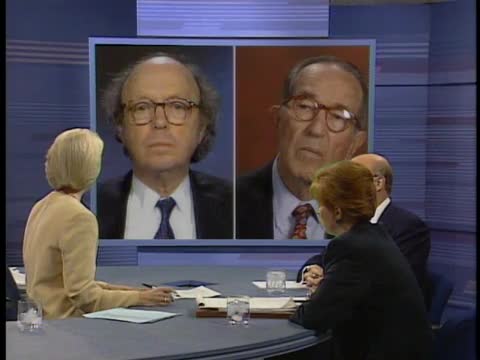
MS. FARNSWORTH: Last night, President Clinton asked for new legislation to combat domestic terrorism. He wants to give the FBI increased authority to gather intelligence on groups that may be planning terrorist activity in the United States. This would include expanded federal wire tapping powers and easier access to telephone credit and hotel records of suspected groups. But is new authority necessary, or is it an overreaction to the Oklahoma City bombing? We debate that now with Griffin Bell, former attorney general during the Carter administration; Anthony Lewis, a columnist with the New York Times; Victoria Toensing, deputy assistant attorney general in the criminal division in the Reagan administration -- she set up the Justice Department's Office on Terrorism -- and Neil Livingstone, author of eight books on terrorism and a consultant on crisis management. Thank you all for being with us. Ms. Toensing, why would the FBI need new powers to combat domestic terrorism? What powers does the FBI lack?
VICTORIA TOENSING, Former Reagan Justice Official: Well, what we need to do is distinguish between any new powers, internal powers that the FBI may need and proposed legislation. There is legislation right now in the Senate and the House that's already been introduced that is very necessary. And it has been around for a good many years. It isn't just a recent development. Three of the crucial things that this legislation would do is make a federal law out of its Domestic Terrorism Act, prohibit funding of certain terrorism groups, and call for the removal of aliens who are suspected to be involved in terrorism. Those are very different issues, and they have been thought about for a long time as opposed to this immediate ad hoc kind of reactionism that I see going on right now about changing whatever guidelines the FBI has had for investigating domestic terrorism groups.
MS. FARNSWORTH: But do they need those changes? I mean, President Clinton is talking about making it easier to get authority for wire taps and that sort of thing. Is it necessary?
MS. TOENSING: He is talking about that just in the last twenty- four to thirty-six hours. And he has not been specific as to why that is needed, nor have I heard from the FBI, nor have any of us heard from the FBI as to why those particular guidelines, internal powers, are necessary. And until we do -- and this is my whole point for this whole area -- we must -- we must not rush to judgment in an area that really needs to be carefully laid out and thought about.
MS. FARNSWORTH: Mr. Lewis, do you worry that there will be a rush to judgment?
ANTHONY LEWIS, New York Times Columnist: I do, and I quite agree with Ms. Toensing, we need to be careful. The reason we should worry is history, because we've had some episodes in this country in which the authority of federal agencies was abused. We had the FBI under Mr. Hoover carrying out Co-Intel-Pro, which harassed people because of their views on the Vietnam War or their opposition to the war in El Salvador. We had the CIA violating its charter by carrying on mail openings inside the United States and other illegal activities. We had McCarthyism. We had way back in the '20s an attorney general, Mitchell Palmer, who in one night arrested thousands of people with no ground based in law. These are concerns. We have to be very, very careful.
MS. FARNSWORTH: Mr. Attorney General, let's talk about those concerns for a moment. When you were attorney general during the Carter administration, you oversaw reforms, as I understand it, which tried to deal with some of the abuses that had been going on during the '60s and '70s, abuses of the FBI and other organizations. What were you specifically trying to change? What were the abuses that you were trying to change?
GRIFFIN BELL, Former Carter Attorney General: Well, the general feeling and evidence was that the -- that it would not have helped accountability in the CIA and in the FBI, and we put in controls, and I think they're working well. I'd be quite surprised if the FBI were to say that they don't have adequate power now. But they haven't spoken one way or the other. I think we ought to be very cautious about anymore powers, and I think we ought to maybe study -- I feel certain we should study the matter, because the American people need reassuring that we've got -- we're doing everything we can do to keep down terrorism and some of these other law enforcement problems that we have. That would be a good thing. That would be in the public interest. But to rush out to changing things, giving the law enforcement agencies, particularly the FBI, more power is something we have to be very cautious about.
MS. FARNSWORTH: Mr. Livingstone, there is -- the President certainly believes that we have to give or he's saying that we need to give the FBI more power, and the leaders of Congress are saying that we need to have legislation which gives the FBI added power to conduct surveillance and other -- take other measures to combat terrorism. Do you think it's necessary?
NEIL LIVINGSTONE, Terrorism Expert: Well, I think the strongest argument in favor of greater power right now is the fact that we are picking up the pieces once again of a disastrous terrorist action which has killed many, many Americans. The fact that we could not preempt this, the fact we didn't preempt the World Trade Center bombing, yes, occasionally we have preempted things, as President Clinton said the other day -- this attack that was going to be on Disneyland. But over the past fifteen or twenty years, we've preempted very few of these situations. So I, I think that's a very loud and eloquent argument, that we must go back to the drawing boards and try to make a more effective police effort in this country and abroad to try to see these things before they happen. And I'd add one other thing to that, and that is that I think this is a one of a kind, a one time incident. I'm very hopeful that our problem is still predominantly from terrorism abroad. And we have made great strides in recent years in dealing with that. But the fact remains that we have just suffered the largest single terrorist attack on our soil, and we need to reassess our ability for addressing it.
MS. FARNSWORTH: Well, can you give me legislation or a change in internal guidelines -- and I'd like to ask you this afterwards, Ms. Toensing -- which would have perhaps made this -- which -- infiltration or whatever that would have made this -- that would have forestalled this.
MR. LIVINGSTONE: Well, I will tell you, quite frankly, being a westerner that the media and the government have not paid enough attention to this rage that's been growing in the country, and those of us who follow domestic hate crimesand terrorism and so on have seen the rise of the militia movement very much bringing into the fold many racists, anti-semites, people who are tax resisters and they've been energized by the Waco situation, by the standoff in Ruby Ridge, Idaho, a couple of years ago, where some white supremacist was holed up on top of a mountain, and by the, the gun legislation, the assault weapon ban. And as a consequence, not enough attention was paid to them or the people in New York City. And what we need to do is not just be able to investigate them, when we believe that there's a criminal conspiracy happening, because by then it may be too late, but some of these groups who clearly are stockpiling weapons, who have clearly made their expressions known, be they for hate crimes or whatever, there's no doubt that they have bad intent. And as a consequence, if we have proper supervision and proper accountability as former attorney general Bell says, the President signs off on some of these groups, I think that we should be able to look at them before they actually carry out a terrorist act or get involved in a major conspiracy.
MS. FARNSWORTH: But I want to get specific on this. They can presumably be infiltrated now under current guidelines. Am I wrong about that?
MS. TOENSING: If there's a reason --
MS. FARNSWORTH: What needs to be changed to make the infiltration easier?
MS. TOENSING: Well, Neil and I go back a long way in fighting terrorism, and I will say that I've never had to take a back seat on being tough on terrorism, but I do have a problem with our lowering the threshold any degree on investigating domestic groups.
MS. FARNSWORTH: So they can already be infiltrated, there can already be wire taps?
MS. TOENSING: We have certain levels, and one of them is for a long time it was only if there was suspicion that there was a crime that was to take place or had taken place. And then under attorney general William French Smith back in 1983, I was chief counsel for the Senate Intelligence Committee at that time, so I oversaw that from the Hill perspective, we changed it to say if these groups just come out and advocate the breaking of a criminal law, we could then investigate them. I don't know how much lower you can take that threshold without really infringing on First Amendment rights.
MS. FARNSWORTH: But you think the threshold's too low?
MR. LIVINGSTONE: I think part of it has been the interpretation in recent years by the Justice Department and the FBI who have wanted to be very safe on this issue, and this also was the case by -- was actually said by New York authorities in connection with the World Trade Center bombing, where they really felt there was both a First Amendment problem and a freedom of religion problem in this case, that if they focused on these Islamic groups that they suspected were engaged in illegal activity or maybe not illegal activity but they were certainly concerned about them, but they were very, very reluctant to take the step of really surveilling them.
MS. TOENSING: Let me tell you a problem that I think about going any lower, and I'm sure attorney general Bell will chime in on this, and that is if you take it much lower, then you're going to have to make the area gray and murky, which Congress is often very capable of doing, because now they're compromising. They don't quite want to go this way, they don't want to quite go that way, so they write bad legislation, and then it's unclear. And if there's one thing that our FBI needs it's one thing the investigators need, it is clarity. And they should not be subject to a Don Edwards one day chastising them for their investigation and a Robert Dornan the next day, not knowing which person is going to be in power.
MS. FARNSWORTH: Mr. Bell, Attorney General Bell, do you have a comment on that?
ATTORNEY GENERAL BELL: Well, we all had the same problem in the foreign intelligence for many years, and we created -- had the Congress create the foreign intelligence court. And we've never had any complaints since then about the law enforcement side of the foreign intelligence because the judge always signs off. The head of the FBI makes recommendations to the attorney general, and then the attorney general makes a recommendation to a federal judge, and that is the accountability.
MS. FARNSWORTH: And what would be wrong with having that sort of court which would make the same sort of decision about surveilling domestic groups?
ATTORNEY GENERAL BELL: Nothing at all, but it's just part of a study we ought to make. It took about two years of debate on that foreign intelligence surveillance court.
MS. FARNSWORTH: Mr. Lewis, what do you think about that, study, moving toward something, or do you think we really have just the kind of laws we need right now?
MR. LEWIS: I think we've heard really a consensus here tonight, not quite, but pretty much of a consensus that we should not rush into things because of this terrible act. Nobody could listen to what you quoted from President Clinton's speech without feeling terrible about it, but, you know, the answer probably is that more attention should have been paid to the militia groups and to other paranoid groups. It isn't that we need, we needed new laws to deal with them. We just needed more attention to be paid. Actually, in the World Trade Center bombing that was mentioned, that group was infiltrated, and the FBI had a handle on it, but for reasons that haven't become clear to me did not stop it or did not take the necessary steps to follow up on their informant's advice. So I think, you know, maybe the court is a good idea, but let's be cautious. I don't know if you are also going to discuss the foreign part of this, but one of the things that's happened is that this incident, this terrible event has been used to advocate the passage of a counterterrorism act that deals with foreign things. And that has real flaws for me particularly, the idea of being able to deport aliens, I mean, people who are living here permanently with green cards, without showing them the evidence against them, depriving them of what Justice Brandeis called all that makes life worth living, staying here with their families.
MS. FARNSWORTH: I'll come back to the counter -- the foreign counterterrorism omnibus bill which of course was proposed earlier this year before the bombing ever happened. We'll talk about that in a minute, but still on the push for legislation involving domestic groups which we're hearing from the President and from the leaders of Congress, do you think this is politics? Why are they pushing it so hard if the laws that exist are, are adequate, why are they pushing it so hard?
MR. LEWIS: I think it's natural that after an event like this everybody is going to look for some way to keep it from happening, and it's very hard for any political leader to say, there's no perfect way to stop terrorism. That is a fact. You have to try. God knows, it is a terrible thing, whether it's caused from abroad or at home, some ways it's more devastating to have Americans doing it, but in any event, there's no perfect defense. You can't make every building in the country car bomb proof, you can't investigate every, every group. What you have to be careful of doing is not letting the terrorists win by destroying our freedoms in the search for ways to stop them. That's the balance that we have to strike, and it's going to have to be done with care.
MS. TOENSING: Let me tell you one of the political realities from my days at the Justice Department. We would find along the way in specific cases that there was a problem, for example, during the TWA 847 hijacking, we actually had to take down a wire tap and not collect information, intelligence information that was sorely needed. And Mary Lawton, God rest her soul, and I talked about it afterwards and said, gee, should we correct this, should we go up to the Hill, and we both decided, and of course, the Justice Department legislative division also agreed with us, that if you go up there to the Hill and you open up this little can of worms, you might end up with something that's even worse than the problem you took up there, and you might not even get that fixed. And so there is this political reality from the executive branch that going along and fixing things along the way, as should be done in good management, is almost a political impossibility, because you're afraid of the consequences of asking for the specific fix.
MS. FARNSWORTH: But let's assume for a moment that there is adequate study, that some of the measures the White House is talking about are adopted. Let's talk about a couple specifically. Easier access to court-ordered wire taps of new digital computer lines, would that help, Mr. Livingstone?
MR. LIVINGSTONE: Well, it certainly would, but I think that's somewhat of a fool's errand, because the technology is outrunning the ability to get into some of those systems. There are encryption systems available today that are going to make information harder and harder and harder to collect. So in theory, that sounds good, but I think it's going to be very hard to implement that one.
MS. FARNSWORTH: Okay. A counterterrorism center to be headed by the FBI, Ms. Toensing.
MS. TOENSING: Well, I think that would be very wise, depending on how the resources are used, because we see you need a federal response. And you can't -- these are crimes of violence historically taken care of by the individual states. You need that centralization when it is a terrorism act.
MS. FARNSWORTH: Okay. Let's go back to the omnibus counterterrorist and foreign bill that Mr. Lewis was talking about. It has rather specific measures which have been before Congress, and now there's a new impetus on this bill, as Mr. Lewis said. It forbids fund-raising by organizations the President designates as terrorist. It permits evidence from secret sources to be used in deportation proceedings. Mr. Lewis has given us his objections to that. What do you think, Mr. Attorney General?
ATTORNEY GENERAL BELL: Well, I think I agree with Mr. Lewis. I would add that the FBI now have a counterterrorism group for foreign investigation. It investigated the Lockerbie disaster, for example. And if you want to expand into domestic terrorism, it seems to me it'd be a fairly easy thing to do. That too ought to be studied. I'm not too familiar with the bill that Mr. Lewis is referring to, but there's not -- it has not been clear to me that the alien problem is a source of much of this.
MS. FARNSWORTH: Mr. Livingstone, you've been looking at this closely. We have very little time. Briefly, what do you think about that?
MR. LIVINGSTONE: I think that the fund-raising aspect is very, very good. What this bill tries to do is to put into law an executive action that President Clinton issued earlier this year which froze the assets of 12 groups and 18 individuals who were suspected of supporting foreign terrorism. I think it's unconscionable for Americans to actually underwrite or finance terrorism either here at home or abroad, which kills, for example, Israeli citizens.
MS. TOENSING: And the working group.
MS. FARNSWORTH: I'm afraid that --
MS. TOENSING: The removal of alien terrorists --
MS. FARNSWORTH: That's all the time we have tonight. I'm sorry. Gentlemen, Ms. Toensing, thank you very much. Robin. FOCUS - SEARCH FOR SURVIVORS
MR. MAC NEIL: We turn now to a close-up view of the rescue effort in Oklahoma City, where as many as 160 people may still be unaccounted for. Authorities today allowed a pool reporter, NBC's Roger O'Neill, accompanied by a CNN cameraman, to enter the bombed out federal building. Using their material, we've put together this look at what's involved in digging out the remaining victims.
JON HANSON, Asst. Chief, Oklahoma City Fire Department: The closer you get, the worse it looks. It's imperative we stay together. It's just a dangerous situation in there. I'm serious. We can't afford to get you all hurt. We're going to take you to where the folks are working, but you've got to stay with us. Now, this is their parking garage. This is the typical construction throughout the building. When we take you in here and show you the debris, this will give you a good idea where you can relate to what fire and rescue personnel are dealing with in there and why it's taking us so long to do the things we're doing.
MIKE SHANNON, District Chief, Oklahoma City Fire Department: And what we're standing in right now is about three foot of rubble, so you're looking in, you're crawling downhill to go underneath these beams, and then they're turning on their backs, taking off their helmets, sliding in, then putting all their gear back on, and then moving rocks and just crawling.
ROGER O'NEILL: Did you find any bodies or survivors here?
MIKE SHANNON: We've had both. That's why we call it the cave. A lot of recoveries were taken out here, about 18 behind this wall, and many of them were literally impaled together. The first bomb scare myself and some of the people was back in there and we had to leave the area. They asked us not to leave 'em, and it was real trying on most of the men that were in this area. We had three survivors, and all three begged you not to leave.
ROGER O'NEILL: What did you say to them?
MIKE SHANNON: You pray. You just ask them not -- you'll be back. Let's go to the other side. We call that the pit. All this down here is still relatively unstable. A lot of shoring was done. A lot of recoveries were made from where we're standing here throughout the rubble onto this side.
ROGER O'NEILL: This is the ground floor of this building.
MIKE SHANNON: Right. All the -- by the way, all the survivors were found along here were from the third floor and up. So they traveled quite a distance the hard way. Earlier in the incident, the cave was the hot spot. And that area, a tremendous amount of recoveries came from that area. Now, this area literally, we're shoulder high and higher, some places head high right in here.
ROGER O'NEILL: And this is where you think the missing children are going to be?
MIKE SHANNON: We think so. When we first came here, there -- it was littered in coloring books, little mats to sleep on, small chairs, small children toilets, andthat's bothered a lot of guys working in the area, because you knew every time you turned around what you may find. That was a real slowdown.
ROGER O'NEILL: Where was the truck with the bomb?
MIKE SHANNON: The plywood covers the crater. There are big sheets of plywood down there covering, covering the crater.
ROGER O'NEILL: And you're moving this all day long?
JON HANSON: We've moved over a hundred tons of the building, this stuff all by hand. And this is the kind of stuff that came down on the people, the victims in this building. It's tough to remain optimistic that we can open up an area like where these firefighters are right here, crawling in an area there, and have somebody alive, but that's one of the things that's got to keep these guys and gals going.
ROGER O'NEILL: The hope that there is somebody?
JON HANSON: The hope that there is somebody, and it keeps 'em motivated.
MR. MAC NEIL: Rescue workers had hoped to reach the wreckage of the second floor day care center today, but that's now expected to happen tomorrow. FOCUS - REMEMBER THE CHILDREN
MR. MAC NEIL: There were funerals today for three of the children whose bodies were already pulled from the rubble. Those children and the many still unaccounted for were on everyone's mind at this weekend's memorial services. Betty Ann Bowser reports.
BETTY ANN BOWSER: It's almost an unspoken tradition in Oklahoma: when hearts are heavy, folks take them to church on Sunday. But this Sunday morning, the wait was almost unbearable. Worshipers at City Church in downtown Oklahoma City had to get through police lines just to attend services. Once inside, they were astonished to see the damage the explosion a few blocks away had done. A spectacular skylight was gone, covered now by protective plastic. Every stained glass window was either damaged or blown away. On this Sunday morning, however, there was less concern about the physical damage. The grown-ups were concerned about the children.
MIKAILI ENRIQUEZ: [singing - little girl] It may be a stranger's face, but I'm praying for your grace.
MS. BOWSER: Mikaili Enriquez is only eight years old, but her son expressed some very adult feelings.
MIKAILI ENRIQUEZ: [still singing] Somebody's hurting not too far from here. Help me, Lord, not to turn away from pain. Help me not to rest while those around me weep. Give me your strength and compassion when somebody finds the road of life too steep.
MS. BOWSER: Then Pastor Richard Hogue called Mikaili and the other children too him.
PASTOR RICHARD HOGUE, City Church: Now, I don't want you to be full of fear and anxiety and frustration and all those things. I want you to be full of faith and confidence that the Lord is going to provide for you and take care of you. Okay? So I want us to pray. Just raise your hands out to these precious ones. Would you do it right now. In every way, Father, I pray that You will help them let their faith not be damaged, let their heart not be damaged out of this week.
MS. BOWSER: From the early hours after the explosion, the children have watched their parents and fellow church members reach out to the community with a shelter for rescue workers and a 24- hour-a-day food kitchen. Still, Rev. Hogue's wife, Marilyn, wanted to give the children a chance to talk about the past week in Sunday school.
MARILYN HOGUE: It was kind of a hard week, wasn't it? A real unusual week ever. I hope we never have one like it again.
MS. BOWSER: Most of the kids will remember where they were when the bomb exploded for the rest of their lives.
LITTLE GIRL: Well, I was listening to -- I was listening to a CD. And I thought it was part of it, but it wasn't. Then my mom came in and my next door neighbor, she told us that the federal building had been bombed, so we came in and turned on the TV and everything, and then I found out what it was. But it was a surprise, because why wasn't it in New York or something?
LITTLE BOY: My grandpa was in the hospital because he was sick, and once we got to the hospital, we were going in, and there was this big old crowd, and then I said, "What's happened?" And the building just blew up.
SECOND LITTLE BOY: My dad turned on the radio and the radio said that there was a man coming out and there was still 150 people still gone.
MS. BOWSER: But Hogue also gave them a chance to express their feelings.
THIRD LITTLE BOY: The people that did this, you know, how some people are saying that how could they have the heart to do this, do that? I mean, the point is they didn't have a heart.
MARILYN HOGUE: You'll never think of people as you did before? Tell me about that. In what way? What do you mean by that?
LITTLE GIRL IN GROUP: I thought some people were, like, always better than them, and I just thought that I was better than them and they couldn't do anything about it, and I didn't care to help. Now I realize that people need as much help as you do, and you need to pray for everyone, even your enemies.
MARILYN HOGUE: Should these guys be punished?
CHILDREN IN UNISON: Yes.
MARILYN HOGUE: Let me ask you this. Will God see that they're punished?
CHILDREN IN UNISON: Yes.
PRESIDENT CLINTON: Today our nation joins with you in grief.
MS. BOWSER: All over the country it was a national day of mourning, but nowhere was the heartbreak more poignant than at this memorial service in Oklahoma City. More than 20,000 mourners attended. Relatives of dead and missing children were given teddy bears which they clutched in their arms as they listened to President Clinton, who with the First Lady came to town to bring comfort.
PRESIDENT CLINTON: Let us let our own children know that we will stand against the forces of fear. When there is talk of hatred, let us stand up and talk against it. When there is talk of violence, let us stand up and talk against it. In the face of death, let us honor life.
MS. BOWSER: Mikaili and her sisters, 11 year old Jessica and 9 year old Tosha, had seen the events of the past week unfold on television. They are trying to make some sense of it.
MIKAILI: This happened to babies, two month, year old babies, I don't understand it.
JESSICA: I don't understand it either because they didn't even get to have a life. They didn't even get to be a teenager or to drive or to have all those exciting things to happen. They had to die when they were little babies.
MS. BOWSER: What do you think ought to be done about the bad guys who did this?
JESSICA: Death penalty or jail all their life, because they need to feel what other people have been feeling like, umm, I don't know. People have been in that bomb, and some of them are still in it, but I think they should be put to death.
MS. BOWSER: You do, Jessica?
JESSICA: Yes.
MS. BOWSER: Tosha, what about you?
TOSHA: I think they should die so they can feel how hurt the other people have been around them.
MIKALI: I will remember this all my life. It won't ever be the same, because people are dying, and that just hurts me.
MS. BOWSER: Do you think you'll feel normal again anytime soon?
MIKALI: Probably one time, but not anytime soon.
MS. BOWSER: Mikali's mother,Pamela, and stepfather Jerry are impressed with their children's ability to cope but concerned what the long-term effects will be.
PAMELA SLOAN: I was really astounded at the, the hurt and the pain that I heard in their voices.
JERRY SLOAN: I was surprised that they knew as much about it as they did and that not really the hurt. I noticed their concern about the people, but what caught me more surprised was their feelings towards the person or persons that did this.
PAMELA SLOAN: I saw growth in my children just overnight, and I sat there listening, thinking, this should be happening if we lived in Bosnia or another country that's war-torn, and to think that this has affected our children to that degree that they're answering questions that children of war would be answering, and yet to have to allow them to talk about it, you have to let 'em deal with it.
MR. MAC NEIL: Since last Wednesday's bombing in Oklahoma City, security reviews have been ordered at the 98 child day care centers at federal buildings in 31 states. More than 6,000 families, including federal employees, and others, use the centers. SERIES - AFFIRMATIVE ACTION
MS. FARNSWORTH: Next tonight, Charlayne Hunter-Gault continues her series of conversations on rethinking affirmative action. President Clinton has called for a complete review of the government's affirmative action policies amid a growing, often contentious public debate. Tonight, Charlayne talks with Herma Hill Kaye, the first female dean of the University of California at Berkeley Law School.
MS. HUNTER-GAULT: Dean Norma Hill Kaye, thank you for joining us.
HERMA HILL KAYE, Dean, Law School of University of California, Berkeley: You're welcome.
MS. HUNTER-GAULT: Do you think affirmative action should continue?
DEAN HERMA HILL KAYE: I do. I think that affirmative action was designed to redress past discrimination, and I don't think past discrimination has been adequately redressed yet.
MS. HUNTER-GAULT: What makes you think that?
DEAN HERMA HILL KAYE: Well, I remember when I first began teaching law here in 1960. There were no minorities and almost no women in the law school classes at that time. And it was not until we began a policy of race conscious admission that we began to get large numbers of women and minorities in the classrooms here at Boalt.
MS. HUNTER-GAULT: When you say race conscious admission, explain how it works.
DEAN HERMA HILL KAYE: Well, it works by taking into account a great variety of factors, background, obstacles overcome, experiences in college and also race and ethnicity. We don't ourselves take gender into account because we've had great success in improving the pool of women applicants over the years.
MS. HUNTER-GAULT: So that, in effect, you're saying that while there's more to be done, the people who were supposed to benefit from affirmative action have benefited?
DEAN HERMA HILL KAYE: I think they have benefited. Some of the more recent studies show that particularly Title 7 and the voluntary affirmative action that's been undertaken there have had great success in improving entry level hiring.
MS. HUNTER-GAULT: Title 7 being --
DEAN HERMA HILL KAYE: The Civil Rights Act that was passed to prohibit discrimination in employment in 1964, but still when you get to upper level jobs, the so-called glass ceiling still exists both for women and minorities.
MS. HUNTER-GAULT: Some who are critics of affirmative action say that it's not surprising that women wouldn't be in the upper levels of management simply because it takes a while to advanceso that the discrimination, they argue, has been eliminated because they're getting into the entry level and middle levels, and it's just a matter of, of time passing before they get to the top levels, it's not discrimination that's keeping them from being there. Do you agree with that?
DEAN HERMA HILL KAYE: No, I don't. I'd like to know how long that pipeline is going to last. I think that, for example, in universities, we've had large numbers of women entering legal education in teaching since 1973, and yet, as we're talking, I am the only woman dean of a top 10 law school in the country. Now, I'm not the first. But there has only been one who preceded me.
MS. HUNTER-GAULT: Why is that, you think?
DEAN HERMA HILL KAYE: Well, I think it's because people have still attitudes about women's leadership capacities. If we're too soft, then we don't really have enough aggression. If we're too hostile and aggressive, copying some of our male peers, then we're not feminine enough.
MS. HUNTER-GAULT: So you think that the good old boy network is still getting in the way of women's advancement. Is that what you're saying?
DEAN HERMA HILL KAYE: Well, I don't think I'd want to use the word good old boy network but I think that certainly conventional assumptions about women and what they're capable of doing are still getting in the way, yes.
MS. HUNTER-GAULT: You mentioned earlier that you take into consideration race and gender as factors in evaluating applicants for law school. But critics say that this kind of preference, they cite it as reverse discrimination. How do you respond to that?
DEAN HERMA HILL KAYE: Well, we had last year over 5,000 applications for our first year class. We had 270 places in the first year class. And a lot of white people displaced a lot of other white people also. We take into account factors. We don't take into account gender as a specific factor, but we do take into account race and ethnicity. And we find that the people who are accepted in our class, some are at the highest levels, and some spread throughout the class, but the factors that are in addition to numbers are taken into account for every one we admit.
MS. HUNTER-GAULT: Well, why is it that there seems to be a widespread perception that the minorities who are admitted with those special considerations are the result of the standards being lowered?
DEAN HERMA HILL KAYE: Well, I don't think that it applies to the universe that I know best, which is to law schools. We have a very low academic disqualification rate here, and it stands to reason if you're so selective, applying only 270 out of over 5,000, you really have a choice, a wide choice, and we don't admit anyone that we think will not be academically successful. Now there has, of course, been grade inflation over the past several years, and white students who were admitted here 10 years ago probably wouldn't be admitted in the competition of this class today.
MS. HUNTER-GAULT: Well, do you understand at all the argument of the so-called angry white male? I mean, do you have any sympathy for that?
DEAN HERMA HILL KAYE: I don't have sympathy for it. I think that people feel that they are not themselves prejudiced, that they are being asked to pay for a social obligation that the burden of this falls on them. When the voluntary affirmative action programs were begun, the economy was expanding, and it seemed possible to make way for all persons. The Supreme Court in its opinion in the Webber case pointed out that minority hires were not displacing majority hires, and as we're getting into the shrinking economy, that's no longer possible. And when you have to choose between two equally qualified persons and it's always the white person who gets de- selected, obviously, people to whom that happens feel that it's unfair. And yet, if you are going to continue to try and do something about the really fundamental problem of racial prejudice in this society, there's no turning back, at least until we've made further advances.
MS. HUNTER-GAULT: How do you see the criticism that affirmative action was created to address the issue of racial discrimination emanating from slavery, from segregation, and so forth, and it's been diluted when it has applied to women?
DEAN HERMA HILL KAYE: I don't think it's been diluted, nor do I think it's been misapplied. Although white women have not had the history of discrimination that minority women have had, they have still been rejected for no reason related to their own abilities. I remember, for example, when I was trying to go into the law, my own mother said that women couldn't go into law and that I would never be able to earn a living if I wanted to go to law school. And yet, I loved the idea of studying law so much that I went despite that advice. And I think I'm supporting myself pretty well.
MS. HUNTER-GAULT: You mentioned your own individual case. There are those who say that that's fine, pursue individual cases of discrimination, but that just the notion of group rights, that groups are entitled to things goes against the whole idea of American values and democracy.
DEAN HERMA HILL KAYE: Prejudice is not individual. Prejudice is against groups. People who are black are thought to be less able than people who are white by prejudiced people. Women are thought to be less capable of performing in the public sphere than men just because they're women. I remember when Professor Barbara Babcock at Stanford was appointed by President Carter to the civil rights division in the Justice Department, and reporters said to her, "Professor Babcock, how does it feel to think that you've got this job just because you're a woman?" And she said, "It feels a lot better than thinking I got it -- thinking I didn't get it just because I'm a woman."
MS. HUNTER-GAULT: President Clinton has called for a review of affirmative action. Do you think that's a good thing?
DEAN HERMA HILL KAYE: Well, I think that in view of the public distrust and feeling that there should be a re-examination, I think that a public debate on the subject is healthy, but I also think that we have to be very careful that this debate does not further exacerbate racial tensions.
MS. HUNTER-GAULT: How could it?
DEAN HERMA HILL KAYE: Well, I think that there's a lot of anger being expressed here. I think that the so-called angry white men are not participating in the debate in a rational kind of way. And I think that all of us, as President Clinton said in California, need to have a conversation about this and not a shouting match.
MS. HUNTER-GAULT: What about race relations in general, how do you think this debate is going to affect race relations?
DEAN HERMA HILL KAYE: I think it will have a very backward effect on race relations. I can see here in the law school we have in this year's entering class 40 percent people of color, and they feel very threatened directly. We've had two incidents of hate mail this semester, both of which linked the vilest kind of racism with attacks on affirmative action. And while the whole community came together to condemn the hate mail, it's had a spillover effect on the affirmative action discussion as well.
MS. HUNTER-GAULT: What do you think would happen if affirmative action were discontinued?
DEAN HERMA HILL KAYE: Well, I think that there would be a large segment of the citizens of this country who would feel they had been abandoned and that their hopes and aspirations were no longer being treated with dignity and respect. And I think that would be a bad thing for the country.
MS. HUNTER-GAULT: Finally, let me ask you this. There are those who say affirmative action should continue but not on the basis of race or gender but on the basis of class. Would that be a more equitable way of doing it, do you think?
DEAN HERMA HILL KAYE: I don't think so. People were not that prohibited from going to school in the South because of their class. They were prohibited because of race. Women were -- women were not permitted to go to school in the early days because of their sex, not because of their class. And I think that there may be reasons, or I would like to take account of class because that has obviously very disadvantaging circumstances, but I don't think it's a substitute for trying to redress something that still needs to be redressed in this country.
MS. HUNTER-GAULT: Well, Dean Herma Hill Kaye, thank you for joining us.
DEAN HERMA HILL KAYE: It was a pleasure, thank you. RECAP
MR. MAC NEIL: Again, the major stories of this Monday, the official death toll in the Oklahoma City bombing rose to 79, but officials said it may eventually top 200. And a package bomb exploded at the Office of the California Forestry Association in Sacramento. One person was reported killed. Good night, Elizabeth.
MS. FARNSWORTH: Good night, Robin. That's the NewsHour for tonight. We'll be back tomorrow. I'm Elizabeth Farnsworth. Good night.
- Series
- The MacNeil/Lehrer NewsHour
- Producing Organization
- NewsHour Productions
- Contributing Organization
- NewsHour Productions (Washington, District of Columbia)
- AAPB ID
- cpb-aacip/507-z892806189
If you have more information about this item than what is given here, or if you have concerns about this record, we want to know! Contact us, indicating the AAPB ID (cpb-aacip/507-z892806189).
- Description
- Episode Description
- This episode's headline: Broader Powers; Search for Survivors; Remember the Children; Affirmative Action. The guests include PRESIDENT CLINTON; VICTORIA TOENSING, Former Reagan Justice Official; ANTHONY LEWIS, New York Times Columnist; GRIFFIN BELL, Former Carter Attorney General; NEIL LIVINGSTONE, Terrorism Expert; HERMA HILL KAYE, Dean, Law School, University of California, Berkeley; CORRESPONDENTS: BETTY ANNE BOWSER; CHARLAYNE HUNTER-GAULT; ROGER O'NEILL. Byline: In New York: ROBERT MAC NEIL; In Washington: ELIZABETH FARNSWORTH
- Date
- 1995-04-24
- Asset type
- Episode
- Topics
- Education
- Social Issues
- Technology
- Race and Ethnicity
- War and Conflict
- Politics and Government
- Rights
- Copyright NewsHour Productions, LLC. Licensed under a Creative Commons Attribution-NonCommercial-NoDerivatives 4.0 International Public License (https://creativecommons.org/licenses/by-nc-nd/4.0/legalcode)
- Media type
- Moving Image
- Duration
- 00:58:28
- Credits
-
-
Producing Organization:
NewsHour Productions
- AAPB Contributor Holdings
-
NewsHour Productions
Identifier: 5212 (Show Code)
Format: Betacam
Generation: Master
Duration: 1:00:00;00
If you have a copy of this asset and would like us to add it to our catalog, please contact us.
- Citations
- Chicago: “The MacNeil/Lehrer NewsHour,” 1995-04-24, NewsHour Productions, American Archive of Public Broadcasting (GBH and the Library of Congress), Boston, MA and Washington, DC, accessed April 25, 2026, http://americanarchive.org/catalog/cpb-aacip-507-z892806189.
- MLA: “The MacNeil/Lehrer NewsHour.” 1995-04-24. NewsHour Productions, American Archive of Public Broadcasting (GBH and the Library of Congress), Boston, MA and Washington, DC. Web. April 25, 2026. <http://americanarchive.org/catalog/cpb-aacip-507-z892806189>.
- APA: The MacNeil/Lehrer NewsHour. Boston, MA: NewsHour Productions, American Archive of Public Broadcasting (GBH and the Library of Congress), Boston, MA and Washington, DC. Retrieved from http://americanarchive.org/catalog/cpb-aacip-507-z892806189