The MacNeil/Lehrer NewsHour
- Transcript
MR. LEHRER: Good evening. Leading the news this Monday, there was more ethnic violence in the Soviet Republic of Azerbaijan, Campeau Corporation took its two major department store chains into bankruptcy, and the nation observed the birthday of Martin Luther King, Jr. We'll have the details in our News Summary in a moment. Judy Woodruff is in New York tonight. Judy.
MS. WOODRUFF: After the News Summary, the Campeau bankruptcy is our lead focus [UPDATE - CAMPEAU - MARK DOWN]. Journalist Seymour Zucker explains what today's developments mean for the nine retail chains affected. Then [FOCUS - RACISM IN AMERICA] on the birthday of Dr. Martin Luther King, we look at relations between blacks and whites in America with NAACP Head Benjamin Hooks, former Civil Rights Commission Director Linda Chavez, Rabbi Abraham Cooper of the Simon Wiesenthal Center, Harvard Law Professor Charles Ogletree, Economist Paul Craig Roberts and Poet and Professor Haki Madhubuti.NEWS SUMMARY
MR. LEHRER: A state of emergency was declared today in parts of Azerbaijan. The official Soviet media said some 300 people fought today with submachine guns and hunting rifles. The latest violence between Azerbaijanis and Armenians broke out Saturday. Authorities said at least 37 people have died. Army, navy and KGB forces have been flown to the area to try and restore order. Today's official emergency decree said the situation had "reached the point of murders, robberies and attempts at armed overthrow of Soviet power". The Soviet problem in Lithuania also continued today. Lithuania's Communist Party chief was overwhelmingly elected president of the republic. The vote was seen as another sign of defiance against Moscow. The new president supported his party's decision to split from the national leadership in December. Soviet Pres. Gorbachev visited Lithuania last week in an effort to bring the party back into the fold. Judy.
MS. WOODRUFF: The 45 year monopoly of power held by Bulgaria's Communist Party ended today. The country's parliament voted unanimously to change language in the constitution which granted the party a leading role in the government. After the vote, a member of the Communist Politburo said his party was ready for an open dialogue on democracy. In Romania, the new government today said that it would put the future of that country's Communist Party up for a national vote later this month. On Friday, the nation's acting president outlawed the party, but that decision was overturned by the provisional government a day later. Also today trials were set to begin in the Western City of Timisoara for members of Nicolae Ceausescu's secret police. Protests in that city led to last month's successful revolt against the dictator.
MR. LEHRER: Thousands of East Germans stormed secret police headquarters in East Berlin today. The violence came as talks were underway between the government and opposition groups about dismantling the police organization. Last Friday, East German Premier Hans Modrow agreed to opposition demands that the force not be reformed after democratic elections next May. State television said today's rampage put democratic reforms in gravest danger. We have a report narrated by Richard Vaughn of Worldwide Television News.
MR. VAUGHN: The protest started in the afternoon. By nightfall, more than 100,000 demonstrators had reached fever pitch. With little effort and facing almost no opposition, they broke down the doors to the secret police headquarters and poured inside. They stormed past the apparently passive guard shouting, "Stasi Out". It was another sign of people power on the march. Once inside, locked doors didn't deter the mob. Witnesses said protesters used stones to smash down glass doors. Many used the opportunity to view the secret files of an organization that ate up nearly 1 1/2 percent of the entire national budget. Stasi looked into its citizens' mail and listened in to phone conversations. The protesters scattered files, threw furniture out of windows, and in some cases looted. State television said the situation was out of control.
MR. LEHRER: Also today East Germany's chief prosecutor said he expected indictments for high treason against the country's ousted Communist leader, Eric Honecker, along with the former head of his secret police.
MS. WOODRUFF: Back in this country, the Campeau Corporation today put its Allied and Federated Department Store chains in bankruptcy. It was the biggest filing for bankruptcy court protection in American retailing history. The two chains operate 260 stores, including Bloomingdale's, Jordan Marsh, Abraham & Strauss and Burdine's. The Toronto-based Campeau said all of its U.S. stores will remain open. Under so-called Chapter 11 procedures, the companies will not have to repay creditors while they reorganize their finances. Campeau has $8 billion in outstanding debt. Much of it came when it borrowed to buy the two American chains.
MR. LEHRER: Today is the birthday of Martin Luther King, Jr. The murdered civil rights leader would have been 61 years old. He was remembered with church services and ceremonies across the country. In Atlanta, Coretta Scott King joined worshipers at an inter-faith service at her husband's home church, the Ebaneezer Baptist Church. Later there was a parade viewed by some 300,000 spectators in Atlanta's downtown business district. The annual parade celebrating Dr. King's birthday was carried nationwide on cable television.
MS. WOODRUFF: Later in the program we will look at Dr. King's legacy and the ongoing fight against racism in America. But first America's biggest retail bankruptcy. UPDATE - CAMPEAU - MARK DOWN
MS. WOODRUFF: We turn first to today's top business story, the Campeau Corporation's bankruptcy filing for its 260 American department stores. Robert Campeau is a Canadian real estate tycoon whose company in the 1980s bought the Federated and Allied Department store chains. Campeau's stores in almost every region of the U.S. will be put under bankruptcy protection, affecting as many as 100,000 employees in 28 states, in the Northeast, Jordan Marsh based in Massachusetts, New York-based Bloomingdale's with stores in 10 states, and Brooklyn-based Abraham & Strauss, Stern's in New Jersey, in the Midwest, the Lazarus Department store chain, in the South Georgia-based Rich's-Goldsmith, Florida's Burdines, and the Maas Jordan Marsh chain, and in Seattle, the Bon Marche. Here to tell us what bankruptcy means for Campeau, its customers and its creditors is Seymour Zucker, Senior Editor of Business Week Magazine. First of all, Mr. Zucker, is this good news or bad news?
SEYMOUR ZUCKER, BusinessWeek: I think generally it is good news. It had to be done. The companies could not meet their debt payments and not going into bankruptcy would have meant that sooner or later there would be empty shelves, customers would not get the merchandise they wanted and in effect the company would have to liquidate. By going in to bankruptcy protection which means the creditors now have no recourse except through the courts. The vendors go to the top of the list that means people selling to the stores will now get paid for their merchandise first and that means that there will be merchandise on the shelves and you and I benefit from that.
MS. WOODRUFF: So the stores stay in business. They will continue to have merchandise to sell?
MR. ZUCKER: Absolutely.
MS. WOODRUFF: Well who loses out in this?
MR. ZUCKER: Well the creditors the bond holders, the junk bond holders.
MS. WOODRUFF: Who are these people?
MR. ZUCKER: Well these are large institutions that bought bond when Campaue decided to make a bid for first Allied and then Federated. They bought high priced high interest rate bonds. Some yields as high 14 to 15 percent. It looked good at the time. The Federated deal was in 1988 and retailing was supposed to be the stable industry in this country. The cash flow looked rather stable. That meant that they could pay off the debt but in the end its seems that Campaeu overpaid and the result is this bankruptcy.
MS. WOODRUFF: Well again I said I just said who are they? Do we know who some of these big bond holders are?
MR. ZUCKER: Oh yes these are institutions, very large institutions, they are junk bond Funds.
MS. WOODRUFF: Pension Funds.
MR. ZUCKER: Some pension funds are involved in this. These are the losers and in effect what happens is that the markets have already discounted all this entire bankruptcy but it was inevitable that they would have to go in to bankruptcy. So some of these bonds are now selling 10 to 15 cents on the dollars. So a $1000 bond in effect is selling at a $100. So the losers are the big institutions but they have lost already. In other words today's bankruptcy did not effect a new result. That result was there weeks ago when it was obvious back in December that they would have to go in to bankruptcy.
MS. WOODRUFF: So you are saying nobody is really hurt as of now? Is that what I hear you say?
MR. ZUCKER: As of this minute but the entire sequence of events has caused some losers. The bond holders, the banks to some degree.
MS. WOODRUFF: Citicorp I understand is one of these?
MR. ZUCKER: Well Citicorp has secured loans which means that they will probably be getting when the reorganization goes in to effect and this has to be approved by all creditors and it may take a number of years they have a secured loans. They will be getting more on the dollar than the junk bond dealer.
MS. WOODRUFF: And what about little investors, I mean there are some little investors involved here?
MR. ZUCKER: Well those who bought through the Funds yes but they have already been hurt that is the point. The value of these funds has already gone down because the bonds were selling at a discount at a tremendous discount.
MS. WOODRUFF: What about the stores themselves. Are they okay for the indefinite future does this mean?
MR. ZUCKER: The stores look okay. In fact I would argue that the likelihood of Bloomingdale's being sold now is less than it was a couple of days ago because what it does is that there is no pressure now to meet any debt payments. So what can happen now is the new chief executive who takes over and we don't know who he is yet he will be able to shop around and perhaps get a better price for Bloomingdale's or some of the other assets than if he were forced to sell because he couldn't meet an interest payment next week. So again you and I benefit to the extent that we can get the merchandise. The losers are the bond holders and to some extent the banks and the winners I might add are those people who sold Federated back in 1988 at $73 a share.
MS. WOODRUFF: How are they the winners?
MR. ZUCKER: Well in January of 88 Federated Department Stores was trading on the New York Stock Exchange at $34 a share. Campaue paid $73 a share for Federated.
MS. WOODRUFF: But in terms of selling off these stores you don't see that happening?
MR. ZUCKER: I think the likelihood of that is less now than it was before but I still think that they will have to sell assets.
MS. WOODRUFF: This was one of the big takeover, buy out deals of the last decade. Is there a message in what has happened to Campaeu for Future deals, for the deals that took place in the 80s?
MR. ZUCKER: I think there is a message here and the message is that the decade of the 80s was the decade of the deals, the decade of the takeovers and to some extent I would argue that was very beneficial for you and me because what it did was that it said that some how corporate America was being undervalued by the stock market and if you pruned companies and if you trimmed operations, if you sold off assets you could actually get the parts to be worth more than the whole and to the extent that this raised the value of Corporate America it helped you and me because it increased the value of our pensions Funds, it increased the value of our stock holdings and so forth so it was very beneficial but what this says is that there was an excess here and we perhaps went to far. You know the message never go to an auction. You bid the price to much. There was an auction going on there was a bidding war going on for Federated and what happened was the prices paid were simply too high and this says that maybe there are some other deals here that are suspect. I think that this puts a damper on the probability of the deal mania continuing. It has already slowed down and to some extent it is beneficial because it tells the corporate raiders and it tells the financiers of America to look more carefully at deals. This idea that we can some how project out and things will be honky dory we will be getting our cash flow exactly when we need it and the economy will continue at a 3 percent growth rate that is now suspect. So I would argue that this puts a damper on deals and says that maybe some deals out in the future.
MS. WOODRUFF: And when you say some of the deals that already have taken place may look a little shaky as a result of this. Can you be more specific about which ones?
MR. ZUCKER: I prefer not to at this point for an obvious reason. Those deals will emerge.
MS. WOODRUFF: You don't want to give us an insight?
MR. ZUCKER: Not at this point Judy.
MS. WOODRUFF: We'll let you come back when you are ready to tell us.
MR. ZUCKER: Okay.
MS. WOODRUFF: Seymour Zucker thank you for being with us. FOCUS -RACISM IN AMERICA
MR. LEHRER: We go next to a discussion of racism in America. It comes on the day set aside as a Federal Holiday to honor the late Civil Rights Leader, Martin Luther King Jr. The discussion begins after this backgrounder by Elizabeth Brackett.
MS. BRACKETT: One year ago on Martin Luther King's birthday the President spoke of his hopes for a better America.
PRESIDENT BUSH: Bigotry and indifference to disadvantage will find no safe home on our shores ion our public life in our neighborhoods or in our home.
MS. BRACKETT: And in a look back at the last year there were signs that bigotry had loosed its country. Douglas Wilder was sworn in as governor of Virginia on Saturday the nations first black governor though still some felt that Wilders narrow margin of victory meant that it was still harder for a black candidate to win a major office. In the nations largest and most ethnically diverse city another black man won the right to govern. David Dinkins will confront the challenge of New York and across the country seven other blacks were elected to the majors office in cities where black voters are not in the majority. Blacks won races in cities like Seattle where they make up just 10 percent of the population. In the military the top job in the nation is now held by a black American. Chairman of the Joint Chiefs of Staff was in charge last month when U.S. troops went in to Panama.
GENERAL POWEL: Operation Just Cause can be a great sense of satisfaction and pride.
MS. BRACKETT: But critics say the reality for much of black America does not match that of its individual achievers. Bureau of Labor Statistics show black unemployment still more than twice that of, white unemployment. The median family for blacks according to the Census Bureau is just over $18 thousand per year while white income is $32,000 per year. Infant mortality statistics from the Children's Defense Fund show that black babies are twice as likely to die than white babies in this country. And once again last year there were acts of violence across the country that inflamed racial tensions. The year began with the death of a black motorcyclist in Miami shot by a Miami police officer. Riots erupted in Miami streets following the shooting. Just this month the Officer was convicted of man slaughter. In April a group of 8 black youths attacked and nearly killed a white women in New York's Central Park. The so called wilding incident generated shock and outrage in the city and across the country. Then in August another racial incident rocked New York City. Yusef Hawkins a 16 year old black youth was gunned down while walking through an Italian neighborhood. Residents of Bensonhust in the Borough of Brooklyn blamed the attack on a case of mistaken identity. Many in the black community blamed the attack on racism. In the South a series of letter bombs were motivated by racial hatred. The bombs resulted in injuries and two deaths, a white federal judge and a black civil rights attorney. In Boston the city with a history of bitter racial problems there were new strains. In October Charles Stuart claimed that a black assailant had murdered his wife and infant son.
SPOKESMAN: THis community has been absolutely devastated.
MS. BRACKETT: Blacks were angered by what they saw as an over reaction by the White Community as large numbers of police were sent in to black neighborhoods. Stuart committed suicide after he learned that he was the main suspect in the case but the outrage in the Black Community did not subside. At a rally in Boston last week lead leaders began to try top bring the community back together.
MR. LEHRER: Now to six perspectives on the state of racism in America. They are those of Benjamin Hooks, president of the NAACP, he joins us from Atlanta, Charles Ogletree, professor of criminal and civil rights law at Harvard Law School. He is in the studios of WGBH in Boston, Haki Madhubuti, a poet, professor of English at Chicago State University, he's the author of a new book, Black Men, Obsolete, Single and Dangerous, he's in Ann Arbor, Michigan, Linda Chavez, former executive director of the U.S. Commission on Civil Rights, she's now a senior fellow at the Manhattan Institute for Policy Research, Rabbi Abraham Cooper, Associate Dean of the Simon Wiesenthal Center, a research organization focusing on human rights and anti-semitism issues, and Paul Craig Roberts, former editor of the Wall Street Journal, now at the Center for Strategic and International Studies. First, Mr. Hooks, to you, what is your own definition of racism?
BENJAMIN HOOKS, President, NAACP: Well, racism is the ability of one race because of its color or leading characteristic to dominate wrongfully another race, and by that definition we have a lot of racism still alive and well in America. The picture today is one of opposites, it's ambivalent. On the one hand, blacks have made a tremendous amount of progress, as has been said at Wile's election in Virginia, Dinkins' election in New York City, and not only that but the 7,000, 7,500 elected black officials, more than 300 mayors, Franklin Thomas, president of the Ford Foundation, many many indications, 1 million blacks in post secondary education, $250 billion gross national products, owners of fast food franchises, and members of boards of directors of various companies. At the same time while there is that bright side, there is that assault on civil rights by the Supreme Court, the incidents of racism on college campuses, graffiti and all kinds of violence, the incidents in Bensonhurst, New York, and all those things constitute the dark side. In addition to that there's a pathology that seems to be taking place that makes the young black male an endangered species, and the fact that there is, there are a large number of homicides committed black on black we call it, the incidents of AIDS, the large black population of prisoners, there are tremendous problems, and teen-age pregnancy is abounding in the community of America. And so you have at one side, as Dickens put it in his Tale of Two Cities, the best of times, the worst of times. Our job is to examine what has happened in our nation, to continue those things which are moving forward, and to stop those things which move us backward.
MR. LEHRER: Visa your definition and your good and bad lists, is racism responsible for the bad and if it's responsible for the bad, then how is it not responsible for the good or what?
MR. HOOKS: Well, I don't think racism is responsible for the good, but there are many many responsible white people in this nation. After all, we've had the civil rights laws passed and at the time they were passed my recollection is we either had no black Senators or only one at the most. We've had all kinds of progress. In the heyday of the civil rights movement, black and whites marched together, were killed together, suffered together. I'm not sitting here accusing the whole American population of being racist. I'm simply saying there is a strong residue of racism. The recent hate bomb mailings, our office has been shot through and all kinds of threats have been made, at the Georgia office, the Jacksonville, Florida office. It's obvious, one doesn't have to be a seer or a prophet to know that racism is very prevalent, alive and well. One can look at the Supreme Court decisions where the last five big cases involving affirmative action have been negative for the black community. This is perhaps the worst Supreme Court from the civil rights viewpoint that we've had since the Dread Scott Supreme Court 100 years ago. So there's a mixed bag. But I certainly don't want to accuse all white people in America of being racism. I don't want to say that all black folk in America are suffering in the sense that some of us are not making progress. But unless all of make progress, then the whole bag is messed up. And as Martin King put it, injustice anywhere is a threat to justice everywhere. As Lincoln put it, we cannot exist half slave and half free and we cannot exist half first class and half second class. Therefore, the job is to bring people of good will together be they black, white, Jew, gentile, Catholic or Protestant or whatever, and work for the elimination of racism and for the movement forward of people, black and white, in this nation.
MR. LEHRER: Ms. Chavez, racism, how alive and how well in your opinion?
LINDA CHAVEZ, Former Director, U.S. Civil Rights Commission: Well, first of all, I think there are racists, but I disagree with Ben Hooks' definition of racism. I think it's too broad. I think that Martin Luther King indirectly gave us the best definition of racism yet, and that is racism is judging people by the color of their skin rather than the content of their character. That means judging someone as a criminal simply because he has a black skin. But it also means granting preference on the basis of race. And I think unfortunately what we've seen over the last 20 years is polarization on the issue of race, and we've seen black racism as well as white racism increase.
MR. LEHRER: Give me an example of black racism.
MS. CHAVEZ: Black racism is judging all whites by the actions of a few, just as judging all blacks by the actions of a few is racist. I think to suggest that this country is more racism today than it was 25 years ago, and this is something you hear over and over again in the community, that racism is on the rise, yes, individual acts of racism, there have been some very hideous and heinous acts over the last year, including these bombings, but, in fact, relations between the races are better today than they were, opportunity is greater today than it has been in the past. And I think that as a society we have come an awfully long way since Martin Luther King died.
MR. LEHRER: Mr. Ogletree, what would be your definition and your assessment of where we stand right now?
CHARLES OGLETREE, Law Professor: Well, my assessment is that Ms. Chavez is obviously living in a different environment than I am. It's clear that we've made some progress, that progress has been very modest. I would hate to be the messenger to Dr. King today to tell him in 1990 that we have the problems of unemployment, that we have the problems of under education, that we have the problems of early pregnancy, and tell him that even in cities like Boston where he studied religion and where he talked about peace, that in 1989, an entire black community was subject to clearly racist views from the mayor, to the commissioner of police, throughout the community. I would hate to have to report to him on how broad the racism is in 1990, and that we haven't really made the progress that some think we have made. Some symbolic efforts have been made. It's impressive to have a substantive governor and mayor. It's impressive to have other elected officials, but the bottom line is that the people who suffer the most, the homeless, the poor, the unemployed blacks, minorities, their status hasn't changed at all, and what we should be talking about in 1990 in terms of racism is that we should have our President saying 1990 is the year to fight racism, every governor should sign on to that edict, every mayor should sign on to that edict. That's what we need to deal with the problem of racism.
MR. LEHRER: Make the connection for me in your mind between black unemployment and racism.
PROF. OGLETREE: Well, it's clear because the most fundamental connection is that we see more opportunities available now, we see an economy that's improved over the last eight years in many aspects, and yet you see the gap between black and white employment growing, you see the gap in homelessness growing, you see the under education in minority communities growing. Those are the connections between racism, education and opportunity in this country.
MR. LEHRER: So define racism though. I mean, give me a specific as to how a racist attitude causes unemployment and all of these things. That's what I'm trying to get at, specifics.
PROF. OGLETREE: Clearly, you talk about admissions to educational opportunities. Racist attitudes certainly will influence whether or not people have access to jobs, access to education. When you talk about racism playing itself out, in the employment market when you see two people who are equally qualified and yet the black or minority has to show something extra in order to be granted those opportunities. We don't see much progress at the top and we see a lot of stagnation and a lack of progress from minorities at the bottom. That's a clear evidence that nothing's happened.
MR. LEHRER: Rabbi Cooper, nothing's happening?
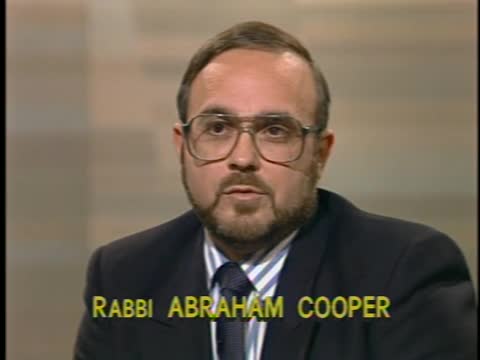
RABBI ABRAHAM COOPER: Well, I think there's a great deal that's happening. First, to put things in perspective, we have in America today over 230 indigenous hate groups. Thankfully, most of them are on the periphery, but we know the damage that even a single individual apparently could do with these bombs. Twenty-five thousand hard core white supremacists, three thousand skin heads, now there are about 35 states that have tried, many municipalities trying to deal with it on a local level, the police in many locations have tried to do their job, but I think on the birthday of Martin Luther King, Jr., it's safe to say that hatred cannot be legislated out of existence. There's a moral dimension. I think a lot of the issues on the agenda, the political issues, the economic issues are being addressed. That's part of his legacy. What I miss most as someone who grew up, as a young person during his times, is the moral dimension, and the way in which he didn't avoid the race issues, but starting from that perspective that we have a problem in America, how do we define the American dream, and incorporate as many people within that dream. It's that moral dimension, the educational dimension that's really the hardest to put your finger on and to get a movement on, but that's where the progress is going to be made.
MR. LEHRER: And that's where you would define racism at that hard core edge of the hate groups, right? That's where you begin drawing the --
RABBI COOPER: You have to deal with the practicalities. We're a society. We have a social contract. Each of us has to live up to that, but I think it's important for all elected officials and those people who are in law enforcement to do their jobs. But to be fair to them and their limitations, you have to try to go to the roots of the problem, and that goes to the educational process and the messages that people are getting.
MR. LEHRER: Educate whom, the people in the hate groups, or who needs to be educated about racism?
RABBI COOPER: I think that we have to go right across the board starting with young people in the schools. There are certain bigots --
MR. LEHRER: Are you talking about white people or black people, brown people, all people?
RABBI COOPER: The message that I learned from Martin Luther King, Jr. as a young person was there has to be one standard in the battle against bigotry, against racism, against hatred, which means that just as it's safe to say that racism, the inequality, how people view things is certainly not dead in white America, or in any ethnic group, I think it's also safe to say we've seen a lack of leadership in talking out when there have been bigoted statements and actions emanating from the black community.
MR. LEHRER: Mr. Madhubuti, do you agree with that, that racism education is required for blacks, as well as for whites and others?
HAKI MADHUBUTI, English Professor: Education is required across the board but most certainly not in terms of racism. Racism in America is not only alive and well, it is a growth industry. I think that it's important to define racism in the context of white world supremacy. You have white people in this country controlling all the areas of life that are life giving and life saving. Education, politics, economics, law, entertainment, education, our military and so forth, and to suggest that black people are racists or have any power to inflict racist actions on anybody else in this country is ludicrous. Ben Hooks talked about the $200 billion economy that flows in and out of the black community. Well, that economy is now based upon black people producing or distributing indigenous products, that economy is based upon black people working for white people, and that economy stays in the black community for approximately four hours. Our community for the most part is decimated. We're the only community in this country that allow other cultural groups to come in for the most part and control the economy of our country. In Chicago over the last three or four years, we find that the Asian community, the Arab community, along with the dominant white community for the most part use our community as a playground. So racism is nowhere near our being sound in this country or in the world.
MR. LEHRER: In other words, your definition of racism, it's not just an attitude, you also have to have the power to hurt, is that right?
PROF. MADHUBUTI: Absolutely, absolutely correct, and that black people in this country for the most part are powerless. And you talk about Colin Powell and you talk about certain individuals in positions of power and influence, it takes us away from the real problem. Obviously, our white world supremacy will allow certain individuals of every ethnic group to rise to certain positions. But these positions for the most part are not in the best interests of the great majority of black people. And what's in our interest for Colin Powell to be the head of the Joint Chiefs and he's sending our troops down to Panama, all right, or this country involved in other wars in the third world which essentially affect our people here too? We can solve problems in Panama, but we can'tsolve problems on the West Side and South Side of Chicago or in Brooklyn, or in Detroit. It doesn't make any sense at all.
MR. LEHRER: Mr. Roberts, what do you say to that, to the point that the Colin Powells and the others, the other positive things that have been mentioned here really don't mean that much?
PAUL CRAIG ROBERTS, Economist: Well, I don't think there's any such thing as the white community or white power structure. The white community consists of a whole different, lots of different ethnic groups that used to call each other ethnic names, Degas and Pollacks and all of these people proved themselves and just became part of society. We used to be a melting pot and now we're a boiling pot. And I think the reason we're a boiling pot is that the civil rights movement has degenerated from being a movement struggling for equality before the law, equality under the law, and it's become a struggle for minority privileges and when you have minority privileges which we now have.
MR. LEHRER: Like give me an example. What do you mean?
MR. ROBERTS: Well, you have quotas in hirings, in promotion, in university admissions. You have special programs, special treatment for minority students in universities. This is a destruction of equality under the law and it creates economic value to being a minority because you now qualify for certain preferential treatments. This causes resentment among the people who don't qualify, and therefore, I think that racism is on the rebound, because the civil rights struggle has lost sight of its goal, which was equality under the law. And it's no longer struggles for equality under the law. It's struggles for minority privileges.
MR. LEHRER: And you think the growth that Rabbi Cooper mentioned, these hate groups --
MR. ROBERTS: That's right.
MR. LEHRER: -- and the growth of the various things, you think that is kind of a counter reaction to --
MR. ROBERTS: I think it's a reaction. You see, it's very, it's strange to me that a decade, a generation raised on Sesame Street, a generation that had never experienced segregation should have such an astounding number of racial incidents and have all of this proliferation of hate groups. You know, when I was a child or a young man there was only one hate group, the Ku Klux Klan. He says there's two hundred and something now.
RABBI COOPER: Two hundred thirty plus according to the Southern Poverty Center.
MR. ROBERTS: I think we've made racism an industry. I agree, it's a growing industry, and we've made it one, because we don't have any social wisdom.
MR. LEHRER: And you mean the people like Benjamin Hooks are the ones that have created this whole thing?
MR. ROBERTS: I'm afraid Ben Hooks has lost sight of the struggle. When he says the Supreme Court is acting in ways that are racism, this is a great tragedy, that the court is applying equality under the law, it doesn't make any sense to me for minorities to be trying to gain inequality under the law.
MR. LEHRER: Is that what you're doing, Benjamin Hooks?
MR. HOOKS: Well, I think that's nonsense, utter nonsense. It shows an utter disregard of the history of this nation.
MR. ROBERTS: It doesn't show any such thing, Mr. Hooks.
MR. HOOKS: I kept very quiet while you were speaking. I didn't say a word. It's hard to sit here and listen to that kind of nonsense without speaking, but I did. The point is that it had been proven for years that blacks could not be policemen, they could not be firemen, they could not be officers in the army, all kinds of jobs had been reserved for white. That is a fact in America. When the laws were passed that afforded equal opportunity, then the question came how do you assume it. One state is a good example. In a state which I will not call, the federal judge said you must have some black troopers on the highway patrol. Two or three years went by. NAACP filed a suit. We went back to court, the state highway commissioner absolutely defied to hire any blacks, and finally, the federal judge said the only way I can do it is it a contempt of the laws of this land and the highway patrol chief said we can't find a single black in this state with more than a million who qualify. That is where goals and timetables started. It was never designed to make a man who couldn't knock a tree down become a brain surgeon and white folk make a lot of mistakes too. They perform too many unnecessary operations a year, lawyers routinely imprison clients who ought to be free. So that this nonsense about whites -- I'd like to know where all these jobs are that black folk have or that women have that somehow white men ought to have. What happened during the Reagan administration, let's call it like it was, we had all of this kind of talk that encouraged the haters to believe somehow that whenever you saw a woman as an anchor on a television program or a woman driving a truck or a woman running a railroad train, that somehow she was not qualified and that she had beaten some white man out of the job who ought to have it, and we contributed to that. And racism, as far as I'm concerned, is using your race in a way that is harmful. If somebody hates a person and has no way to effectuate it, I do not call that racism. That's something else. It's wrong and it's wrong, and so as far as I'm concerned, affirmative action was a methodology utilized to keep those who had been in power from continuing themselves in power, the old boys network, and we had to have some method, and those methods have not resulted in a wholesale dislocation of white people, and to say that it's economic value to be a black person in this country, to me I can't think of anything worse to say.
MR. ROBERTS: It's absolutely of economic value to have these quotas because you now have white people claiming to be black to get them.
MR. LEHRER: Gentlemen.
MR. HOOKS: It's patent nonsense to say that.
MR. ROBERTS: It's not. It's a matter of factual record. You now have white firemen in Boston claiming they're black. You have white policemen in New York claiming they're Hispanics. You have Hispanic policemen claiming they're black.
MR. HOOKS: Is it better to have --
MR. LEHRER: Gentlemen, let me ask you --
MR. ROBERTS: People in -- over these classifications --
MR. HOOKS: That still has nothing to do with it. It has to do with the fact that we have to deal with a network that had been set up in Birmingham, where there had not been a single black fireman since they had a fire department until about 20 years ago. Once blacks became eligible to be firemen, the question then arose, or women became eligible, the question, how do you deal with emotion, and that is where the whole question comes up.
MR. LEHRER: I want to ask Ms. Chavez a question in this regard. You've written a book that's caused some stir. You said there's a victimized mentality that can come. And you do not want Hispanic Americans to do what black Americans have done in that area. Fit that into this discussion.
MS. CHAVEZ: Well, I think it's very relevant to what Dr. Hooks just said. In fact, it was wrong that blacks were kept out of fire departments and police departments in places like Birmingham. And the whole point of the Civil Rights Act of 1964 was to lift that barrier, to tear down discrimination. But it was not to take that discrimination and turn it on its head and to allow race or color or national origin or gender to be used as the final determinant of who was going to be hired and who was going to be promoted.
MR. HOOKS: We're all in favor of --
MR. LEHRER: Mr. Hooks, let her finish, please.
MR. HOOKS: All right, I'll listen.
MS. CHAVEZ: What I'm suggesting in terms of this ideology, of victimization, which I think takes place with affirmative action is it tells minorities that they are not able to compete, that they are not good enough to compete in the way of whites. It says to them that they always need to be taken care of and it is a patronizing attitude and one that I think has done tremendous disservice to minorities in this country and one that I personally believe is racist at its root.
MR. LEHRER: Mr. Madhubuti, what's your view of that?
PROF. MADHUBUTI: I disagree. I think that if you talk about higher education, period, you find that blacks in terms of the major universities is less than 3 percent. Today the American Council on Education issued its 8th annual staff report on minorities in higher education and we found in 1987 less than 5.7 percent at the bachelor level received degrees in the black community, whereas in 1967 it was 6.4 percent. So we are losing. And to say that these hate groups or these fringe groups is the cause for racism does not deal with the facts. These hate groups do not cause unemployment in the black community. These hate groups on the fringe do not cause infant mortality in the black community. So I think you have to begin to look at the major causes which comes from the people who do control power in this country which are basically white people, from the White House to the major corporations. We're talking about the major 1000 corporations of this country. I don't see any black men running those corporations or black women.
MR. LEHRER: But what about Ms. Chavez' point that there is a victimization kind of in the air among blacks that is demeaning to you all?
PROF. MADHUBUTI: Well, there is a certain amount of victim's analysis. I think most of us have been talking the European American point of view and therefore, analysis of the problem for the most part does not come from the point of view that best works for us. It's an Afro-eccentric point of view. I think what Ms. Chavez doesn't understand is that for over 250 some odd years black people were slaves in this country and we were forced to give our labor and as a result of that, when slavery say chattel slavery ended, we moved to another level of scientific slavery or psychological slavery. But the major point is that people come out of chattel slavery and we are asked to compete in a world with the slave masters who have been running the marathons and we are asked to run up against them. There's nothing to run with.
MR. ROBERTS: I believe that historically race has affected all races. Every race at one time or another has been held in slavery, including whites.
PROF. MADHUBUTI: It certainly has not affected any other people in the world like it affects blacks.
MR. ROBERTS: The Romans had white slaves, the Greeks had white slaves.
MR. LEHRER: Let me ask Rabbi Cooper a point. You heard what Mr. Madhubuti just said, that these hatreds are not the people that are causing blacks to be unemployed in Boston or anywhere else.
RABBI COOPER: I'd like to get back to this issue too. Iwant to list another group that is not the cause of this problem, but if you ask certain people in the black community, certain vocal ones, they'll say that the Jews caused AIDS, they ran slavery, that they're the root of all evil, and every problem, the real problems that we're trying to grapple with in tonight's problem, and whether he's an assistant in City Hall in Chicago or a member of America's No. 1 black rap music, we've had these kinds of incidents where people in their own way who are prominent in their own right in the black community speaking out and in this case scapegoating my group. We haven't seen any sort of reaction on the part of the mainstream or any other sort of leadership from the black community saying, wait a second, if we have real problems, let's define it and go after the real problems. One of the messages I think that I want to put out here tonight to Mr. Madhubuti is, maybe he doesn't believe it, I happen to take everything that I hear seriously.
PROF. MADHUBUTI: I do too.
RABBI COOPER: Members of other minority groups especially. If I hear something, I take it seriously. I'm going to react the same way when I hear it from a black man as if I'm going to hear it from a racist group or a neo Nazi person. And so for example, when we had a situation more recently with a man named Professor Griff, who happens to be a member of the Public Enemy Black Rap Group, a very popular group among millions of young blacks. Now he's telling America and telling his constituency, Jews are the roots of all evil, we brought AIDS to this country, we control South Africa, you name the problem, I've become, I'm personified as the real stumbling block for another minority group. Now as ludicrous as that may sound when there's no counter reaction to it on the part of responsible black leadership, it hurts all the legitimate issues we're talking about.
MR. LEHRER: Mr. Ogletree, does the rabbi have a legitimate complaint?
CHARLES OGLETREE, Law Professor: He has a point. I don't know if there's a complaint. There has been response and criticism of those comments. I think what we should be focusing on in 1990 on the 61st birthday of Dr. King is the fact that he stood for all these principles. He was not a racist. And what you seem to be saying and what I'm hearing today is that the things that we're asking for, a decent job, a decent education, fair opportunity, meaningful votes, are things that he fought for. If he came here in 1990 and listened to this discussion, he would be shocked. What do you mean unemployment is just as bad, what do you mean education is just as bad? I think what we should do is to reaffirm those principles that he stood for in the 60s and say that we want the same laws to be enforced, we want pride, we want respect throughout our communities. It's not a Jewish thing, it's not a black thing, it's not a white thing, it's a people thing. We should all be about principles to support equality in this country.
MR. LEHRER: Do you believe that if Dr. King were to come back and see this, that he would blame all of the problems on racism, on the part of the majority whites?
PROF. OGLETREE: He would say, he would not talk about the majority of white people, he would talk about government that is now retrenching on laws that were passed in the 60s, he would talk about a Supreme Court that took some positive steps in the 1960s and has turned its back on civil rights, he would talk about elected officials who use the black vote, minority vote to get elected, and yet don't carry out any agenda supporting those interests. He would talk about people who were in a position to make a difference. He would be very disappointed. He would say this is not the America I ever expected to see in 1990s, this is not the America I expected my children to be raised in to still have to be worried about the color of their skin and not the content of their character. He would be very disappointed in all of us in 1990.
MR. LEHRER: Ms. Chavez.
MS. CHAVEZ: I wonder what he'd have to say about government policies that, in fact, have also had a devastating consequence in the black community, welfare policies that have encouraged families to break up.
PROF. OGLETREE: Give us a job. Give us a job, we won't be on welfare. Give us an education, we won't need welfare. Give us a vote that makes a difference, we can get people in there who will have job programs and make a difference. That's what he would say.
MS. CHAVEZ: But the fact is that unemployment in the black community is one problem, but an even more devastating problem is the lack of labor force participation by black men. They have an abysmally low rate of labor force participation.
PROF. OGLETREE: Ms. Chavez, I hate to surprise you. They're in jails across this country. They're in jails. That's why they're not in the labor market. They're unemployed, they're homeless.
MS. CHAVEZ: What kind of response is that and is it racist?
PROF. MADHUBUTI: Of course.
PROF. OGLETREE: It's a response to the circumstances in this country. That's what it is.
MR. LEHRER: Who said they were there in jail because of racism?
PROF. MADHUBUTI: I did.
MR. LEHRER: Mr. Madhubuti. In what way?
PROF. MADHUBUTI: Black men have been locked out of the economy. It is naive to suggest anything else. But we have to understand when I said politics, economics, law, entertainment, education, military, every area that's life giving and life saving are controlled by white people, mainly white men.
MS. CHAVEZ: As a matter of fact, that group at the highest labor force participation rate in this country are Mexican immigrants. Mexican-Americans have labor force rates that are just the same as whites. Asians have higher labor force participation rates than whites. So it's not simply a black and white issue. There are other things that are involved in terms of the decline in the black community in the United States, and some of those I believe are the responsibility of government policies that have encouraged the breakdown of the family, the breakdown of standards, the dilution of values, and those have had a devastating consequence in that community.
MR. LEHRER: Would you agree with that, Mr. Hooks?
MR. HOOKS: I'm sorry Ms. Chavez has lost her way. There was a time in her life when she understood these problems particularly well. She does not do it now. To talk about labor force participation, you have to deal with a whole set of socii economic conditions. I'm the last one to apologize for people who don't want to work no matter where they come from, but you see a succession of role models that destroy the concept of work. When you have people who have lost faith in America, you have a problem. There was this other question raised about black-Jewish relations. Let me say that I think we need to work on the whole question of black- Jewish relationships, but none of us, I have had some of the most vicious attacks made on me and my organization by black people that you could ever imagine. If I spent all of my time trying to answer my critics, I'd never get anything done on the job. So I think that all of us are going to have to understand, NAACP, Joe Lowery, Coretta King, all the leading black spokespersons have made statements affirming our desire to work with all people and particularly the Jewish population helped us, but if every time some black obscure person I've never heard of makes a statement I'm called on to refute that statement and enter into another argument, we'll never get to doing any business. Finally, no matter what I say, it's never known unless somebody reports it, unless the Atlanta Constitution or Journal or unless the Detroit News or Free Press or the Los Angeles Times or the networks or some television station report it, I'm speaking like the tree that falls and nobody hears it. I've answered, sent out hundreds of news releases that are never published and printed, and when they are, they've been chopped up, and I make it a habit to try to speak up in defense of the rights of human beings whatever color or gender or religious persuasion. Today you get an idea of why we can't come together. We're moving off in all kinds of directions. We're dealing with cliches and points of view that necessarily don't have any relevance, sometimes abysmal ignorance, we don't understand what we're saying. What I am trying to say very briefly, and I'll state it in two words, we have made a great deal of progress. To say otherwise means that Martin Luther King died in vain, that Roy Wilkins and Whitney Young and Fannie Lou Haymer and Fredrick Douglas and Harry Tutman, this civil rights struggle has been going on since 1619 and will continue to go on, but to try to say that government policies that have tried to help people have been a strangling block really really really troubles me because it shows an entire misconception. I, therefore, fall on the fact is it people of literacy and intelligence who would never throw a brick never throw a rock, but who deliberately try to stop progress through philosophical arguments that won't hold water, this begins to disturb me no end. And when you cannot see that this Supreme Court is indeed turning back much of the progress we've been making, then it seems to me that literate, intelligent, articulate, kindly disposed people are helping to destroy this country.
MR. LEHRER: Rabbi Cooper.
RABBI COOPER: I want to come back to a piece of history. You know, from jail cells in Birmingham and threats against his life and running against the media a generation ago that wasn't all that interested in his story, Martin Luther King Jr. still found time, and talking now as an American Jew and then a young Jew, to talk about the rights of Soviet Jewry before American Jewish leaders spoke about it, to talk about the important lessons of the holocaust, to talk about a solidarity with Israel. He found times on the firing lines of history to set a moral agenda. And the fact of the matter is that we do have an inter-group problem and American Jews and American blacks are going to have to work harder in the future. You can't stand here pointing fingers. We're going to have to communicate better and perhaps you're going to need a lot of people to help fill that void.
MR. LEHRER: Mr. Roberts wanted to say something. Just a second, Mr. Hooks.
MR. HOOKS: I'd like to be on the record.
MR. ROBERTS: Mr. Hooks, I'm going to make what I think is a fundamental point. Let's suppose that we would continue the violation of Title 7 of the Civil Rights Bill, which is explicit against quotas, and we use quotas until we get minorities proportionately represented in the corporate 500 managements, all the professions and everything throughout. How then do we then take away these preferences? They will have become an entitlement.
MR. HOOKS: If you're asking me a question, I can answer it.
MR. LEHRER: Just a moment.
MR. ROBERTS: You will have permanent inequality under the law. How do you take back these preferences? How does society revoke them once they have become an hereditary right? That is a fundamental problem that is going to bust up this society.
MR. LEHRER: Mr. Ogletree, let's ask Mr. Ogletree. Do you think it's going to bust up society if it continues?
PROF. OGLETREE: No, none of these laws are perpetual. They're not here forever. They're here to give everyone an equal chance. You've got to catch up to be in the same race before you talk about getting rid of those laws and I think that Mr. Roberts is just missing the boat.
MR. ROBERTS: Well, actually the laws are against the quotas, but despite the illegality, they're becoming hereditary rights, like squatter's rights. How do you take them back?
MR. LEHRER: Mr. Madhubuti, what's your view of that?
PROF. MADHUBUTI: Why is it necessary to take them back? I think that it's very important to realize that for the most part that black people have not been the benefactors of the laws in this country, I mean, a few black people but the great majority of black people in this country are still at the bottom of the pot. I just don't see this kind of progress that we're talking about. I live and work in a community that every afternoon you drive through the community you see black men standing on corners.
MR. ROBERTS: Well, do you define progress as having inequality under the law?
PROF. MADHUBUTI: Well, inequality exists in this culture not only because of the law.
MR. ROBERTS: Yes, it exists in any competitive culture, but in the law, there's not supposed to be inequality.
MR. LEHRER: We have to leave it there, I'm sorry, gentlemen. Thank you very much. Ms. Chavez, thank you very much for being with us. RECAP
MS. WOODRUFF: Again the major stories of this Monday, there was more violence among ethnic groups in the Soviet Republic of Azerbaijan, and the Campeau Corporation filed bankruptcy on behalf of its two major U.S. department store chains. Good night, Jim.
MR. LEHRER: Good night, Judy. We'll see you tomorrow night. I'm Jim Lehrer. Thank you and good night.
- Series
- The MacNeil/Lehrer NewsHour
- Producing Organization
- NewsHour Productions
- Contributing Organization
- NewsHour Productions (Washington, District of Columbia)
- AAPB ID
- cpb-aacip/507-s46h12w34p
If you have more information about this item than what is given here, or if you have concerns about this record, we want to know! Contact us, indicating the AAPB ID (cpb-aacip/507-s46h12w34p).
- Description
- Episode Description
- This episode's headline: Campeau - Markdown; Racism in America. The guests include SEYMOUR ZUCKER, BusinessWeek; BENJAMIN HOOKS, President, NAACP; LINDA CHAVEZ, Former Director, U.S. Civil Rights Commission; RABBI ABRAHAM COOPER, Simon Wiesenthal Center; CHARLES OGLETREE, Harvard Law Professor; PAUL CRAIG ROBERTS, Economist; HAKI MADHUBUTI, English Professor; CORRESPONDENT: ELIZABETH BRACKETT. Byline: In Washington: JAMES LEHRER; In New York: JUDY WOODRUFF
- Date
- 1990-01-15
- Asset type
- Episode
- Topics
- Economics
- Social Issues
- Race and Ethnicity
- War and Conflict
- Military Forces and Armaments
- Politics and Government
- Rights
- Copyright NewsHour Productions, LLC. Licensed under a Creative Commons Attribution-NonCommercial-NoDerivatives 4.0 International Public License (https://creativecommons.org/licenses/by-nc-nd/4.0/legalcode)
- Media type
- Moving Image
- Duration
- 01:00:46
- Credits
-
-
Producing Organization:
NewsHour Productions
- AAPB Contributor Holdings
-
NewsHour Productions
Identifier: NH-1645 (NH Show Code)
Format: 1 inch videotape
Generation: Master
Duration: 01:00:00;00
If you have a copy of this asset and would like us to add it to our catalog, please contact us.
- Citations
- Chicago: “The MacNeil/Lehrer NewsHour,” 1990-01-15, NewsHour Productions, American Archive of Public Broadcasting (GBH and the Library of Congress), Boston, MA and Washington, DC, accessed April 17, 2026, http://americanarchive.org/catalog/cpb-aacip-507-s46h12w34p.
- MLA: “The MacNeil/Lehrer NewsHour.” 1990-01-15. NewsHour Productions, American Archive of Public Broadcasting (GBH and the Library of Congress), Boston, MA and Washington, DC. Web. April 17, 2026. <http://americanarchive.org/catalog/cpb-aacip-507-s46h12w34p>.
- APA: The MacNeil/Lehrer NewsHour. Boston, MA: NewsHour Productions, American Archive of Public Broadcasting (GBH and the Library of Congress), Boston, MA and Washington, DC. Retrieved from http://americanarchive.org/catalog/cpb-aacip-507-s46h12w34p