The NewsHour with Jim Lehrer
- Transcript
JIM LEHRER:
Good evening. I'm Jim Lehrer. On the NewsHour tonight: Our summary of the news; a look at the options for restoring peace and stability in Haiti; a democratic campaign wrap-up; today at the supreme court from Marcia Coyle of the "national law journal"; a John Merrow report on the financial problems of black colleges; and some perspective on Mel Gibson's big new movie on the last days of Jesus.
NEWS SUMMARY
JIM LEHRER: More foreigners trying to get out of Haiti today. Canada September in troops to help evacuate its citizens as looting and other lawless acts spread in the capital port-au-prince. We have a report on the situation from Bill Neely of Independent Television News.
BILL NEELY: The fear is visible on Haiti's streets today. Burning tires and barricades ring the capital. They'll hardly stop an attack by rebels, but people here are determined to resist. Lorry loads of armed men, supporters of the beleaguered president, tour looking for trouble. The rebels were flexing their muscles today in Haiti's second city, arresting the president's supporters. They have plenty to fear. The rebels killed 5,000 people the last time they took to the streets to take on President Aristide. So far this time, the death toll is lower, but the terror is growing. So much so that well armed U.S. Special Forces protecting U.N. workers escorted them to the airport to flee the country today, and it's an exodus that's growing. Many of the thousands of Americans and Europeans who live here have had enough. It's the gunmen on the streets who are now calling the shots and are firing them, and Haiti is braced for more.
JIM LEHRER: Late today the main rebel leader said his forces would delay attacking Port-au-Prince. He said he wanted to see if President Aristide would agree to step down. France called today for sending an international civilian force to restore order in Haiti, immediately. But in Washington, President Bush said he'd support that move only after a peace agreement.
PRESIDENT GEORGE W. BUSH: We still hope to be able to achieve a political settlement between the current government and the rebels. We are watching the situation very carefully. The secretary of state has been in touch with Canadian officials and French officials and Caribbean officials, all aimed to convince the parties to come to the table and affect a peaceable solution.
JIM LEHRER: The president also urged Haitians to stay put despite the unrest. He warned the U.S. Coast Guard would turn back any new wave of refugees. We'll have more on Haiti right after this News Summary. In Iraq today, a U.S. Kiowa helicopter crashed in a river 120 miles northwest of Baghdad. The two American crew members were killed. The cause of the crash was under investigation. To the north in Mosul, gunmen in a car shot and killed a senior police official today as he headed to his office. It was the latest in a series of attacks on Iraqis working with the United States. The chairman of the Federal Reserve called today for cutting Social Security benefits for future retirees. Alan Greenspan said that step was vital to deal with growing federal deficits, and hold down long-term interest rates. He told a House Committee that cutting benefits made more sense than raising taxes.
ALAN GREENSPAN: I believe that a thorough review of our spending commitments and at least some adjustments in those commitments is necessary for prudent policy. I certainly agree that the same scrutiny needs to be applied to taxes. However, tax rate increases of sufficient dimension to deal with our looming fiscal problems arguably pose significant risks to economic growth and the revenue base.
JIM LEHRER: Greenspan said any change in benefits should not affect current retirees or people getting close to retiring. In response, President Bush called again for letting younger workers invest Social Security taxes in the markets. On the Democratic side, John Kerry condemned Greenspan's remarks in Toledo, Ohio.
SEN. JOHN KERRY: Thewrong way to cut the deficit is to cut Social Security benefits. ( Applause ) if I'm... if I'm president, we're simply not going to do it. And if I'm the Democratic nominee, and I welcome this debate, this is a debate that I will win and we will win and we will restore our economy in a way that is fair to Americans without destroying the solemn contract of Social Security in this nation.
JIM LEHRER: Among the other Democratic candidates, John Edwards said it was an outrage for Greenspan to endorse cuts in benefits, but support making the Bush tax cuts permanent. And Dennis Kucinich demanded that Greenspan resign. We'll have more on the day's campaign events later in the program. The U.S. Supreme Court agreed today to let states deny academic scholarships to divinity students. The ruling was 7-2 in a case from Washington State. The majority cited the doctrine of separate of church and state. It said: "Training someone to lead a congregation is an essentially religious endeavor." We'll have more on this later in the program. The Speaker of the House, Dennis Hastert, will not introduce legislation giving the 9/11 commission more time. The panel's findings are due May 27, but it wants another 60 days. President Bush has agreed, and he met today with Hastert. Hastert said through an aide today that he will not bring up a bill granting the extension. He doesn't want the report any closer to the presidential election. U.S. and North Korean officials held a rare informal meeting today in Beijing, China. It lasted more than an hour, but no details were available. The meeting happened as six- nation talks resumed on North Korea's nuclear program. The U.S. insists the communist state give up efforts to build nuclear weapons. North Korea wants economic aid and assurances the United States will not attack. The hotly debated film "The Passion of the Christ" opened in movie theaters nationwide today. It details the final 12 hours in the life of Jesus. Across the country, lines formed early to see one of the first screenings. An estimated 6,000 movie-goers filled one theater complex outside Dallas. We'll have more on "The Passion" later in the program. On Wall Street today, the Dow Jones Industrial Average gained 35 points to close above 10,601. The NASDAQ rose more than 17 points to close at nearly 2023. That's it for the News Summary tonight. Now it's on to the latest on Haiti, the democratic race, the supreme court, black colleges, and "The Passion."
UPDATE - ON THE BRINK
JIM LEHRER: The uprising in Haiti and to Margaret Warner.
MARGARET WARNER: As violence continued in Haiti today, international diplomats were still struggling to broker a deal between President Jean-Bertrand Aristide and opposition groups demanding his ouster. A delegation came to the capital, Port-au-Prince, last Saturday to present a U.S.-drafted proposal in which Aristide would remain as president, but share power with his rivals. Secretary of State Colin Powell had said the U.S. would not endorse forcible regime change.
COLIN POWELL: We cannot buy into a proposition that says the elected president must be forced out of office by thugs and those who do not respect law.
MARGARET WARNER: Aristide promptly accepted the proposed deal Sunday, but yesterday the political and civic opposition leaders said "no."
SPOKESMAN: And there will be a worsening of the situation of violence as long as Mr. Aristide is in power
MARGARET WARNER: The violence, which has killed 70 people, began with an armed rebel uprising three weeks ago. The rebels, who say they're not connected to the civic opposition, now control the northern half of Haiti and are threatening to seize the capital. Yesterday, Aristide appealed for foreign assistance to his outmanned Haitian police force. Otherwise, he warned, thousands will die or flee to U.S. shores.
PRESIDENT ARISTIDE: The world sees this kind of tragedy, it is a genocide, it is a crime against humanity.
MARGARET WARNER: On Capitol Hill today, the congressional black caucus urged the president to act quickly to end the violence without waiting for a negotiated settlement.
REP. CHARLES RANGEL: We don't want any more Haitian blood on American hands. And no matter what the French or anybody else thinks of Aristide, we cannot have his life taken away on our watch.
MARGARET WARNER: Now for the latest on diplomatic efforts to solve the Haiti crisis, we turn to Luigi Einaudi. He's assistant secretary general of the Organization of American States, he's also the OAS point person on Haiti. He's met frequently with President Aristide and many of the political opposition leaders. Welcome.
LUIGI EINAUDI: Thank you very much.
MARGARET WARNER: Let's start with what Congressman Rangel just said at the end of the tape. Is President Aristide in danger of losing his life here? Is the situation that dire?
LUIGI EINAUDI: Quite possibly. To some extent, the situation is as bad as it is because President Aristide was humiliated and nearly killed in a military coup in September of 1991. And to some extent, he has vowed never to let that happen again. And it's one of the reasons for his attempt to control power in ways that a lot of people find objectionable. Conversely, there are people who moved against him then who are sorry they left him alive.
MARGARET WARNER: So, take us back to this weekend, this latest effort to negotiate a settlement. Secretary Powell got personally involved. He even interceded with the opposition trying to get them to agree. It failed. Give us your political analysis of why it didn't work.
LUIGI EINAUDI: Basically because I think that the only people who wanted it really to work are us foreigners. It's hard to be Haitian. If you're Haitian, you're poor, you live in a very difficult environment. You are forced to be suspicious. You're aware of your slave heritage. But it is also hard to be a friend of Haitians because they suspect the motives of the outsiders and I think basically for two years we've had a hidden war that has been escalating into the present. And it's interesting. The opposition did not want to do anything that might legitimate Aristide. Aristide did not want to do anything that would really undermine his power. And the outside community, to some extent, was a bit late in reacting to all of this, although we have made... the OAS has made a major effort because people felt we've been doing this before. We tried in 1994 and nothing works here.
MARGARET WARNER: Let me ask you this. The way it has been portrayed here, Aristide was willing to share power and the opposition wasn't. Is that the case? Or is the opposition right to be suspicious of Aristide and whether he really means it.
LUIGI EINAUDI: Yes.
MARGARET WARNER: Yes, they have a right to be suspicious.
LUIGI EINAUDI: It is also true he was willing to offer. The problem is that on the basis of past history, this distrust that I mentioned reigns supreme. And I've often said that you distrust people and they come back at me in Haiti saying it's not that we distrust, it's that we know that everybody's planning how to get out of whatever commitment has been made.
MARGARET WARNER: Now, what is the connection between the civic or political opposition? Let me ask you a quick question about them. Is that a unified group?
LUIGI EINAUDI: Not at all.
MARGARET WARNER: No?
LUIGI EINAUDI: No, I think that in fact the one unifying factor for much of the opposition is anti-Aristide. And they themselves are divided. There are some very optimistic long-term elements here. Used to be that Haitian politics was left to the hands of the professional politicians and the military. Now the military's largely out and disbanded, although, as we've seen, some of them are coming back. We've also had the growth of civic movement and the like. The problem is that they have all united in a way that creates a further polarization and division for the time being.
MARGARET WARNER: Now what's the connection? There isn't one between the political opposition in the city and the armed rebels out in the countryside. But is there a connection?
LUIGI EINAUDI: Well, if you spend all of your time talking and the government is not particularly responsive, after a while, you need a bit of bite and you don't necessarily object that some other people take advantage and mobilize and give you some bite. The difficulty in Haiti now is that I think things have really gone to a further path than anybody expected. The government never expected its police to crumple the way it has. The opposition really, until recently, was hoping to provoke an armed intervention from the United States or somebody else to change things. They didn't think they could take things into their own hands. One of the reasons they turned down the peace plan over the weekend was that they now think they don't need the outside. They think they can win.
MARGARET WARNER: You mean because the rebels are providing the pressure?
LUIGI EINAUDI: Yes.
MARGARET WARNER: Now President Aristide, as we just saw, warned yesterday, if somebody doesn't intervene and shore up his police force, thousands will be killed and many will try to flee to the U.S. as refugees. Do you think that's true?
LUIGI EINAUDI: Yes, I do think that's true.
MARGARET WARNER: On both counts?
LUIGI EINAUDI: Yes, I think the flights have already begun. The deaths are gradually growing I think the expectation and the fear right now in Port-au-Prince itself, the capital, is that there could be loosed some terrible revenge taking. There's a sad lesson from what's happened in the North. There's a report from the United Nations in Geneva, and everybody tried to put together when fuel and food and medicine started to be blocked by these uprisings, a humanitarian corridor. I mean that's one thing that the entire international community is in total unity about. The U.N. is saying, and we saw the clip of some of their workers leading now, that that they are leaving now because they have been unable to do it and the report said this. There are too many fiefdoms with barricades and demands. That to me is a description of growing anarchy.
MARGARET WARNER: Do you also have a split in the international community? The wires reported the French put out a statement and we heard president bush say happy to support a force but only after there is a compromise. Is there a lack of unity also among the foreign diplomats and foreign countries that would like to solve this?
LUIGI EINAUDI: I think there has been a lack of unity. Whether that lack of unity will continue under the pressure of these events is not clear. We saw Secretary Powell say very clearly, and he didn't say just in your clip, he has repeated it a number of times recently, and when we met with him ten days ago, that we have to recognize that there is an elected president. There are others who are less interested in that principle, and are willing to say, look, this man must go. On the other hand, I think the U.S., reeling still from the experience of 1994 when we did, under President Clinton, put Aristide back in power after the coup, but didn't really ultimately leave feeling that we had achieved a major result, so the U.S. is not clear that it wants to go in and sort of defend a regime that's under attack.
MARGARET WARNER: And a regime whose record is not exactly proud of or can't really stand behind.
LUIGI EINAUDI: That's right. Although frankly I think the political reasoning is that we don't want to get involved in a conflict where we will be losing more casualties. And that is true of everybody. I think the French would like toe do things, but are constrained. They're far away. They're the former colonial power. The Caribbean countries are small.
MARGARET WARNER: Let me ask you about something the French said today at the end of their statement, Aristide bears ultimate responsibility for the current situation they said. It is a new decision but a new page must be opened in Haiti's history. Do you read that as the French pressing Aristide to leave, to step down before his two years are up?
LUIGI EINAUDI: The whole French statement is very parallel to the opposition of the opposition. --. It is a very intelligently and well crafted position.
MARGARET WARNER: And from what you know, would President Aristide ever do that?
LUIGI EINAUDI: I think we are in this trouble in part because he vowed that he would never be thrown out.
MARGARET WARNER: All right, Mr. Ambassador, thank you so much.
LUIGI EINAUDI: Thank you.
SERIES - CAMPAIGN 2004
JIM LEHRER: Back in this country now and to today in the democratic presidential race.
Kwame Holman reports our round- up.
KWAME HOLMAN: Massachusetts Senator John Kerry hit the campaign trail early this morning in Ohio, fresh from the delegate wins he picked up in Utah, Idaho, and Hawaii yesterday.
SEN. JOHN KERRY: How are you doing?
KWAME HOLMAN: The Democratic frontrunner paused for a television interview in which he attacked President Bush's call for a constitutional amendment banning same-sex marriage.
SEN. JOHN KERRY: A year and a half ago or two years ago he said we didn't need a constitutional amendment. Now, we still don't need it. I believe that you ought to have civil unions. I think you ought to have partnership rights, I think it is important to respect civil rights in our country. I think the president is trying to divide America. I think he's a president in trouble, and he's just looking for a political change of subject.
KWAME HOLMAN: Kerry has continued to focus this week on the nation's job losses. Ohio, a key state in the upcoming Super Tuesday contests, has seen its share. In Toledo, he proposed companies be required to warn workers before outsourcing their jobs.
SEN. JOHN KERRY: We're going to demand accountability from corporations when jobs are unjustifiably shipped overseas. We're going to require full disclosure to the American public about how many jobs being overseas, where they're going, why they're going, and companies will no longer simply be able to simply surprise their workers with a pink slip instead of a paycheck. They're going to be required to give their workers three months notice if their jobs are being exported offshore, so we have notice. (Applause)
KWAME HOLMAN: Kerry has put that proposal into Senate legislation; one of the bill's co-sponsors happens to be North Carolina Senator John Edwards. Edwards' campaign has downplayed the candidate's losses in all three states yesterday, noting he's been concentrating almost exclusively on a handful of Super Tuesday battleground states. Today, he began a three day quest to win most of California's 370 delegates. He spoke at Pomona College in the southern part of the state, and called for tuition support and more aid for the poor. He also paid homage to a former opponent.
SEN. JOHN EDWARDS: I want to say just a word about a man who was a candidate in this presidential campaign -- somebody that I believe was a powerful voice for change -- somebody who brought a whole group of people into the political process who were otherwise not in the political process, particularly young people; somebody that I have a great deal of personal affection and enormous deal of affection for, my friend Gov. Howard Dean. And I think we should honor him and honor what he has done as a powerful voice in this campaign.
KWAME HOLMAN: Edwards hopes some former Dean supporters will shift their allegiance to him. Congressman Dennis Kucinich finished second in Hawaii last night, ahead of Edwards, picking up six delegates. He campaigned today in Massachusetts. The Reverend Al Sharpton won no delegates last night, and had no public events today.
JIM LEHRER: Still to come on the NewsHour tonight, the Supreme Court, black colleges, and "The Passion."
FOCUS - SUPREME COURT WATCH
JIM LEHRER: Gwen Ifill has our Supreme Court story.
GWEN IFILL: The question before the court was whether a state could deny a government- sponsored scholarship to a student studying to become a minister. The answer today: An unexpectedly lopsided yes, as the court ruled 7-2 in favor of Washington State. What did this latest church- versus-state ruling tell us about other religious issues before the court, including school vouchers? To take us inside the Supreme Court chamber, we turn to Marcia Coyle from the "National Law Journal." NewsHour regular Jan Crawford Greenburg is on maternity leave, little girl. Remind us, Marcia, who this student was.
MARCIA COYLE: The student was Joshua Davey, and he wanted to go to a bible college, Northwest College in Washington State. He had always planned to be a church pastor. When he went to Northwest College, he took a double major in theology and business administration. He had been awarded a scholarship, a state funded scholarship. It's called the Promise scholarship program. And that program awards academically gifted students but cannot be used if you major in theology. He could not use this scholarship. He turned around and he sued the state.
GWEN IFILL: Today the court agreed with the state. What was the reasoning?
MARCIA COYLE: Chief Justice Rehnquist wrote the opinion for the 7-2 majority and he said that Davey was wrong in saying that this discriminated on the basis of religion. Davey was arguing that his practice of religion was burdened in an unconstitutional way. And he looked to the free exercise clause of the first amendment to make that argument. And the free exercise clause does protect our practice of religion. Chief Justice Rehnquist said that this was really unlike other laws and programs that the court had struck down because they burdened the practice of religion. He said this program really doesn't disfavor religion, and if it does, it very mildly disfavors it. There were no criminal or civil sanctions imposed. The student wasn't forced to choose between his religious beliefs and the government benefit here. Ministers, which Mr. Davey wanted to become, weren't prohibited from participating in public affairs. He said the state's interest here was in separation of church and state. And this was an interest that can be traced back to the founding fathers, back to the early years of the country when we had popular uprisings against tax assessments in order to fund religions. So the state had a historical interest, and it had a substantial interest in separation of church and state.
GWEN IFILL: If the distinction in this case that it was the state that had outlined this in its own state constitution as opposed to other religious-- other religion cases in which the court has seemed to move more toward commingling church and state.
MARCIA COYLE: Yes, first of all, this was written into state law as well as the state constitution. The constitutional amendment here was very broad in prohibiting state religious activities. The state law then said in this program you can't fund degrees in theology. It seems counter to the trend where we've seen that the Supreme Court has been more accommodating of government and religion. But those cases also fell under the establishment clause of the Constitution, which is sort of the second clause in the first amendment that protects separation of church and state.
GWEN IFILL: Justices Scalia and Thomas were the dissenters in the 7-2 decision. What were their arguments?
MARCIA COYLE: Justice Scalia said that this was discrimination. It couldn't be clear -- it was on the face of the statute, singled out a particular course of study. Chief Justice Rehnquist said, well, it does single out a course of study, but look, religion is different. The Constitution acknowledges that training in a religion profession is different from training in another profession because training to be a minister is an essentially religious endeavor. And so the state here justified it not to fund a particular course of study. It wasn't hostile to religion.
GWEN IFILL: This is different from the other cases we talked about at this table how, for instance, we talked about school voucher cases. We talked about in a more political sense, the administration's efforts to expand faith-based initiatives. One at a time, how is this different from the vouchers?
MARCIA COYLE: All right. Well, this case actually attracted a lot of attention because of the school voucher debate. The amendment in the Washington constitution is very similar to other state constitutional amendments that prohibit state funding of religious activities. Supporters of school vouchers right now are fighting in those states to invalidate those state amendments because they see them as an obstacle to school voucher programs. So they were hoping in this case they might get a statement from the Supreme Court that said you can't discriminate on the basis of religion in your state constitution.
GWEN IFILL: The court stayed wide of that.
MARCIA COYLE: It really did. It said this is a narrow case amendment and the state constitution isn't like the other amendments. So the school voucher supporters did not get what they were hoping for in this particular case. It also was attractive to those involved in the debate over President Bush's faith-based initiatives. And there was hope that it would have implications for that. Good lawyers, I think... and there are very good lawyers in these debates... will always find something in Supreme Court opinions to support their cause. I think those who support the president's faith-based initiative will look at this opinion and see Chief Justice Rehnquist's language that the state of Washington could have funded the doctorate of theology study under the establishment clause. There wouldn't have been any problem. There was no, you know, commingling or entanglement of church and state. And they'll say, okay. It will be all right under the establishment clause under the federal constitution for the federal government to support religious-based organizations providing social services. Opponents of faith-based initiatives will look at this opinion and say the Supreme Court said it's not discrimination. It doesn't violate the free exercise clause of the federal constitution not to fund these activities.
GWEN IFILL: So let me get this straight, I guess and I think I'm about to confuse it. If you have a school voucher program which deems that you must fund a certain amount of religious education or pay for education that is in a religious environment, that hasn't... the court did not speak to that. But if you have a case which is the opposite of that, the court said you are allowed to ban it.
MARCIA COYLE: This shows the tension between the free exercise clause and the establishment clause. The chief justice said what the establishment clause allows is not necessarily required by the free exercise clause. The school voucher case that got to the Supreme Court was a city program. What was at issue before the supreme court was not a state constitutional amendment prohibiting funding of religious activities. What was before the supreme court was whether that school voucher program violated the establishment clause of the first amendment. So the next step, the next battle is going to be over these state constitutional amendments.
GWEN IFILL: As also, Marcia Coyle, you explain it better than I could. Thank you very much.
MARCIA COYLE: My pleasure.
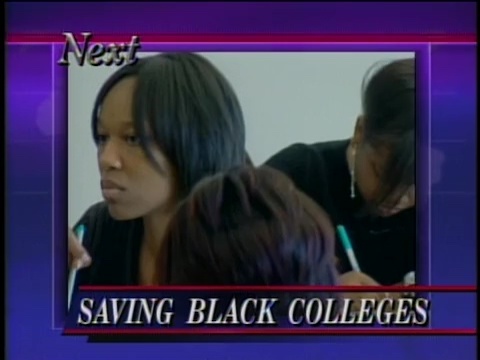
FOCUS - SAVING BLACK COLLEGES
JIM LEHRER: Now economic difficulties at black colleges. John Merrow, the News hour's special correspondent for education, reports.
JOHN MERROW: Morris Brown College in Atlanta, Georgia, is one of 105 historically black colleges and universities in this country. Its doors have been open to anyone who wished to attend since its founding by former slaves in 1882. In 2002, the school was featured in the movie "Drumline."
ACTOR: That's the unstoppable, undefeatable Morris Brown.
JOHN MERROW: But what was once a thriving campus is now a ghost town. The stadium is empty. The student center and library are desolate. ( Speaking French ) Some classes have one or two students. The trouble at Morris Brown began in December of 2002. Because of years of mismanagement and accumulated debt, Morris Brown lost its accreditation, essentially its right to operate. Without accreditation, the school became ineligible for state and federal money, and lost 80% of its operating budget.
AARON WATSON: The athletic program has been eliminated. The band has been eliminated for the moment. The student body has gone down from 2,600 to 2,700, down to less than 100. The faculty has gone from over 500 to less than 100.
JOHN MERROW: To survive, Morris Brown needs to find a president and raise $26 million to pay off its debt. Senior music major Stacey Barrett is one of the few students who did not transfer. Why should Morris Brown survive?
STACEY BARRETT: Because of the 122-year legacy that's been played a part in ground one in forming this school. And as long as there are students who need to learn, there should be an institution like Morris Brown who is willing to take in anybody who wants that opportunity.
JOHN MERROW: The majority of historically black colleges and universities were founded by churches following the Civil War, to provide educational opportunities for African Americans when there were none. WEB Dubois, author Toni Morrison, Martin Luther King, Jr., and filmmaker spike lee all graduated from black colleges.
SPOKESMAN: The African American community will not succeed in America, has not succeeded in America, without the contribution of historically black colleges and universities.
JOHN MERROW: But today, with more than 270,000 students, these schools face daunting challenges, money problems, low retention and graduation rates, and a reputation for academic mediocrity.
JOHN MERROW: Why does the world need historically black colleges and universities? Aren't we moving past that?
DENNIS KIMBRO: Well, I could say the same question, why does the Jewish community need Yeshiva? Why do the Irish need Notre Dame?
JOHN MERROW: Reporter: Dennis Kimbro, a professor at a black college, writes about African American issues.
DAVID KAY: Right now we have about 103 HBC U.S-- historically black colleges and universities. At one time we had 117. The tragedy is, today's black middle class can't even keep them open.
JOHN MERROW: Reporter: On average, 80 percent of students who attend black colleges are on financial aid. In addition, the combined endowment for all 105 black colleges in this country is only $1.6 billion. Harvard's alone is $19 billion. These factors threaten the stability of many black colleges.
JOHNNETTA COLE: Suppose we gave them up now, let me tell you what we would lose. Three-quarters of all black PhD's in our country did their undergraduate work at historically black colleges and universities. Are we going to stop that right now? I don't think so.
JOHN MERROW: Dr. Johnnetta Cole, a longtime leader in the education community, is finding ways to revitalize these schools. In June of 2002, she was brought in to rescue 130-year-old Bennett College in Greensboro, North Carolina. And today her success is a ray of hope for many struggling black colleges.
JOHNNETTA COLE: We celebrate a new day at Bennett College for women.
JOHN MERROW: Two years ago, Bennett was $3.5 million in debt and its accreditation was on probation. Dr. Cole solicited prominent friends like former U.S. Senator Bob Dole and entertainer Bill Cosby to pledge time and money to save the school.
SPOKESPERSON: Dr. William H. Cosby, jr., helped us to raise over $1 million. ( Cheers and applause )
JOHN MERROW: Today, Bennett has been taken off probation. It is out of debt and even finished the year with a $300,000 surplus. Another school that is turning itself around is Clark Atlanta University in Atlanta, Georgia, home to more than 7,500 students. When Walter Broadnax became president in the fall of 2002, the school's operating budget was $7.5 million in the red because of years of fiscal mismanagement. Despite much opposition, he eliminated more than 100 positions and began phasing out entire departments. According to Broadnax, this was necessary to avert financial disaster.
WALTER BROADNAX: The goal here is not just to make the school smaller, it's to make the university stronger.
JOHN MERROW: Tell me about that meeting this morning. I mean, it seemed like the theme was "cut, cut, cut."
WALTER BROADNAX: Well, it's not just cut, cut, cut. It's cut strategically. We are reducing our expenditures so that this institution can thrive, not just be smaller.
JOHN MERROW: Broadnax is also willing to spend strategically and invest in areas he thinks will make a difference, like the new multimillion dollar classroom center, now under construction.
WALTER BROADNAX: We have to be competitive. Our dormitories and our classrooms and our instruction has to be as good as anybody else's, because today's youngsters aren't going to accept anything but the best.
JOHN MERROW: President Broadnax said, you know, the future of HBCUS really requires that they become good enough to compete with every institution.
DENNIS KIMBRO: I agree.
JOHN MERROW: What has to be done to get to that level?
DENNIS KIMBRO: Oh, you're talking, really, a shopping list: Number one in terms of resources; number two in terms of faculty and faculty development; number three in terms of overall quality of the students.
JOHN MERROW: Improving the quality of students is an ongoing struggle for many black colleges, because the country's most prestigious universities recruit the best and brightest black students in order to maintain diversity. To compete, schools like Clark Atlanta offer their best applicants four-year scholarships.
WALTER BROADNAX: I think our high-performing students are very important to our colleges and universities, just like they are to white institutions. That's why white institutions work so hard to get those students there, and that's why we work so hard to get them here.
JOHN MERROW: But critics say there is a bigger issue: Students may be getting an inferior education at black colleges in general. In this year's national ranking of undergraduate liberal arts colleges and universities, only one black college was ranked in the top 100.
WALTER WILLIAMS: On average, the education offered at historically black colleges is less challenging than many, many other colleges.
JOHN MERROW: Walter Williams is an economics professor at George Mason University, and a syndicated columnist.
WALTER WILLIAMS: Many people will say, including whites, that Howard University is just as good as a Harvard, Yale, or university of Chicago. That's nonsense, unless you're saying that "considering it's black, it's a good school." And I find that something that's racist.
JOHN MERROW: One of the critics of historically black colleges and universities said basically that any good white college outperforms the Howards, et cetera; HBCU's should be for low-performing black students. What's your reaction to that?
WALTER BROADNAX: Well, he's by definition just going to turn them into some sort of poor ghettos. If you... if you restrict who's going to attend and take all the good students and send them off to white schools, then he's probably right. It will just turn them into sort of low-end little ghettos.
JOHNNETTA COLE: Sisters and brothers all.
JOHN MERROW: Despite the ongoing debate, black college presidents like Johnnetta Cole firmly believe that schools like Bennett and Clark Atlanta must be preserved so that students who wish to go can.
JOHNNETTA COLE: I think the greatest strength in American higher education is its very diversity. What do you want? You want a research institution, you want a small liberal arts college? You want a coed school, you want a women's school? You want a predominantly white institution, you want an historically black college or university?
JOHN MERROW: Over the past two years, the United Negro College Fund has partnered with major companies to upgrade technology at historically black colleges. And while Morris Brown has a long way to go, it's getting help from private donors. Since June 2002, the college has retired one-third of its debt. It hopes to apply for re-accreditation in the spring.
FINALLY - THE PASSION
JIM LEHRER: Finally tonight, the storm surrounding the arrival of a new movie looking at the last hours of the life of Jesus. Arts correspondent Jeffrey Brown has our report.
JEFFREY BROWN: Mel Gibson's new movie, "The Passion of the Christ" opened in more than 2800 theatres nationwide today, timed to the Ash Wednesday religious observance. The film, in which characters speak Aramaic and Latin with English subtitles, depicts the last 12 hours of the life of Jesus, from his arrest in the Garden of Gethsemane to his crucifixion. The violent beatings, torture, and suffering of Jesus are graphic and detailed. The film is rated "R," and has generated extraordinary prerelease controversy and publicity. Mel Gibson, a superstar actor who's appeared in numerous blockbuster films, directed, produced, co-wrote, and put some $25 million of his own money into "The Passion." In the months before its general release, he showed the film in private screenings and in churches around the nation, winning praise from many religious leaders.
MAN: Watch the screen.
MAN: Go to this R-rated movie.
REV. DAN MARLER: This movie is going to generate this interest. It's almost like I see a tsunami called interest in Jesus.
JEFFREY BROWN: The controversy over the film has centered on its historical accuracy, particularly its portrayal of Jews, the Roman Prefect Pontius Pilate, and the explosive question of who bears responsibility for the death of Jesus. Abraham Foxman, head of the Anti-Defamation League, went to a screening of the film uninvited.
ABE FOXMAN: I was very troubled. I was disturbed. I was pained.
JEFFREY BROWN: According to Foxman and a number of other critics who've spoken out, the film plays into a centuries-old tradition that includes medieval passion plays and writings, such as those of a controversial 19th century mystic, Anne Catherine Emmerich, that has blamed Jews for the crucifixion and led to their persecution.
ABE FOXMAN: It's as if the Jews ruled, the Romans were only pawns in the Jewish hands.
JEFFREY BROWN: In a recent interview with ABC's Diane Sawyer, Gibson disavowed any anti-Semitism.
MEL GIBSON: For me, it goes against the tenants of my faith to be racist in any form. To be anti-Semitic is a sin.
JEFFREY BROWN: Gibson has said repeatedly the film is based on the four gospels, and comes directly from his personal faith. He is a traditionalist Roman Catholic, part of an ultraconservative movement that rejects many of the 1960s Vatican II reforms in the Catholic Church. Gibson sees the bible as literal truth.
MEL GIBSON: You either accept the whole thing or you don't accept it at all.
JEFFREY BROWN: Early reviews of "The Passion" have been mixed, with some critics decrying excessive violence and a lack of context, while others have praised the film's power.
JEFFREY BROWN: Two scholars share their views of "The Passion" with us now. Robert Johnston is professor of theology and culture at Fuller Theological Seminary in Pasadena. He is author of the book Reel - that's - r-e-e-l -- Spirituality. Philip Cunningham teaches theology at Boston College and heads the Center for Christian Jewish Learning. He was among a group of scholars who raised concerns over an early script of "The Passion."
And before we begin let me tell our audience that our two guests tonight have had a chance to see the movie in pre-released screenings. Gentlemen, that's where would I like to start. First with you, Professor Johnston. What was your genre action after seeing the film?
ROBERT JOHNSTON: I love film, I love theology, I love Jesus. And this movie brought thee of my passions together. I was deeply moved as it allowed me to medicate on the extent of Christ's suffering love for me. Tears involuntarily started down my cheek. I think the only other time in researches to a Jesus event that I can remember that was in graduate school when I heard Handel's Messiah.
JEFFREY BROWN: Professor Cunningham, your reaction?
PHIILIP CUNNINGHAM: Well, my reaction was a little different. Two things struck me. First the graphic brutal unrelenting violence was deeply disturbing. I found it difficult to really do much thinking or meditating simply in the face of the visceral sort of torture that I witnessed. The second reaction was that the presence of demons that flit in and out, the presence of a satanic figure drifting amongst the various characters suggested to me that this atmosphere of a cosmic battle between the forces of darkness and believers or people of faith. And that also, I found disturbing.
JEFFREY BROWN: Let's walk through the issues. First the one you raised about the violence, because it is a very graphic film, and focuses so much on the intense suffering of Jesus. Let me ask you, Professor Johnston, did you find that to be a strength of the movie?
ROBERT JOHNSTON: It was also very troubling to me, but it was its strength. It's the crux of the matter. I see it as a Catholic gift to many of us in the Protestant tradition who so easily move from Palm Sunday to Easter and just gloss over what happened on Good Friday. And that to be given the gift of focusing on the central moment in the Christian faith, when our savior died on the cross for our sins, it was deeply moving to me.
JEFFREY BROWN: So Professor Cunningham, why did you find that intense focus to be such a drawback?
PHIILIP CUNNINGHAM: Well, for a couple of reasons. One, there were gratuitous scenes of violence that are not attested to in the New Testament in any of the gospels, which are fairly sparse in how they describe these events in any case. But sometimes I think it's almost a glorification of violence threatened to jeopardize the message of God's forgiveness; for example, minutes after Jesus, as He is being crucified prays as in the Gospel of Luke, "Father forgive them, they know not what they do moments later, a raven flies down from the heavens and pecks out one of the eyes of one of the people crucified with Jesus who presumably is just as ignorant of things as his cruise fire. That suggests either that Jesus' prayer to the Father is not very effective or god isn't as forgiving as the gospel message conveys to me. And again that element of a raven pecking out the eye of someone is not found in the New Testament.
JEFFREY BROWN: Now, the other issue you raise, Professor Cunningham is the accuracy question, and of course much of the controversy there is focused on the portrayal of Jews. Can you flesh out what has bothered you there?
PHIILIP CUNNINGHAM: Well, there are two dimensions to that as well. First of all, there are many scenes not found in the New Testament in which Jewish characters inflict violence on Jesus; for example, he is thrown off a bridge in chains as he is being brought before the high priest. There is also some severe violence there that the New Testament certainly doesn't present at that juncture. In addition, and more historically, significant is the fact that Pontius Pilate is clearly subordinate in power to the high priest. If not subordinate, he is certainly intimidated by him. He tells his wife in a scene that also is not found in the gospels, that he is afraid Qiasis will lead a revolt against Roman rule unless Pilate complies with Qiasis's insistence on Jesus' execution. Now we know historically that Qiasis was effectively appointed high priest by Pilate and I fact was more fearful that the Romans would destroy the temple as it indicates in john Chapter 11 than in leading any revolt which was not in his power to do. The power relationships between the two are almost totally reversed from what we know historically.
JEFFREY BROWN: Professor Johnston, why don't you respond to that? How did the portrayal of the Jews affect you and your view of the movie?
ROBERT JOHNSTON: Maybe there are two things that need to be said. One is if we simply went with the sparse facts of the four gospels, we wouldn't have a story, we wouldn't have a movie. This is an interpretation of those four gospels in which they're combined and Gibson has tried to fill in the gaps. And that is both its strength and its weakness. I think we'll debate for a long time whether it's a little bit too much Braveheart theology, a little too gory. I had to look away. My wife looked away several times. It also is the fact that Jesus was beaten to death and died on a cross. That's a very bloody and gory event. As to the extra facts or the interpretation, I think that anyone who sees the movie will see that there are good Jews and bad Jews. There are good Romans and bad Romans. I thought that some of the Romans who beat Jesus up were somewhat over the top. That Gibson used his own hands to drive the spike into Jesus or that Gibson used his own voice to give the wail that Judas gave as he died says that Gibson was not trying to scapegoat. He was not trying to put that violence on one group of people or another group of persons. I think he, in fact, understands the cross to be a very violent act. For me as a Protestant who seldom concentrates on the crucifix, we have an empty cross it was the occasion for reflection and pondering and meditation. Why do I so easily run away from that aspect of the Christ story --
JEFFREY BROWN: Professor Johnston, as someone whose expertise this is intersection of culture and religion, particularly movies and religion, this is a subject, the life of Jesus, that has been in our history for centuries. What is the role of a film like "The Passion" for our culture today?
ROBERT JOHNSTON: If the art form for people under 30 is the Cineplex, then we have to realize that film is an increasingly powerful medium. In the church, increasingly clips of films are being shown. Study groups are being formed around movies. I think we realize that we need to bring the Christian story into dialogues with our story and film is a very powerful medium to do that.
JEFFREY BROWN: So, Professor Cunningham, if that is true and if it does have that much power, then the responsibility of the director in creating that film must be very powerful.
PHIILIP CUNNINGHAM: Well, certainly. I mean I think there are several things that could be said here. I would agree with Professor Johnston that Mel Gibson should not be accused of malice towards Jews by the selections and choices that he made; however, they were choices that were not necessary choices. I think the reason for Gibson's choices, besides drama is really because he's very much driven by the vision of Ann Catherine Emmerich whom you mentioned earlier who also has demons urging on pain to be inflicted upon Jesus and who portrays Jews much more negatively than any gospel, singularly or combined than the new testament has.
ROBERT JOHNSTON: Jeffrey.
JEFFREY BROWN: Yes. Go ahead.
ROBERT JOHNSTON: There are three classical interpretations of the cross in Christian theology. One emphasizes Christ's' love. One of those emphasizes that justice and judgment was rendered and that Christ took that judgment on our behalf and the third is that there was a cosmic battle and that the forces of good and evil, Satan and God fought, and this is not a new theology with Mel Gibson. It is both in scripture. It goes back to Iranaeus. It is part of the rich history of the church. And in our day and age in which spirituality is increasingly to the fore, when we recognize forces of both good and evil that are beyond us, an interpretation that allows for some mystery, that allows for some transcendent evil might be particularly useful for our day and age.
JEFFREY BROWN: All right. Professor Robert Johnston and Philip Cunningham, thank you very much for joining us.
PHILIP CUNNINGHAM: Thank you very much.
ROBERT JOHNSTON: Thank you.
JIM LEHRER: You can join an on-line forum with the passion with Professors Johnston and Cunningham. Please visit us at pbs.Org.
RECAP
JIM LEHRER: Again, the other major developments of this day: More foreigners tried to get out of Haiti, but President Bush said he had not given up on a peaceful settlement there. And Federal Reserve Chairman Greenspan called for cutting Social Security benefits for future retirees to help reduce the deficit. We'll see you online, and again here tomorrow evening. I'm Jim Lehrer. Thank you and good night
- Series
- The NewsHour with Jim Lehrer
- Producing Organization
- NewsHour Productions
- Contributing Organization
- NewsHour Productions (Washington, District of Columbia)
- AAPB ID
- cpb-aacip/507-930ns0mj15
If you have more information about this item than what is given here, or if you have concerns about this record, we want to know! Contact us, indicating the AAPB ID (cpb-aacip/507-930ns0mj15).
- Description
- Episode Description
- This episode's headline: Update - on the Brink; Campaign 2004; Supreme Court Watch; Saving Black Colleges; The Passion. ANCHOR: JIM LEHRER; GUESTS: LUIGI EINAUDI; MARCIA COYLE; ROBERT JOHNSTON; PHILIP CUNNINGHAM; CORRESPONDENTS: KWAME HOLMAN; RAY SUAREZ; SPENCER MICHELS; MARGARET WARNER; GWEN IFILL; TERENCE SMITH; KWAME HOLMAN
- Date
- 2004-02-25
- Asset type
- Episode
- Rights
- Copyright NewsHour Productions, LLC. Licensed under a Creative Commons Attribution-NonCommercial-NoDerivatives 4.0 International Public License (https://creativecommons.org/licenses/by-nc-nd/4.0/legalcode)
- Media type
- Moving Image
- Duration
- 01:03:56
- Credits
-
-
Producing Organization: NewsHour Productions
- AAPB Contributor Holdings
-
NewsHour Productions
Identifier: NH-7872 (NH Show Code)
Format: Betacam: SP
Generation: Preservation
Duration: 01:00:00;00
If you have a copy of this asset and would like us to add it to our catalog, please contact us.
- Citations
- Chicago: “The NewsHour with Jim Lehrer,” 2004-02-25, NewsHour Productions, American Archive of Public Broadcasting (GBH and the Library of Congress), Boston, MA and Washington, DC, accessed March 5, 2026, http://americanarchive.org/catalog/cpb-aacip-507-930ns0mj15.
- MLA: “The NewsHour with Jim Lehrer.” 2004-02-25. NewsHour Productions, American Archive of Public Broadcasting (GBH and the Library of Congress), Boston, MA and Washington, DC. Web. March 5, 2026. <http://americanarchive.org/catalog/cpb-aacip-507-930ns0mj15>.
- APA: The NewsHour with Jim Lehrer. Boston, MA: NewsHour Productions, American Archive of Public Broadcasting (GBH and the Library of Congress), Boston, MA and Washington, DC. Retrieved from http://americanarchive.org/catalog/cpb-aacip-507-930ns0mj15