The Great Depression; Interview with Ossie Davis. Part 3
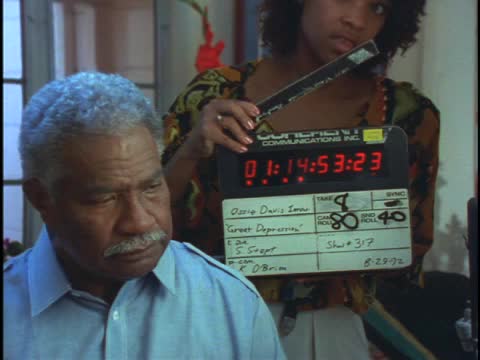
- Transcript
CAMERA CREW MEMBER #2:
OK, change camera rolls seventy-nine, sound roll forty.
CAMERA CREW MEMBER:
Mark it. Thank you.
INTERVIEWER:
OK, again, just a, just briefly actually, because we have the background of it—
OSSIE DAVIS:
Mm-hmm.
INTERVIEWER:
In terms of your reaction to the, sort of the, the movement of black Americans towards Ethiopia, what—?
OSSIE DAVIS:
We thought that something should be done, by everybody, the League of Nations, but also by the black community, to express our help for this great man. It percolated down to my classroom and a friend of mine, Garrett Taylor, and I decided that we wanted to leave school and go and join the Ethiopian army to help fight this great war. But nobody knew exactly which way Ethiopia was and we couldn't get sufficient intelligence or support to leave town with that purpose. So we failed, but it was truly in our hearts to go and help the Ethiopians.
INTERVIEWER:
Now, the Marian Anderson incident in 1939, were you aware that this DAR [Daughters of the American Revolution], that the DAR had in fact turned her away, this great singer, were you aware of it through the newspapers or whatever, and what was your reaction to that incident?
OSSIE DAVIS:
I was aware of it, but not through the newspapers. I was a student at Howard University at that time. She had been invited by the student body at Howard University to come and sing at a church I think, or some other place, but the church burned down. So the thought was, this is Marian Anderson, let's move it to a larger place. But the student body—and I wasn't very active, but we were a part of all that—so we know when she went to try and get Constitution Hall, and
we know what the Daughters of the American Revolution said to her, which was a slap to us as well, and we know the great sense of relief we felt when Harold Ickies and the others said, \"Well if you can't do Constitution Hall,\" and Eleanor Roosevelt too, \"let's go to the Lincoln Memorial.\"
So I was a part of the social ferment surrounding the whole incident. It was to us, political, as well as cultural because of this fact. So, I myself had previously planned to leave college and come to New York on the, sixteenth I guess it was, of April, but it turned out that that was the day that Marian Anderson was going to sing at the Lincoln Memorial. So I delayed my departure from college by one whole week so that, instead of coming to New York, I could be at that Lincoln Memorial with that 75,000 people listening to Marian Anderson sing. Now, here again was a situation that had basic spiritual and religious dimensions. There is a thing about the Lincoln Memorial, when you stand and see him sitting there, and it's awe inspiring. It tends to generate from within the memorial a certain sense of quiet and respect that you feel. And then, there is in
this magnificent woman,
that same sense of being a larger person than life. Marian Anderson was never a star in the star sense, she was always more than that. She was an institution, an icon. To come into her presence, you know, was almost a religious experience, and to see her standing there in that quiet dignity, singing those songs. And we knew what the songs meant, you know, they never had to be explained, they never had to be embellished, but nobody could sing the songs that meant so much to us better than Marian Anderson. So it was almost a holy moment, in this particular place with that tall imposing figure of Lincoln in the background and Marian Anderson standing quietly on the steps. She too was not one for furbelows, or gestures, or anything. She was the quintessence of quiet, self-contained dignity. And every gesture, every word, had a meaning which we all understood, and it went beyond our identity as human beings, it was religious in its dimensions. And there have been other singers, great people, with perhaps even greater voices, but none of them had that quality that Marian Anderson had. She was holy, in a sense. I can imagine people who feel strongly about the Virgin Mary having that sense of awe when she stood in our presence and when she sang. I was always in love with her in that kind of way, that you love something and worship it legitimately at the same time. And it's hard to think of it even now without tears, not tears of sorrow, but the tears of awe at seeing something so great, so sublime, and participating in it. She
blessed us in a way that nothing else could or did,
and that was one of the truly most memorable things that ever happened to me in my life. Marian Anderson singing the songs that took me back to slavery, but also brought me out of it, and set me at a higher level. She was a spiritual resource to black people, and to America, the likes of which seldom appears. That day, that Easter Sunday,
standing there with all those people
and those students,
being lifted over, above, and beyond ourselves on the wings of this voice that just picked us up and carried us.
That woman, Marian Anderson.
INTERVIEWER:
When she sang, you talk about the songs, the spirituals that she sang on that day, what about, there she was at the Lincoln Memorial and she sang of all things after all the indignity that preceded it, she sang, the first thing she sang-
CAMERA CREW MEMBER:
OK.
INTERVIEWER:
All right. The first thing she sang was \"My Country, 'Tis of Thee.\"
OSSIE DAVIS:
Yes.
INTERVIEWER:
It was, it was, I mean correct me if I'm wrong, but it was the white man's song, right?
OSSIE DAVIS:
Yeah.
INTERVIEWER:
My country, \"sweet land of liberty,\" and that's the song she chose to sing first.
OSSIE DAVIS:
Mm-hmm.
INTERVIEWER:
What, what must that have felt like? What about that choice, that-?
OSSIE DAVIS:
It was a very symbolic choice. A part of what we've had to assume as a group responsibility has been to give back to the white man his best and greatest thoughts, to remind him of the magnificence of the vision which he brought to the country and which brought him here, to restore to him his own greatness, and to participate in it. If America is not an extraordinary company, if America is not a paragon of all the virtues, think to what degree that pulls the rug out from under all black struggle.
We can only dignify our struggle by dignifying the objective of that struggle, which is to be included in an America, but it has to be an America that is worth all that we can do and say. So when she sang \"My Country, 'Tis of Thee\" she was reminding the country, \"this is who you truly are, and what has happened to me is a measure of how far you've strayed from that. But this moment let's get back to who you truly are, America.
\"My Country, 'Tis of Thee.\" It's an act of faith that black people have to accept, otherwise we'd go crazy, we'd shoot ourselves, we'd shoot white folks. We have to believe that the original promise of America is still the last best hope on Earth worth preserving no matter what sacrifices we may have to make, because in the end, when it is truly seen who we are and the contribution we made, then all will be well. We live because we know that in the course of time that must happen or America will lose its identity itself and won't be anymore. At the heart of the experience, the American experience, is the black experience, and that's what Marian singing of America, \"My Country, 'Tis of Thee,\" and I felt as she did. I didn't feel all these lynchers, and all these segregators, and all these mean people, and this is their song and their constitution, I'm not going, I'm not going to participate, I'm not—
OSSIE DAVIS:
I'm not going to be a member of that, no, you know. It's a part of—
CAMERA CREW MEMBER:
I'm sorry, sorry we ran out.
CAMERA CREW MEMBER #2:
Take eight.
CAMERA CREW MEMBER:
Thank you.
INTERVIEWER:
OK, so just to finish kind of what you had just, you were just about to conclude, so when she sang that song, \"My Country, 'Tis of Thee,\" what that brought together—
OSSIE DAVIS:
Yeah, Marian's singing of that song was the expression of the affirmation of our faith, black people's faith, and a vision of America that, though it's never been there, it's still real for us. Langston wrote a poem, he said, \"Let America be America again,\" you know, it's that same expression. And, you know, when Martin Luther King and that great \"I Have a Dream\" speech, it is that we see the vision of what America truly is in terms of what America can be, in terms of what it truly is, what it must be, to be what it is, so we don't give up faith. You know, the lynchings come, the riots come, the disappointments come, but we don't give up the faith because we know, that if America does give itself a chance to be itself, then we would be automatically included, and that's all we truly want. Marian sang it for us that day, \"My country, 'tis of thee, that I sing.\"
INTERVIEWER:
Great, thank you. This is kind of a, this is kind of a wild card, but there's some connection here that I can't quite, sort of think this through with me and think through it on film, but is there some connection between Joe Louis and Marian Anderson? Is there some common significance that they had for, not only for black people, but for Americans, is there something about the two, one's an artist, one's a boxer, is there something about that that, I don't know, that it feels like it's all right for that time. There's something about that time that those, that there was these two people, and these great incidents, these great events—
OSSIE DAVIS:
There was something, and you mentioned it when you said, \"the time.\" It was the circumstances, it was the peculiar and particular atmosphere in which we as black folks lived, in which America handled its race relations at that time. We were by and large an oppressed people. We saw ourselves as oppressed peoples, but we were not negative about our oppression. We knew that it was something imposed upon us and we knew that somehow or rather we would someday get rid of it. But oppressed peoples have certain deep needs which must be continually met. Joe Louis and Marian Anderson, and they were only two, helped us to meet the needs of an oppressed people, how not to be destroyed, how not to be the victim although you're, how in spite of what you were involved in you could still see victory and rise towards it, you could still affirm who you truly were in spite of what all the facts said that you were. And we needed it desperately because the country was organized along racial lines in a way that it is not organized now. There was desegregation remember, you know, there was Jim Crow, and there were signs on the water coolers, \"Black Water\" and \"White Water,\" and all that sort of, all the constant reminders of us being forced into an inferior position. We needed to struggle against that, not only socially and politically, but physically and spiritually as well. And it was those people who helped us to struggle against it, but they were not alone. There was Duke Ellington telling us the same thing in music, and there was Bill 'Bojangles' Robinson telling us the same thing in dance. \"You, in spite of all,\" they say, \"you're an excellent people, you're a marvelous people, you're gift giving people, so keep your hands on the plow. Don't give up now, keep at it, good brother. One day it's gonna happen. It must happen in the course of things, that all of this will be wiped away and be made, it will be justified. In the end you will see that all of the suffering was somehow worth it.\" And Joe, Marian, Paul Robeson, a lot of other people, kept telling us that.
INTERVIEWER:
Great, thank you. You can cut now for a second.
CAMERA CREW MEMBER:
Mark it.
CAMERA CREW MEMBER #2:
Take nine.
INTERVIEWER:
So how did African-Americans react to Nazism, and to the plight of the Jews, were they aware that the Jews, that there was danger abroad for the Jews, and did they feel any need to do anything or was that their problem, or how did that work in the black community at the time?
OSSIE DAVIS:
Yeah there was strong awareness of what was happening, in Europe, to the Jews and to others as a result of the Nazi onslaught, and we were aware of it. And one of the reasons we were aware was that there were those in the community who kept us aware. W.E.B. Dubois was an internationalist, you know, and Paul Robeson, a young man named Alfius Hunten. Africanist people who always tried to keep us in contacts, context with what was happening in the world at large. And there was a significant left-wing contribution, there were communist writers and thinkers who were far in advance in terms of describing the Nazi threat than the regular channels of communication, but they were there and they were making an impact, you know. And people like A. Philip Randolph, people like Adam Clayton Powell, they saw what was happening. They saw what was happening, and they knew, and they reminded us that, you know, if they can do this to the Jews, who do you think is going to be next in line? And they told us what the Nazis had done when the Nazis went into France and one of the first things they did was to begin to deface the statues and the things that France had erected in memory of black soldiers in World War I, and we knew that if they got the statues down, if they got to us, you know, we certainly would be in the line of fire. And there was the Lincoln Brigade, a group of Americans who went to Spain early on in order to launch the fight against fascism and Hitler. And in that brigade were black people who fought because they understood very thoroughly what was going on. Langston Hughes, I think, went as a war correspondent, and he reported on what was happening in Spain and black newspapers carried it. So we were very well aware, and remember that Hitler and Mussolini were the thugs and gangsters who had done this desperate deed to Ethiopia, so we certainly hadn't forgiven them for that. Yes, there was a tremendous awareness among us of what was going on, what was happening on the African continent, and there was a tremendous desire on our part that we should do something, that the government should do something. And
I remember,
as non-aggressive as I am, you know when World War II came, I volunteered because I felt that that was the place to be. Oh yeah, we never thought of it as the white man's war, or let them settle it. Some of us did, some of us articulated that, and we had a right to be, to feel badly about it, you know. Even when we got into the army when the war was on, we were still in segregated units and we were still treated as inferior people.
INTERVIEWER:
What about for earlier, before the war started, when the Jews were trying to get into this country and they were being turned away—
OSSIE DAVIS:
Yeah.
INTERVIEWER:
Was there any reaction to that in—?
OSSIE DAVIS:
Yes, there was reaction to that. And remember that—
INTERVIEWER:
Again tell me because they don't here my question. Tell me what the reaction, you know, the reaction to what?
OSSIE DAVIS:
When, the prelude to World War II, you know, was before us, and awful things were happening and the racist, the racist nature of the Nazis was made very plain by what they had done to the Jews. There was not only discussion in our communities, but there were efforts to even help persuade our government, you know, to open up and to be more responsive to the plights. Racism, you know, was a key issue to black folks, always, and when it happened to somebody else, we were very sensitive to that. You know, there were people in the NAACP for example, particularly the youth groups, and we used to meet and discuss what was going on, and to petition government to do something about it. I'm sure that in the broad sense the black community was possibly not any more forward thinking than Americans in terms of organized effort to help the Jews. But there was, in circles, certainly on the college campus where I was, and in the New York community where I came, very articulate expressions of support for the Jewish community, and of protest of what was happening over there, and of protest to our government for not doing more.
OSSIE DAVIS:
I remember, as a young man, you know working in the garment center and going on Saturday to the demonstrations—
INTERVIEWER:
We ran, we ran out.
- Series
- The Great Depression
- Raw Footage
- Interview with Ossie Davis. Part 3
- Producing Organization
- Blackside, Inc.
- Contributing Organization
- Film and Media Archive, Washington University in St. Louis (St. Louis, Missouri)
- AAPB ID
- cpb-aacip/151-dn3zs2kx6p
If you have more information about this item than what is given here, or if you have concerns about this record, we want to know! Contact us, indicating the AAPB ID (cpb-aacip/151-dn3zs2kx6p).
- Description
- Episode Description
- Interview with Ossie Davis conducted for The Great Depression
- Asset type
- Raw Footage
- Genres
- Interview
- Rights
- Copyright Film and Media Archive, Washington University in St. Louis. Licensed under a Creative Commons Attribution-NonCommercial-NoDerivatives 4.0 International Public License (https://creativecommons.org/licenses/by-nc-nd/4.0/legalcode).
- Media type
- Moving Image
- Credits
-
-
Interviewee:
Davis, Ossie
Interviewer: Stept, Stephen
Producing Organization: Blackside, Inc.
- AAPB Contributor Holdings
-
Film & Media Archive, Washington University in St. Louis
Identifier: cpbaacip151rn3028q56p__fma262283int20120529_.h264.mp4 (AAPB Filename)
Generation: Proxy
If you have a copy of this asset and would like us to add it to our catalog, please contact us.
- Citations
- Chicago: “The Great Depression; Interview with Ossie Davis. Part 3,” Film and Media Archive, Washington University in St. Louis, American Archive of Public Broadcasting (GBH and the Library of Congress), Boston, MA and Washington, DC, accessed April 21, 2026, http://americanarchive.org/catalog/cpb-aacip-151-dn3zs2kx6p.
- MLA: “The Great Depression; Interview with Ossie Davis. Part 3.” Film and Media Archive, Washington University in St. Louis, American Archive of Public Broadcasting (GBH and the Library of Congress), Boston, MA and Washington, DC. Web. April 21, 2026. <http://americanarchive.org/catalog/cpb-aacip-151-dn3zs2kx6p>.
- APA: The Great Depression; Interview with Ossie Davis. Part 3. Boston, MA: Film and Media Archive, Washington University in St. Louis, American Archive of Public Broadcasting (GBH and the Library of Congress), Boston, MA and Washington, DC. Retrieved from http://americanarchive.org/catalog/cpb-aacip-151-dn3zs2kx6p