The Great Depression; Interview with Ossie Davis. Part 2
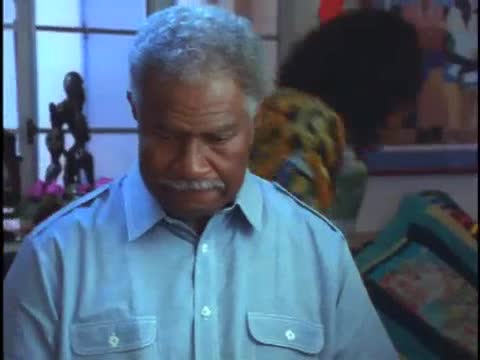
- Transcript
CAMERA CREW MEMBER #2:
Camera roll to seventy-seven, change sound roll to thirty-nine.
CAMERA CREW MEMBER:
Thank you.
INTERVIEWER:
OK, just a couple more questions about Roosevelt. One is, you know in our show we deal a lot with lynching and the Anti-Lynching Law, and the fact that a lynch, an anti-lynching law never passed federally, and Roosevelt never publicly supported it. And so my question always comes around to, if Roosevelt, people loved Roosevelt even though he didn't come out publicly, why did people like Roosevelt if he wasn't publicly supporting a very meaningful civil rights act?
OSSIE DAVIS:
Well we understood that Roosevelt had to rely on a congress that was controlled by Southerners to do anything at all. And I think we also understood that Roosevelt didn't belong to us in the same personal sense that Eleanor Roosevelt did, or Mary McLeod Bethune, whom we looked upon as the kinder faces of the New Deal. We talked about the Anti-Lynch Law, and we wanted it passed, but we were also aware that even had the law passed, we never thought that the law itself would control or tame the Ku Klux Klan, we knew fundamentally that some other thing had to be done. And so we were highly politically motivated, you know to, for the quid pro quo to get what we could, and settle for, you know, what could happen and that which we couldn't get. We decided not to make that the stumbling block, you know, get what you could and keep working toward trying to get that Anti-Lynch Law.
INTERVIEWER:
OK, can you tell me again, and this time without mentioning Mary McLeod Bethune, can you tell me again about Eleanor, what Eleanor Roosevelt meant to people, what she meant to, why, what was she, I mean you alluded to it before but I was afraid we had perhaps a sound problem, if you can tell me about Eleanor again, just what she meant to people?
OSSIE DAVIS:
Well Eleanor Roosevelt meant to black people, and in a sense to the whole of America, the interior spiritual dimension of the New Deal, which I suspect we felt was missing in Franklin because he was such a consummate politician, and such a consummate dealer, quealer[sic] and dealer, that we knew that a lot of the things that we wanted from him, and that he might even promise, would get lost in the shuffle. But we knew on the other hand that there was Eleanor Roosevelt, and she was really where the buck stopped, for us, in the black community. And we always felt that if she guaranteed something, it would happen, and that she was always not only going to be fair, but she was going to go out of her way to make sure that we in the black community were included in everything that happened. I suppose even the fact that we never go the Anti-Lynch Law was made a bit more palatable to us because Eleanor Roosevelt was there, and we knew that she opposed it, and we knew that she would fight against it, and we could depend on her. She was the one who really guaranteed the New Deal, and Franklin Roosevelt, in our community. The buck stopped with Eleanor.
INTERVIEWER:
Great, thank you, thank you. Now I want to talk about Joe Louis.
OSSIE DAVIS:
Ah.
INTERVIEWER:
Again, can you, in these days it's like people, again kids think he's a boxer, you know, why was he such a hero, what was it about Joe Louis that just captivated black folks at that time? What did he mean to people then?
OSSIE DAVIS:
Well, in defense of the young people of today, we have to recognize that that was a different time, and the circumstances of our lives were profoundly different then than they are now. In those days we needed desperately every chance we could to authenticate our value as human beings in the middle of a culture which kept saying, \"No\" to us, which kept pushing us down, which looked upon us as \"niggers,\" as inferiors, and even our white friends, you know, always had, there was something about their appreciation that was paternalistic. We needed, from within ourselves, some affirmation of who we were, and that that picture of us was marvelous and magnificent, and it represented our subconscious wish to be vindicated, wish to be considered as somebody valuable in the world, number one. Number two, since
most of the things that happened to us, in relation to the white community that we objected to, were physical you know, and there were lynchings, and there were beatings, and there were things where physically we had to suffer. Joe Louis coming along
as an example of physical capacity par excellence,
stated our capacity to defend ourselves given a half chance.
And every time he physically beat a white man, we [laughs] beat him too, you know, and it was joyous. This was our revenge for all the things we had suffered, you know. In his fists was our vindication. So it was not only the joy of him as an athlete, we never thought of him as an athlete, he was our
Avenging Angel.
And the very fact that he was sort of inarticulate and never said much, helped the image. We put the words in his mouth, we put the meaning of his actions and everything he did. And I remember the first Schmeling fight before Joe was champion, and how after that twelfth round knock out,
we were stunned, we were voiceless. The agony went beyond words or recrimination.
And first place we knew that Joe had done all he could, he hadn't let us down, he hadn't traduced us, but he was beat. And our Avenging Angel had lost his sword, and our champion, you know, had been knocked into the dirt, and sullied, and begrimed. And so on the other hand, after he did become champion, and Schmeling came again. You know, we sort of knew in advance. We expected that Joe would make up to us and the world for whatever happened back in that first fight, and he did. And the bell rang, you know, it wasn't long before the whole thing was over, and then did our hearts have wings, and our fire in our eyes, and we lost our sense of ourselves because Joe had done for us one more time what needed to be done. And the fact that he had proven not to be a superman, that he had fallen and had been beaten, but had risen up from defeat, you know, and really done such a magnificent thing, only made the triumph all that more wonderful. So it wasn't just little boys seeing a big boy good as an athlete who set an example for what they could do in the ring, it was always more than that. No,
Joe was our
military strength
deployed against the enemy, and knocking them down as fast as they could rise up. He was spiritually necessary to our sense of who we were, to our manhood, to our vision of eventual justice, to our true belief that given one tenth of a chance, there was no field that we couldn't conquer
in. And we knew that the white community, you know, puts a special premium on violence for social ends, the cowboy pictures, you know, where gun play and fist fights, always in defense of somebody's honor or defense of the beautiful maiden, whatever you know, that violence was visited upon the villain. And here was Joe Louis taking that same violence that they used, and using it against them. [laughs] It was about as close to heaven as we could get in Waycross, Georgia in those days without dying. [laughs] Joe was marvelous to us.
INTERVIEWER:
OK, great, thank you. I have one more - how are we doing on footage here?
CAMERA CREW MEMBER:
Go less than a minute here.
INTERVIEWER:
OK, then we should cut and start a new role.
CAMERA CREW MEMBER:
And, mark it.
CAMERA CREW MEMBER #2:
Camera roll seventy-eight.
INTERVIEWER:
OK, again, more about Joe Louis. Can you describe, I assume, I assume that you followed Joe Louis by listening to his fights as they came on the radio, did you listen to it?
OSSIE DAVIS:
Mm-hmm.
INTERVIEWER:
Can you describe what it was like for your family, for your friends, or whatever, to hear Joe Louis fight on the radio, what the feeling was around that on the night of a fight?
OSSIE DAVIS:
Well, my memory seems to put me always in the presence of my classmates or other boys. I don't remember my family in a sense ever listening to a Joe Louis fight, I don't, maybe we didn't have a radio, I'm not sure now, you know. We were not very affluent in those days. But, there was always a group of us, boys normally, who listened to the fight, and, to listen to a fight is a different experience than seeing it on television because in listening you have to supply the images, you know. And we would gather, and the excitement would build for us as we listened to the build-up and whatever was happening, and you know, we would, we would sit tense, and then
when there was a significant blow or anything happened that was worthy of note, we would explode, hit each other on the back, knock each other to the floor, [laughs] we would do violence in our expression of, we would become Joe Louis, and whoever was next to us would be the opponent, you know, you know how boys can do.
And then, you know, we would remember the high spots of the various rounds and we had committed them to memory, so that when the fight was over we would, before we went home, we would replay, and redo every big moment in the fight. But, then of course, it was a spontaneous thing, a sort of tribal ritual, like going to a picnic, or going to a dance, or some big public occasion that you were blessed by participating in. At that time I never thought of the social dynamics or the need of the ego to be massaged, it was an occasion where blessings came down and were shared by us, it was being rich, it was being alive, it was being, it was a part of a brotherhood and a sisterhood of magic, all kinds of possibilities. And then, I remember I would always go home and I would, we would discuss maybe the next day around the dinner table what had happened, and I would listen to Mama and Daddy talk, and though they were fans of Joe Louis, Daddy really was a fan of Jack Johnson, that was his man, you know. And they would talk about the glorious things that had happened, and though we never said it, underneath it all was this thought: that the white man was very superior, and he used his physical prowess as one of the ways to express that superiority which enabled him to dominate the entire world. So we would say to ourselves, \"Well Mr. White Man, if you're all that superior, and you have all that strength and capacity, how is it that you get into the ring and you let a black man knock you down? How can you be superior when you let that happen to you?\" [laughs] So Joe was our lesson in equality, our lesson that we too were valuable and somebody. But the fights themselves were rituals, we could go back and do the fights with Billy Conn, we could do the fights with Schmeling, we could do the fight with Sharkey, we could do the fight with Braddock, you know, and we'd remember the details, and go through the motions each opportunity we had. It was, food, food for the ego and food for the soul at the same time.
INTERVIEWER:
Now tell me in that same, you know, since he meant so much, how did the whites feel about him, how did the whites around, around feel about him? Was he a threat, was he-?
OSSIE DAVIS:
I, no I don't remember that the white community felt that he was a threat. There was a kind of pride that they too expressed, you know. Racial relationships, particularly in the South, a very complex set of circumstances. They too sometimes, maybe they would drive by the house and stop for something, and they would say, \"Did you hear the fight?\" Joe Louis, of course, usually it would be [laughs] somebody from out of the country, Primo Carnera or somebody like that. Joe Louis knocked out somebody who was not an American, and he would defend the country's honor. So as Southerners we joined together. The fights sometimes gave us those moments where whites and blacks could step a little beyond the area and be a little bit more familiar with each other because, you know, Joe Louis is something we sort of had in common.
INTERVIEWER:
Great, thank you. Do you think Joe had a, I mean you sort of alluded to it about the, you know, when he fought Schmeling and Carnera, do you think he had a broader meaning for Americans at large? And I'm not just thinking of the black community, but the nation, so to speak.
OSSIE DAVIS:
Oh, yeah, oh, yes. The, [coughs] the American community has never denied the prowess of the black athlete or the black artist. It was only that they always insisted that it be put in the context of racism, and that it could only go so high. But man they would bet on a champion, and put their money on a black champion as soon as they would on a white one, and feel the satisfaction, you know, \"Oh my lord,\" I should really talk man, \"My nigger,\" you know, and have that sense of ownership, that sense of pride when something you own, who therefore represents you and your interests, has done very well. I don't remember, the Jack Johnson era. I do know that after Jack Johnson did win, from Jeffries I guess it was, that eleven black folks were killed that night because the black man was a threat and all that. Somehow, either we had advanced when Joe Louis came along, or something about Joe's persona was not threatening. Jack of course was a very threatening individual to anybody, black or white. Joe, on the other hand, was never beyond the good, kind, gentle negro, who wouldn't hurt a fly. And this is who he truly was. Therefore, he wasn't as much of a threat, for example, he was not as much of a threat as Muhammad Ali got to be because Muhammad Ali was articulate and expressed point. Joe I don't think ever did that, he just let his fists and his capacity take care of business, speak for him. They did speak for him, and they spoke for us, and they spoke for white Americans too.
INTERVIEWER:
How we doing on—?
CAMERA CREW MEMBER:
Two minutes, two-and-a-half minutes.
INTERVIEWER:
You mentioned, in our conversation before briefly, that when Italy marched on Ethiopia—
OSSIE DAVIS:
Mm-hmm.
INTERVIEWER:
—you and friends of yours had a reaction to that, what was, what was your reaction to the events?
OSSIE DAVIS:
We, we had been following what was happening in Ethiopia long before, well not long, but we knew the raids and the war didn't come all of the sudden. We had known through Haile Selassie, who became a hero to us, brought to us essentially by the black press long before the catastrophic things happened to him and his country. So there was, among us, a feeling of identity that this man, you know, the beauty of the man, and the beard, and the way he expressed himself as \"The Lion of Judah,\" and the son of the Queen of Sheba, you know, that he was a part of our history. And Ethiopia was one of the two countries in Africa that had not been colonized, it was still a free country. So we had a lot of emotional baggage invested in Ethiopia and what happened to it. And also Haile Selassie knew how to direct his plea for help to the American people, he knew how to speak so that everybody would listen, he was somebody on the world stage, bearing in mind that during the Depression you had great personalities on the world stage, you know, Hitler, Roosevelt, Mussolini to mention only three. Well Haile Selassie was one of those people who could speak and express himself.
INTERVIEWER:
So when he was threatened what did you—?
OSSIE DAVIS:
When he was threatened—
INTERVIEWER:
What was your reaction to, and I know there were people in this country who volunteered to go. Were you part of that? Did you think about that?
OSSIE DAVIS:
Well I thought about that, but before we get to that, the war came to us, World War II sort of came to us in Haile Selassie's image, to the black community more than it did as a general threat, which it became later on. And I was in high school, and a friend of mine and I decided when the invasion took place, I think it was '35, or whatever it was, that we wanted to go and fight with Haile Selassie, with the Ethiopians, but-
CAMERA CREW MEMBER:
Let's stop there.
INTERVIEWER:
Oh, well we'll start, we'll pick up—
OSSIE DAVIS:
OK.
- Series
- The Great Depression
- Raw Footage
- Interview with Ossie Davis. Part 2
- Producing Organization
- Blackside, Inc.
- Contributing Organization
- Film and Media Archive, Washington University in St. Louis (St. Louis, Missouri)
- AAPB ID
- cpb-aacip/151-b56d21s47b
If you have more information about this item than what is given here, or if you have concerns about this record, we want to know! Contact us, indicating the AAPB ID (cpb-aacip/151-b56d21s47b).
- Description
- Episode Description
- Interview with Ossie Davis conducted for The Great Depression
- Asset type
- Raw Footage
- Genres
- Interview
- Rights
- Copyright Film and Media Archive, Washington University in St. Louis. Licensed under a Creative Commons Attribution-NonCommercial-NoDerivatives 4.0 International Public License (https://creativecommons.org/licenses/by-nc-nd/4.0/legalcode).
- Media type
- Moving Image
- Credits
-
-
Interviewee:
Davis, Ossie
Interviewer: Stept, Stephen
Producing Organization: Blackside, Inc.
- AAPB Contributor Holdings
-
Film & Media Archive, Washington University in St. Louis
Identifier: cpbaacip151rn3028q56p__fma262282int20120529_.h264.mp4 (AAPB Filename)
Generation: Proxy
If you have a copy of this asset and would like us to add it to our catalog, please contact us.
- Citations
- Chicago: “The Great Depression; Interview with Ossie Davis. Part 2,” Film and Media Archive, Washington University in St. Louis, American Archive of Public Broadcasting (GBH and the Library of Congress), Boston, MA and Washington, DC, accessed April 21, 2026, http://americanarchive.org/catalog/cpb-aacip-151-b56d21s47b.
- MLA: “The Great Depression; Interview with Ossie Davis. Part 2.” Film and Media Archive, Washington University in St. Louis, American Archive of Public Broadcasting (GBH and the Library of Congress), Boston, MA and Washington, DC. Web. April 21, 2026. <http://americanarchive.org/catalog/cpb-aacip-151-b56d21s47b>.
- APA: The Great Depression; Interview with Ossie Davis. Part 2. Boston, MA: Film and Media Archive, Washington University in St. Louis, American Archive of Public Broadcasting (GBH and the Library of Congress), Boston, MA and Washington, DC. Retrieved from http://americanarchive.org/catalog/cpb-aacip-151-b56d21s47b