Education and Race Relations; The Social Psychology of Prejudice; 3
- Transcript
No. I am Professor Caro seeis of the Lincoln filing center at Tufts University. At the session we shall take a close look at the nature of prejudice the harsh fact of American life. Our special lecturer is Professor Thomas Pettigrew of the department of social psychology at Harvard University. He is the author of a profile of the negro America which you will find listed in your study guide and discussion outline. Professor Pettigrew will define and describe the phenomenon of prejudice.
He will also outline some of the ways in which intergroup prejudices can be alleviated. Dr. Pettigrew. Prejudice is a tragic fact of American life as we see in these hate filled faces of our fellow Americans in both the north and size of our nation. Like many other nations is unfortunately far from freeing itself from the eroding cancer of any group prejudice. Let's then take a closer look at this serious problem within our midst. But we can speak of a favorable prejudice. The term generally refers to negative feelings in a popular phrase. Prejudice means being down on something you're not up on. It means in short hostility toward a whole group of people more precisely. Social psychologists specify seven common attributes of any group prejudice in this technical definition. Prejudice is an emotional categorical mode of mental
functioning which involves rigid prejudgment and misjudgment of human groups. It is emotional because it includes both unrealistic hostility and anxiety. It is a categorical mode of mental functioning because it invariably involves an overgeneralized mode of thought that does not allow for the great range of individual differences and is rigid because prejudiced ideas typically are not altered even when conclusively demonstrated to be in error. It involves both prejudgment and misjudgment of human groups because it is far too hasty and generally wrong in its sweeping descriptions of the dislike. So defined prejudice has naturally become a dirty word in America. Virtually no one wants to admit publicly to being prejudice. Least of all those who are in fact the most prejudiced witness the supporters of
racist politicians from Boston to Montgomery to Los Angeles. They speak of their bigoted candidates not as prejudiced but as courageous witness to the hate groups who oppose the racial desegregation of schools in New York City they speak only of defending the supposedly hollowed principle of neighborhood schools while in a silence they speak ironically enough of only trying to prevent racial violence. Now another complication is that prejudice is a mode of thinking does not necessarily translate itself into any particular action. A few prejudiced people manage to keep their attitudes to themselves actually. Most however act them out somehow. But in a variety of ways. Thus bigots may simply engage in occasional untag mystic talk or they may avoid the group as much as possible or they may actively discriminate against the rejected group or even physically attack them and carried to the extreme as in the madness of a Hitler
attempt to exterminate them. Now that confusion often arises here between prejudice on the one hand and discrimination on the other prejudices we have just noted is a way of thinking while discrimination is an overt way of acting against members of an AI group. Normally these two phenomena are closely related of course. Example most white people who are any negro engage in one or more types of infringement upon the negro's rights and education appointment on housing and in turn most racial discrimination is committed by prejudiced individuals. But the two phenomena should always be carefully delineated since the situation may determine behavior despite a person's attitudes. For example some unprejudiced persons in Mississippi find it difficult not to contribute to discrimination and some prejudiced persons in Hawaii find it at least more difficult than usual to discriminate. No mention of the importance of different situations raises another significant aspect of
this phenomenon we call prejudice. Typically we think about prejudice in terms of just psychological considerations in terms of an individual bigot and his particular personality. But there are many useful ways to approach the problem. Professor Gordon Allport in his definitive volume the nature of prejudice provides us with a listing of six broad approaches. First the historical approach outlines the scope and direction of the process in bold and sweeping strokes without historical considerations for example. It is difficult to explain why certain distinguishable groups such as say Negroes and Indians are selected for hostile attention and not others such as redheads. Second the social cultural approach begins to bring the whole arsenal of economic political and social logical tools of analysis upon the problem without social cultural considerations for instance it becomes impossible to understand
why the current Negro American revolution erupted in the 1960s instead of 30 or 40 years ago. All ports third approach the situational approach reminds us of the same people often act quite differently in two contrasting situations. Thus an anti-semantic college student generally does not respond the same way to a Jewish student in the chemistry laboratory as he does say in his discriminatory social fraternity. The fourth approach the personality approach in a deuce is for the first time considerations of the individual baking. We shall return to this well-known approach in just a minute. The fifth approach the phenomenological approach refers to viewing prejudice through the eyes of the bigot. How does the bigoted individual regard the world around him and the object of his prejudice. For a realistic appraisal the results of this approach must be compared with those from all ports 6 and final approach to the study of prejudice. The
stimulus object approach. Here the victim of the prejudice is studied and answers the sought to such questions as how much truth is there to the negative stereotypes held by bigots about Jewish Americans. And what are the effects of prejudice upon its victims. This last question incidentally will be the focus of my second lecture in this series. Now the point of all ports scheme is clear and important. No one theory or approach can do justice to the complexity of the phenomenon of prejudice. Consequently when we hear people casually explain away racial prejudice in the United States solely in terms of past slavery or economics or any one simple and sovereign factor we can be sure the explanation is woefully inadequate. In short a complex phenomenon demands a complex explanation. Now to return to the fourth approach to prejudice the personality approach
Allport writes volume prejudice may become a part of one's life tissue suffusing character because it is essential to the economy of a life. It does not always act in this way for some prejudices or merely conformity and essentially unrelated to the personality as a whole. Now from the personality point of view than one distinctive type of prejudice involves conformity simply going along with the intolerant crowd. But the other type is a deeply rooted prejudice. When an insecure individual uses prejudice like a crutch upon which to limp through life conformity and the crutch let's look at these two polar opposite types of prejudice more carefully. The Krauts type personality has been the object of intensive research by social psychologists in recent decades. One of their principal conclusions is that the basic
problem of the crutch type individual is a lack of insight into his own behavior and feelings. A refusal to look inside of himself now stemming largely from his training as a trial the courts type person refuses to accept his own emotions and tries to deny that they are his for example as a child the crutch type individual may have frequently been punished by a stern father and in turn felt intense hatred for him. But being unable to express his hatred for fear of further punishment the crunch time found these aggressive emotions threatening and unacceptable denied them. And instead he began to see in others his own aggressive feelings. Thus he learned early to see in others or in psychological terms to project onto others his own unacceptable feelings and emotions if he felt hatred voiced father that he would see hatred not in himself but in others and in the dangerous outside world. Of course you and I can remember having had aggressive feelings toward our parents at one time or another
particularly when I found it necessary to punish us. But the significant feature of the cuts type person is that he has difficulty remembering such times. You deny that these feelings ever existed. Indeed if you ask such types to describe their parents they will typically paint a picture of absolutely perfect and loving parents. While most of us have a differentiated image of our parents we can see them as human with some faults as well as virtues. They're carrying over this idealized picture of his parents to other authorities. The crutch type person tends to view the world in good bad up and down power times. Yes generally outwardly submissive even obsequious toward those he views as authorities were power over him. Likewise he is a grassy toward those he views as being beneath him in status. Now this dual attitude toward authority really you see two sides of the same coin. I was lead social psychologist to call the Christ type individual an authoritarian
personality. Now we can see our prejudice is needed as a crutch by these people lacking insight into their inner feelings. They anxiously project their own hatred sexual impulses greed and ambition on new mothers that they view as being beneath them. Negroes are seen as too happy go lucky too lazy and too sexually uninhibited traits that is sometimes attractive to him. So also juiciness too hard working too greedy too ambitious. Other traits that sometimes attracting such people are not just prejudice against these two groups they are frequently against many groups that are different from their own. Indeed one investigator gave a questionnaire that measured prejudice through sample of Crouch type students and included in it two groups that do not even exist. The PI reunions and the loans and you guessed it the credit types didn't like they made. Now in sharp contrast to this deeply rooted generalized prejudice the conforming bigot needs prejudice only as a means of getting along with his
friends as a sort of social entrance ticket. He wants very much to be light and accepted by people around him. And if people around him are any negro he adopts their attitudes. But notice the two important differences between the conformity and the crotch varieties and power. First the individual who is prejudice for conformity reasons will have an tip of the ONLY for those groups that it is fashionable to dislike. His prejudice will not spread and generalize to a great variety of groups as in the case of the crotch type conforming individual wants to take the path of least resistance. He needs to be liked not to hate so he could never be caught showing animosity toward a group that is not generally looked down upon in his culture. Second conformity prejudice is not deeply rooted in childhood experiences but is simply an attempt at living up to what others expect. Thus once the culture and the opinions of friends change and consequently what is expected of him by others is altered
the conforming they get. Unlike the crotch type sheds his bigotry with relative ease goes right on conforming of course but that customs and culture to which he is conforming have changed. I don't understand how these two types of prejudice people fit into the present racial scene. Let's watch two residents of a typical northern city the first a crutch type and the second a conformity type commenting on the attempts by their school system to alleviate de-facto school segregation. We'll ask John Gibson to play first the bow of the crunch time. It's a terrible thing. All these colored people forcing their way into our schools. I don't like our group came here a long time ago. Nobody helped us we made it our own way. We came up the hard way too. I don't know everything you hear these days about well rights of negroes rights of the colored people. What about the white man's rights. Well I don't stand for this I'm going I can I just not going to take it. I'm going to fight back. I'm going to
send my kids to school with all these pushy loud mouth the colored kids I'm just not going to have I don't know I don't what's happening the world today all the changes are taking place I'm going to put up with it. I'm just not going to happen. Now let's ask bilk a very serious to be the conformity kind. Well this sure is a lot of fuss these days about neighborhood schools and Negro youngsters. I'll be glad when it's done. I must confess though that there are enough a lot of white neighbors on my street that hope and don't like the fact that all these Negro new Negro kids are moving into the neighborhood and going to the school across the street. But you know there things are looking all right there's not too much noise and I don't hear anybody at the PTA yelling too loudly about what's going on. And you know if you see these kids
walking down the street they're holding hands and things look pretty good you know. You know Suffer the little children to lead us to the solution. These kids are going to solve the problem. You know in spite of us old adults. You're seeing these two people raises the key question How can any group prejudice be reduced and it's possible eliminate it. Conventional wisdom holds that the most effective route lies in attacking the prejudiced attitude to head on with facts and rational argument. This method would lead us to point out to the crutch type nigger folk that granting negroes their just rights as American citizens does not detract from the rights of white Americans and that's discrimination against Negroes in schools jobs and housing be perversely seen somehow as a constitutional right of white Americans. Rational argument approach would also lead us to point out to the bigot that is history of immigration to the United States is a bit muddled. While most immigrant groups upon
arriving in America faced prejudice and discrimination to be sure no other group in our nation has ever enjoyed 200 years of debilitating slavery and 100 years of degrading segregation. Moreover nor American group has ever made it on its own. All of us want our opportunities for education employment and housing. In part because other Americans of many ethnic backgrounds believe the American dream of equality should apply to us all. Now these are some of the rational answers to a crisis type friend. But our effective you really think such a head on attack is likely to be you know the conventional wisdom approach is not likely to succeed. Indeed it may actually make the predators individual more defensive adamant and irrational than ever. Vast body of psychological data indicates that when confronted with it head on arguments like these prejudiced individuals tend to avoid the message altogether.
Or they deny the relevance of the message for them or they find ways of twisting the meaning of them as a rational intellectual approach can hardly prove an effective antidote to a basically irrational emotional phenomena such as prejudice. What then does work to reduce prejudice. Social psychological research strongly suggests that it is far easier to change attitudes by first modifying behavior as opposed to directly attacking attitudes in order to change behavior. Put succinctly behaving differently is more typically the precursor to thinking differently. It was a well administered newly desegregated school is likely to achieve more improvement in racial attitudes than all the so-called inner cultural materials segregated schools curriculum could ever muster. This is why actual interracial contact in the classroom is so vital. This is why actual interracial
education cannot be compensated for by special materials or advanced remedial techniques. From this vantage point we can now understand why social psychologists are so skeptical about attempts to reduce prejudice which involve only stiff and formal. In a group contact and heavy reliance on exportation consider Brotherhood we can Brotherhood dinners in particular these events do serve some useful functions. They remind us of a true religious national ideals and they certainly strengthen the determination of the already convinced to achieve these ideals in their daily lives. But as a means of convincing the unconvinced of altering prejudiced attitudes and ending discrimination they appear dubious value at best. Worse yet by attending the annual Brotherhood dinner and paying the tax deductible fifty one hundred dollars per plate. Many prejudice individuals regularly relieve their guilt having gone through the
motions. They are free to go right on discriminating as before. Consequently social psychologists agree that the wrecked action and actual desegregation not socials and then ER's are the most effective means to combat prejudice and discrimination in American life now by direct action I mean activities that break out of the old patterns of race relations where whites are always in a superior social status to that of Negroes. I mean any discrimination laws which are rigorously enforced private citizens fair housing practices committee sit ins and other nonviolent protest for change direct actions and actual desegregation. Unlike more speeches and awards for brotherhood attempt to change behavior not attitudes first. To sum up in a group prejudice is a tragic fact of American life. We have defined and described the phenomena distinguished it from discrimination and pointed out that there are
six major approaches to the study of prejudice. We have also detailed two contrasting types of prejudiced individuals crutch type bigot who needs prejudice like a crutch upon which to limp through life and the conforming bigot who uses prejudice as a social entrance ticket. Finally we have noted the far greater efficacy of restructuring behavior to reduce prejudice to attitudes rather than attacking prejudiced attitudes head on with facts and rational arguments. Direct action and actual desegregation are two effective methods for restructuring behavior and are now achieving the long awaited reductions in racial prejudice where mere words and sentiments have failed. Dr. Gallagher in your discussion. Isn't there a danger of over simplification when you divided the bigots into
the category of Dr. Gibson's type than my type. It seems to me that there are a great variety of bigots for example I had a caller the other day as did my colleagues from a suburban housewife in treating us to protest against some action in the inner city. And I had I couldn't refrain from from saying to this ambitious housewife What about the number of Jews living in your community what about the number of negroes living in your community there weren't any. And yet here is this I would call pseudo liberal in treating us to join forces and to marshal our energies to help the inner city negro. Isn't this another type biology. Well I think it fits into this in the type ology. I'm glad you said oversimplified it indeed it is. I slipped in the word poll I think there are two polar types we've been talking about in the current state conformity type.
But most of us would be somewhere in between straight state. A lady to refer of course is typical of a great many people she falls somewhere in between I would say much closer perhaps to the conformity type. It's probably the thing to do in her suburb to scream Oh what a terrible situation it is in the inner city and it's also the conforming thing to do not to question the discrimination goes on in their own suburb. I did what kind of response did you get when you ask her well what about the fact there are no Jews in a blood group spawn of black responds the way he conformed and yet I don't want to be accused of discriminatory action herself. But I want to believe I'd like to tell if I like you help anywhere along the line. You're blind I think we've got to understand it. I do like your rather subtle reference to the guilt ridden type. I notice that in the summer of 65 there were a number of suburban
communities in the Boston area that imported Negroes for summer term and school and I am afraid they exported them after the summer. It seems to me that many of the people who contributed their dollars for this particular venture were doing so under a kind of guilt feeling. Well I think guilt a fine thing as a psychologist. It's what we get done with that guilt. Now I think these are summer programs are of course very useful. Like yourself I'd like to see them extended on a regular school year. And of course they have been going on in the suburbs. That's right United States not just in the Boston area but my complaint about brotherhood donors and their ilk is simply that it's a waste of all that perfectly good honest guilt where for fifty or hundred dollars and tax deductible no less you get relieved annually it's a very convenient
thing. You can just put your guilt feelings and go right on as before now you want to profit with guilt. I want to help change racial discrimination. I don't quite agree with your analysis of some of the summer programs where they bring in some Negro children out into the suburban communities. I think this is a rather important thing because I think it's not a fundamental question not just a just a minute. We're talking about getting as Dr. Pettigrew said a behavioral understanding of different people and I think that the kind of intermingling of young people might well make a start toward understanding each other's behaviors even though the negro's still go off and back into the inner city. There still is a lot of communication as a line of understanding and I think Dr. curtain in his program later in the series is going to talk about some of these co-curricular activities of a summer nature and of an all year around nature that helps too. Dissipate or to mitigate the discriminatory patterns of behavior by bringing young children together of different races.
You don't think this might mount the problem in a certain way. Let's say the answers come out have a certain experience of suburbia and then go back to the terrible schools where the problem exists in the first place. What I think that's that if that happened that would be my definition for success. That is that the child really see what he's missing. And then of course the frustration and the explosive level of the ghetto will be all that great but that's what it should be. If in fact they're going to be discriminated in the way they are typically discriminated against in the United States they should know what they're missing. And so I think that a little taste of suburbia here is just what's called for you don't think that with the TV being what these people are really very sensitive and aware to what they're missing. They don't have to go to suburbia they have cars that I think I think they're aware in part but I think there's nothing like being there yourself. You're suggesting that the concrete experience of going through it would you think that the inner city would be quite content to have suburbia absorb these youngsters so that they can evade
just responsibility you know married to schools and I do have a very serious but you know the fact that the inner inner city is getting paid per child per day of state and federal subsidies. They lose a child in the suburbs are actually losing money from their school system and since they typically spend less and the subsidies often for the disadvantaged child they actually are losing something in their system so they're not quite as anxious as you might think to get help. But let me let me let me just play all three types. There are two different. Type ologies I like to get into let's say this other type which I would identify as the prejudiced type. It seems to me that there are many youngsters many individuals who become somewhat irrational with the kind of love prejudice. As you look at crime statistics there might be many people who would deny for example the higher proportion of crime in the adolescent negro category and say that this is not
so when actually the statistics do indicate that there's a great deal more aggressiveness in this particular group. Of course there are people these people aren't prejudiced in the negative sense in which I've defined it. So he wouldn't come in this continuum but in fact as you suggest I think. They don't do a service to the Negro American or anyone else by attempting to deny or obscure the facts which really form the problems that we have to face. I don't see them as much for a problem to tell you this time they are in the societal scene I do. The organized bigotry that we have to face. But I would say that seems to me the type you're describing quite well sort of denying liberal and denying. The facts. Not only is it a disservice but it seems to me that leaves the primary argument that you can make and that I think should be made for desegregation. That is the
danger of increased crime among Negroes in the ghetto of their poor health due to poor medical facilities etc. and lower income lower IQ test scores not because they are innately less intelligent as experiments and testing them shown time after time but because of their poor opportunities in a ghetto. These are the data. These are the stuff. Right which I think is the argument is best made that we have to have the segregation and that separation and segregation of the past led to these dating liberals who try to obscure that seem to me to miss the whole point of what desegregation is all about. May I get back to myself as a grouch made my position classic much bigot. I am a person who says you know that my group came early nobody helped us along and so on and so forth and you pointed out that I can logically psychologically this is important I mean I think we may in our heart I'm making a point here Doctor. Psychologically this is important for me that was one of the issues you pointed out but
economically might it not be important to me in other words isn't there a functional type of prejudice that goes over the psychological comfortable ness of this kind of behavior. I'm worried about the other group moving up who might want to take my job. I'm worried about the group coming up which might want to be a political force politically forceful in the community and so forth. In other words aren't some of these other dimensions of prejudice important as well. They are indeed they would come under the social cultural approach that was just mentioned briefly and lest all of these functions of course prejudice can serve simultaneously for the court's type as you portray it. So while the fact is some of the functions that are being served could be deeply rooted. Functions that come from really rooted from childhood or they could be economic in the job and so forth. Typically you know it's a fact that the Negro is threatening almost no jobs and people now are whole but the people holding the jobs think they're threatened. And that's what's really important. Housing and so it
was this is why the O-Port approach phenomenological is so important. It's not really the reality of the situation that was crucial in the derivation of prejudice so much as how are the people in the situation view it. They assumption that they're going to lose their jobs when they grow does better is based on the idea that the American economy is going to be the same size pot has never stayed the same size in American history yet there's every reason to believe that the American economy as a matter of fact relatively minor expansion in the law and the labor force what is predicted would have would have soared. Virtually all the negro part which you do gentlemen have put your finger on the economic and the political. How about the sexual fear. You alluded to this. Do you want to expand. Well it's a complex business but I think again we have the sexual difficulties that many prejudice people themselves have are projected onto. But it's not so simple as you are indicating.
I think it has its historical roots frankly from slavery where the Negro family system was systematically destroyed and where it was better exploited first destroyed then exploited for the economic gain of slave owners who actually stood to gain from the miscue snus on the part about how to help your doctor like in his discussion of American history might be one of the family aspect of this and how it affects the contemporary situation in inner cities and race relations so I think he indicated his intent in this particular direction. But as you say it isn't simple it wasn't my implication that it was simple. I have a fear that the kind of personification that you receive but your excellent acting and I think if you don't receive an award I'll be surprised. Second Emmy for that of course I have a feeling that the projection of the sexual inadequacies of many whites in terms
of the problems of the powers visible in the Negro community in the negro male of female does show in much of the phenomenon that you are concerned with. Oh I think guys definitely there are. I would not say that it is the central rooted concern of the United States. I wouldn't say that about anyone concerned would you say it's the fear concern. I would say it among economic deprivation fear of political power fear. I would say Thanks but I would say well it's a complex this is not a unitary problem but it seems to me that this has somewhat a central position that I get into another line of fragrances problem I gather. I wouldn't say that at all sir. I would like to compliment Dr. Pettigrew in pointing out the difference between prejudice and
discrimination because you hear these two terms interrelated one quite obviously you said the prejudice concerns the thoughts and the attitudes and values in the mind. Discrimination concerns the overt behavior and you pointed out that these two go hand in hand for the most part. And you also pointed out that if you bring people together behavior early in terms of overt behavior then this might be a key point in reducing prejudicial. Activity in the mind itself does not mean finding certain conditions hall which I want to talk about and what about what about the armed services is there any evidence or any data available that say essentially this is a context in which people were forced to behave man of course to behave in a racially. What about that. The armed services I'm glad you mention it's are a classic case that led to the principle that I was putting forward of the stand of principle because it's a rather intriguing one you put something into the cut people off to the hospital with a cut. How about stating the principle that it is easier to change behavior first. And that
attitude change will follow as a consequence of that and then it is to try to batter down the attitudes so that behavior can change I think the attitude change first is conventional wisdom the way you go about it and brotherhood enters in any house or set up on this basis in social psychological data are very clear and the army is the best example you can cite I think of the principle that it works much better the other way doesn't say it it's impossible to work the conventional wisdom way wanted real integration begin the arm 1740 know what happened after that time. Well it took time of course for it to seep down through each of the services and maybe it was last but. DAY TO DAY IT IS OUR one of our chief sources of prejudice reduction in American society. This is sort of forced integration though as there was a higher authority and you referred to me in terms of a crutch bigot as having an authoritarian personality. Wouldn't
an authoritarian personality be inclined to accept the authority of the federal government in terms of such things as well the Civil Rights Act and the voting law and so on and so forth. Doesn't he like the law and doesn't like to abide by the law and therefore can't the law itself change his prejudicial thinking and his discriminatory behavior. Wow I wish you did always want to abide by the law but you raise a good point but the difference between the army and the general American society in the army or any other in the armed services the authorities supporting desegregation. It's unanimous. There is no there's no one general saying well we've got to desegregate another general saying no we have to have separation and then the authoritarian kind of course pick out that man who's giving the orders which are closest to his own feelings in the American societal situation where the federal government pressure is certainly achieving first class citizenship for Negroes. That isn't always supported with other
governmental concerns often state suppose it does in my native South or in the Northwest states are often pro-civil rights to in the local communities or on a school committee or school board or in the city council or something of this order you will get that's already authorities that are quite visible in the press and so forth who in fact oppose the general so that the authoritarian seeing this differentiated type of leadership can still pick out what is most suitable to him. I think perhaps the best example of what you're talking about is visible in Ataturk's Turkey. Having worked in that country it's amazing to see how many changes were brought about through national edict from the point of view of language dress because I take it you're referring to come out of Turkey came into power in 1922 and died in 1030 in Turkey and during that period forced upon his society a good deal of change that brought about modernization of the Turkish people.
Listen very well I see a teaching of the United again as in Turkey Turkey I don't think so. Maybe it's because it is probably been you're talking about forced change so in effect well the kind of changes the doctor has indicated May I switch the discussion of that. He did that incidentally with the opposition of traditional leaders which makes this feat of modernizing Turkey in 20 years all the more amazing. Yes may I switch the discussion in a slightly different direction. You assisted us on campus this past summer of 65. Institute for teachers of underprivileged disadvantage youngsters and I said why don't you know they're all inner city teachers. I hope that as you work with us you notice that in our end effect we had a kind of polarization of teachers that as we try to
measure outcomes of this special instance this seven week effort it seemed to me that we could no and we have some data along these lines that those who had some prejudice prejudice became perhaps more prejudiced and those who have had some love became more loving and maybe prejudiced although we did shift the whole group I'm glad to cite in terms of human heartedness up the scale. What would your reaction be to this kind of phenomenon that polarizes further. You know good effort in attempts to help teachers be better teachers and meet the needs of youngsters who come from deprived areas. Well you made the issue of cultural deprivation and. Lesser problems of the Negro American child in particular are salient issues. So they had to organize themselves and their former attitude somehow around this issue which became so central throughout your summer program. Some moved with you and some against you. But all of them I take it are virtually all of them
did react showing the force of the saying Now the fact that you didn't get a uniform or uniform response and a larger response is I think because in fact this was the more conventional attack on change that is going at attitudes primarily first you know the first meeting of this. The series I made mention of the use of the word race in quotes and I note that in your volume on of the profile of the Negro American the term talk about race they talk about race as a dangerous myth. Could you enough in one sentence say something about that. Well any There is no such thing as a pure right and have apologist or even sure if you could ever locate a pure race in ancient civilization. So the whole idea here is based on a pseudo scientific notion that has led to the extermination of six million Jews. I think for one concept that's about as much damage as you can and you've pointed out that this was evidenced
by the extremism of this poll by Adolph Hitler himself that this was taking a racial definition much too far and I think that a number of other people who we have invited to appear with us on our series similarly have taken this kind of definition of race and it's awfully good to see which was their own definition on the previous two sections. Yes unfortunately you're coming back once more. It is and it will be possible for us I hope to return to this particular topic and also to explore this with more reference to the school as a particular agency in the community. I think there are good many questions that I'm sure you have. Dr. Gibson is an excellent actor. But you are. Well I appreciate your comments very much and I sort of look forward to the discussion session that we will have with educators. Following up Dr. Pettigrew has made I guess one more question. Go right ahead sir. Well. Let me go back to the melting pot idea. The United States is a
melting pot how about race in this context. Well I'm not sure it's quite the melting pot that we sometimes think it has had the melting pot is still brewing you might say and the final products I mean the negro of course has been there. They you know at least adjustable part of that melting pot. But one by one the major groups who were seen at one time in American history as major threats to the American consensus. First of Roman Catholics and Jewish Americans and now find we do not expect this. I've been included in next session I don't think there's any doubt of the trend that negroes too would include we appreciate your presentation today and we look forward to the next one Dr. Pettigrew of the university. Yes.
- Series
- Education and Race Relations
- Episode Number
- 3
- Contributing Organization
- WGBH (Boston, Massachusetts)
- AAPB ID
- cpb-aacip-15-9zp3w06n
If you have more information about this item than what is given here, or if you have concerns about this record, we want to know! Contact us, indicating the AAPB ID (cpb-aacip-15-9zp3w06n).
- Description
- Episode Description
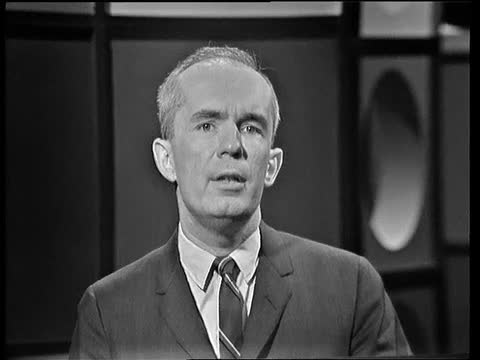
- Lecture concerning the nature of prejudice by Thomas Pettigrew, Associate Professor of of Social Psychology, Harvard University. Recorded in the WGBH Studios 9/23/1965, B&W, Directed by Allan Hinderstein.
- Date
- 1965-09-23
- Topics
- Education
- Race and Ethnicity
- Subjects
- race relations; prejudices; Education; Race; Segregation in education United States; Public schools United States; School integration; African Americans Education
- Rights
- Rights Note:It is the responsibility of a production to investigate and re-clear all rights before re-use in any project.,Rights Type:All,Rights Credit:WGBH Educational Foundation,Rights Holder:WGBH Educational Foundation
- Rights Note:Media not to be released to Open Vault.,Rights Type:Web,Rights Credit:,Rights Holder:
- Media type
- Moving Image
- Duration
- 00:44:55
- Credits
-
-
Publisher: WGBH Educational Foundation
Publisher: WGBH Educational Foundation
- AAPB Contributor Holdings
-
WGBH
Identifier: cpb-aacip-eb61a89afd3 (unknown)
Format: video/quicktime
Color: B&W
Duration: 00:44:55;06
If you have a copy of this asset and would like us to add it to our catalog, please contact us.
- Citations
- Chicago: “Education and Race Relations; The Social Psychology of Prejudice; 3,” 1965-09-23, WGBH, American Archive of Public Broadcasting (GBH and the Library of Congress), Boston, MA and Washington, DC, accessed March 18, 2026, http://americanarchive.org/catalog/cpb-aacip-15-9zp3w06n.
- MLA: “Education and Race Relations; The Social Psychology of Prejudice; 3.” 1965-09-23. WGBH, American Archive of Public Broadcasting (GBH and the Library of Congress), Boston, MA and Washington, DC. Web. March 18, 2026. <http://americanarchive.org/catalog/cpb-aacip-15-9zp3w06n>.
- APA: Education and Race Relations; The Social Psychology of Prejudice; 3. Boston, MA: WGBH, American Archive of Public Broadcasting (GBH and the Library of Congress), Boston, MA and Washington, DC. Retrieved from http://americanarchive.org/catalog/cpb-aacip-15-9zp3w06n