Villa Alegre; 229; Horsemen of America
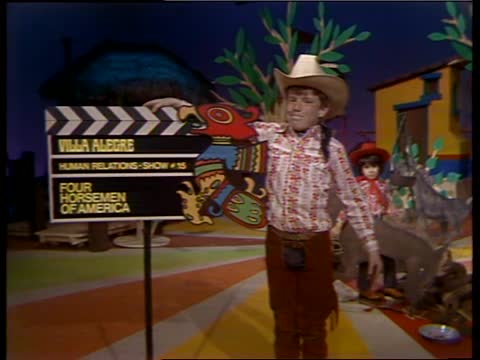
- Transcript
Can you please... and we will sing for you. Girls, come on! It's beautiful!
La, la, la, la, la, la, la, la, la, la, la, la, la, la, la, it's beautiful. Every one here has his own way of getting what he wants planning, and working together, maybe we can do it better and be happier. Howdy
stranger, dare to join me in a play the beans? No play list always come to Quatro Hinetes. Well you came to the right place, your partner. This year is Villalegrae, human relations show number 15, the four horsemen of America. Right I'm here boy. From the Hinetes of America to Quatro we will talk. Mexican Charo. Oh! Ampio Sondrero Farano. Boredado de Platadornando. Jeval Charo Mexican. Galopando en su caballo. The Argentinian Gaucho Gaucho Argentinan
Gaucho Gaucho Argentinan Brazil and Uruguay over Panpas bajo estrellas Galopando siempre van El llanero venezolano El llanero de los llanos De Colombia y Venezuela inspiran una novela Galopando en sus caballos A la la la la la la la la la la la la la la la la la la la la la la inspirar una novela Y el cabo e de los Estados Unidos En los Estados
Unidos El cabo e de los Estados Unidos El cabo e de los Estados Unidos Y el cabo e de los
Estados Unidos Y el cabo e de los Estados Unidos Y el cabo e de los Estados Unidos
Y el cabo e de los Estados Unidos Y el cabo e de los Estados Unidos Y el cabo e de los Estados Unidos Y el
cabo e de los Estados Unidos Excuse me, but you have a very interesting outfit there. Can you tell me something about yourself? Yo soy de México y tengo puesto un traje de chara. You have a chara outfit on. So you're a chara then. Sí, soy una chara. Thank you. We have a very colorful fellow here. You're from Argentina? No, yo soy de Chile. Close, then you have a wasel outfit. Sí, yo soy un wasel. Yo soy de Argentina. You're from Argentina? Then you're the galcho. I see you have a galcho outfit.
Esporque soy un galcho. I'm a cowboy from the United States. I have spurs at jingle, jingle, jingle. Cut it out, will you? I have something to say about cowboy. And I have something to say about cowboys too. Oh, give me a home. Wear the buffalo's room. And I'll give you my dirty hat. Okay, I've had it. I'm not playing with you guys anymore. One day wasp and amapola were happily coming down a mountain trail when look amapola a suspension bridge see how it hangs we have to go across very carefully. Very good, very good amapola. You are very brave.
Don't be afraid, amapola. You see, we are not very high. But amapola without listening to reason and frightened to death started running down the hill. Stop! Stop! Where are you going? Finally, they reached the shores of Lake Chidi Kaga. Well, now I'll make a reed raft so we can have some fun in the lake. Wasp made a reed raft and pushed it into the water. Don't be scared, amapola. Now you can
jump in. Careful, be careful. Don't stay here. Go to the other side so we can balance the boat. I stay here, you go to the other end. Now that's better. Now we can't stay without any danger, amapola. Isn't this fun? And so waspian amapola had a fantastic day at Lake Chidi Kaga and sailed in their boat until sunset. Hello, scared crow. I see you're all dressed for the rodeo. That's scared crow. Say, are you in there old buddy? Oh, amigo, forgive me. I must have been daydreaming. About what? About cowboys. Rodeo time is as good a time as I can think of to be
daydreaming about cowboys. Incidentally, I've been wondering, are there any Latino cowboys? Of course there are. As a matter of fact, many English words for a cowboys' clothes and equipment come from Spanish words. Many English words for a cowboys' gear come from Spanish words? Yes. Watch and listen. The best thing. La Prida, the bridal. La Riendas, the reeds. Losestribos, the stirrups.
La Riendas, the larry. El Corral, the crown. I see what you mean. Ranch, Rancho. By George, I think I've got it. But we both have it. Shall we? Oh, yeah. Rhyda, cowboy. The sombrero flew in front of the bonquixote.
Sancho came by. What's going on, Sancho? Son bonquixote. The wind flew my sombrero. We must remove the sombrero to the wind. Son bonquixote. Son bonquixote. Son bonquixote. Son
bonquixote. The wind flew my sombrero. The wind flew my sombrero. Son bonquixote. The wind flew my sombrero. The wind flew
my sombrero. The wind flew my sombrero. Son bonquixote. The wind
flew my sombrero. Son bonquixote. Son bonquixote. The wind flew my sombrero. The wind flew
my sombrero. The wind flew my sombrero. The wind flew my sombrero. The wind
flew my sombrero. The wind flew my sombrero. My horse can do tricks. How much is one and one? Two and two. Four. Four.
Four. Four. Four. Four. The horse is
very important for the boat. Four. Four. The horse is very important for the boat.
Four. These are the best things I have ever tasted. Cowboy food sure is good. The wind flew
my sombrero. Cowboy food sure is good. Cowboy food sure is good. Cowboy food sure is
good. Cowboy food sure is good. Cowboy food sure is good. Cowboy food sure is good.
Cowboy food sure is good. Cowboy food sure
is good. Cowboy food sure is good. Cowboy food
sure is good. Cowboy food sure is good. Cowboy food sure is good. Cowboy food sure.
- Series
- Villa Alegre
- Episode Number
- 229
- Episode
- Horsemen of America
- Producing Organization
- Bilingual Children's Television
- Contributing Organization
- Library of Congress (Washington, District of Columbia)
- AAPB ID
- cpb-aacip-f48ff8dfc6f
If you have more information about this item than what is given here, or if you have concerns about this record, we want to know! Contact us, indicating the AAPB ID (cpb-aacip-f48ff8dfc6f).
- Description
- Series Description
- Villa Alegre (Happy Village) is the first national bilingual (Spanish/English) program in the United States. It was produced with the goal of teaching Spanish to English-speaking children and English to Spanish-speaking children, and was produced by Bilingual Children's Television as its inaugural project on the company's founding in 1970. Villa Alegre debuted on Public Broadcasting Service (PBS) public television in 1973 and ran there until 1981.
- Broadcast Date
- 1976-05-20
- Asset type
- Episode
- Genres
- Children’s
- Media type
- Moving Image
- Duration
- 00:30:13.279
- Credits
-
-
Producing Organization:
Bilingual Children's Television
- AAPB Contributor Holdings
-
Library of Congress
Identifier: cpb-aacip-1831b4d7fe7 (Filename)
Format: 2 inch videotape
Duration: 00:30:00
If you have a copy of this asset and would like us to add it to our catalog, please contact us.
- Citations
- Chicago: “Villa Alegre; 229; Horsemen of America,” 1976-05-20, Library of Congress, American Archive of Public Broadcasting (GBH and the Library of Congress), Boston, MA and Washington, DC, accessed May 16, 2026, http://americanarchive.org/catalog/cpb-aacip-f48ff8dfc6f.
- MLA: “Villa Alegre; 229; Horsemen of America.” 1976-05-20. Library of Congress, American Archive of Public Broadcasting (GBH and the Library of Congress), Boston, MA and Washington, DC. Web. May 16, 2026. <http://americanarchive.org/catalog/cpb-aacip-f48ff8dfc6f>.
- APA: Villa Alegre; 229; Horsemen of America. Boston, MA: Library of Congress, American Archive of Public Broadcasting (GBH and the Library of Congress), Boston, MA and Washington, DC. Retrieved from http://americanarchive.org/catalog/cpb-aacip-f48ff8dfc6f