¡Colores!; 1006; Duranes LD1
- Transcript
But yeah, I want to take a z-air in, you should actually put this on, I'll do it. Yeah, I've got some Scottish tape back there, you know? Scottish tape and... Oh, no, I've got some left. Yeah, I've got a tape. I've got a pen, and you can have a tape out on my table today. Can you go ahead and just cut the 10 from yourself? 1, 2, 3, 4, 5, 6, 7, 8, 9, 10, 11, 12, 13. How long have you been doing this? This is Java? 20 years. This is Canamy, or is it just... No, no, no, no, no, no, no, no, no. Is this Channel 19 or...? Channel 5. Channel 5? I've been there one year. Channel 5. Okay. So you've been doing this for quite a long time, so you can... Oh, no. Okay, well... Well, you'll be fine. Okay. You're going to be editing some of the bad parts and then, you know? Yeah, so it's not going to run straight, or just...
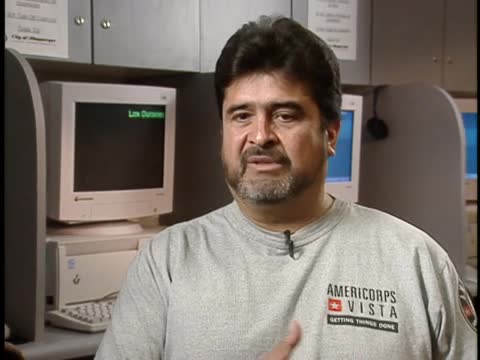
I'll just pick a few parts that we're going to be able to do. Okay. Okay. No. I'll use that piece paper to wipe out. Okay, well, let's roll it out. Okay. All right. All right. Okay, I'm a VISTA volunteer and I work for AmeriCorps. And what I do here is I'm somewhat of a semi-lab instructor. And I work with kids for majors, you know, from 7 to 14, as well as high schoolers that are, you know, sophomore, seniors in high school, and also adults that are, you know, trying to get their GED, as well as some seniors. And I've also been working lately, and I think it's, you know, I think it's some special people that are the mentally disabled or the mentally challenged or some people like to call and will refer to them.
And I think they're special to me, and this is probably one of the best reasons why I'm doing now is showing these individuals how to get on a computer, how to get off. We have a lot of CDs that they've been using, and some of them have been playing games and doing some of the things listening to stories and stuff. And I've been enjoying that. I think it's something really great to me personally. How important is it, do you think, for communities to have these kinds of seniors? I think it's really very important. Because the center works with people that are around the community, specifically, whether it be adults, seniors, kids, high schoolers, whomever, who have the opportunity to come over here rather than, you know, go through what the regular curriculum could be with at high school or other places. They have the opportunity to come over here, only to use the recreation center, ceramics, arts and crafts. I think it's really important. They have the opportunity to come over here, only to use the recreation center, ceramics, arts and crafts, recreation room.
But they can also come in here. And the people that we've been working with are not necessarily outcast. But, you know, you're talking about, you know, kids in high school, that are in high school, are really school-owned fields individuals. They're really can't, or can't maybe work with the regular high school. So, they have the opportunity to come over here and get into something that they may want to, you know, find out about whether it be in the cases that you want, you know, find out about distance learning. We also have the A-plus, you know, learning system. Plus, maybe there's something they want to get into, learn about maybe cars or a certain individual or certain people. And as well as the seniors, although sometimes it's somewhat difficult to have them come in here, because of their eyesight, but at least they have the opportunity to come over here and use not only the senior service center, but have they actually come in here and maybe learn something. At least have that choice, as well as now that we have these mentally disabled coming in here. I think this is, you know, great. Schools on wheels do these sets of mid-town for me. What is that?
They're alternative schools. These are high schoolers who can't make it in the regular curriculum, regular high school. In other words, they're, they're kicked out because they couldn't go along with the teacher or maybe they didn't like how the class was structured. These are really basically good kids, you know, even though maybe they spend time in the D-home because they've gotten into trouble, or maybe they don't have families, or maybe they don't have a regular father and mother to, you know, to structure their life. So they're somewhat kind of an outcast. So when they come in here, they're not, you know, my class isn't what you would consider to be really structured, but they have the option to come in here, sit down, and if there's something that they want to look into, there isn't that kind of pressure they can sit in, and I can show them how to get into the internet, and, you know, give them an idea what they can get into. Plus, you know, they, they can maybe check into, maybe look into other sorts of classes or other options that they can get into.
You tell me that you can be doing anything, you can be doing something else, and why do you do this? I think it's gratifying, it's very little money in it. I had very good jobs before I worked in a university as an advisor. You're recently with the City of Phoenix as a caseworker, and I was making fairly good money, but I see what I'm doing here is gratifying. You look at money, and you look at how you feel about yourself, and this certainly does boost up my ego quite a bit. I've been in the social science industry for quite a long time, and I like what I'm doing. I don't know how else to put it. I really feel like I'm really doing something, doing something for some of these kids who are kind of in that cast, because it was at one time I was in the same situation. I was always in the D-Home, I had everybody graduated from high school, and there was very little centers, such as this, that one can come into, and so I think it's great.
We have that option. We're talking early that there's a bill in the legislature to try to put more money into these centers. You think that's necessary, you think it's needed? Yes, it is needed. I remember President Clinton talking about that, and I think we need to touch base with some of the people that have very little options or choices, and this is a great way to get in touch with them, have them come into the center around their community, and working with people that they're familiar with or know. The director of the program here, Art Sanchez, I think he's one heck of a guy. He does go out to the community. He creates a lot of programs. I think he deserves a lot of credit for what he's been doing here. I'm just in some way just a tool on what's available here. There are so many other people here that can assist, and I'm just glad to be part of the program.
It makes you feel that when the students are here, you're helping them out. We talked earlier about the mentally disabled and challenged kids, how usually they're pretty much observers, and here they get to participate. You're right, just saying, and never being involved in what goes on around them, people have choices. They have very little choices other than options that we give to them. I think it's great that I have the opportunity to see them come in and see them grow. In many ways, just the idea of having them come here and look at what they're doing, it's quite satisfying. At one time, when they first came in, I was kind of skeptical. I mean, what could they learn from this? I mean, it's not going to help them out to get a job or become even more knowledgeable or even smarter, because that's just not going to happen.
Just to become part of the program, have that option to come in here and get involved. I think it's great. Can't begin here your title and what it is that you do. I'm assistant to the director of SEB's, I hear his name is Pete, he's on the side. I refer him as an AmeriCorps VISTA volunteer. So basically, where's it that you do? I help with supervision of all the VISTAs here in Albuquerque and also Bernalillo. It's several different public sites around Albuquerque and Bernalillo. How important is the VISTA participation in this program? The VISTA participation is what's going to facilitate the program itself. They're basically going to oversee the education access rooms, oversee that they're being used correctly, and people who come in to use these education access rooms know what to do, have somebody to troubleshoot for them. Now you know that the legislature is looking at a bill right now to enhance the community centers around the state.
How close are you looking at that? Are you, Bob, that's not a good question. No, is that not a question? What's your series that might have been callable? Sir, I'm going to talk about as a collaborative partner in this bill. What my tie, as far as said, is into this collaborative? Okay. The part that said, plays within this collaborative is that we're going to help with the VISTA volunteers. The VISTA volunteers with providing their services. Right now, the VISTA volunteers are already in place at the centers where we've decided to implement these education access rooms. So, set is actually going to be supervising and helping with the implementation of this program. What are the VISTA volunteers getting involved in this? Is it that important? The VISTA volunteers, most of their goals are dealing with literacy or education towards the community, giving services to usually community members who otherwise wouldn't have it.
And that's basically what their jobs are already. So, this proposal goes hand in hand with what they already do, and it would definitely give them the tools to do more. So, you need the funding? Yes. Well, not even so much the funding also. The supplies that they intend to provide with this program are with this proposal. A lot of the community centers that we were looking at implementing don't have you know, up-to-date, state-of-the-art computers. They don't have, some of them don't even have cable access, which is what the telenet program needs to bring into these centers in order to have distance learning. A lot of the centers that we're looking at right now don't have internet access. The things that this bill is providing. So, a lot of the centers end up too far. They need some more assistance to make them fully functional. Right. The Albuquerque sites that we have chosen, they're pretty good community centers. They have a lot of things, but especially with the Pueblos is where we really come into rural contact with the community.
They don't have much. They're very much so disconnected from everything else. They don't have a lot of the technology that some of the Albuquerque sites have. Why should the legislature care about this? Why should they come to this program? The proposal that we have today not only stops at just giving each community center money and just leaving in at that, but instead we want to take this, help benefit the places that we've already targeted, but then upon that also build a resource, some sort of compilation of the way that we implemented these programs, the things that we did, the troubleshooting that came along the way, in order to compile a book for other centers to use and set up education access rooms. So it goes so much further than just giving money to one community center and it just staying there. We're looking at more a future kind of broad planning. Also, I know working with UNM, UNM is also developing a distance learning program. We'd like to see somewhere along the road for the two to collaborate together, and again, take it further.
I guess what I'm trying to get is, why is this important? What is it that you're providing that the public schools aren't providing? Right now, I feel like the community centers that we're targeting are all in very usually low-income, single-parent, family households. That's where these community centers are targeted and that's the audience that we're targeting. A lot of people that don't have the opportunities beyond what am I trying to say? Okay, people who don't know anything about these community centers don't know why they're important. Basically, I'm trying to get at why is it important that these kinds of community centers are funded? The community centers that we're working with don't, the people that come to these community centers and are being serviced by these community centers don't otherwise have the opportunities that we're providing. A lot of the public schools, there's so many people.
The nice thing about the community center is that it's on a basically if they come in, they can use these services. We're not making them be there. It's that these people really want to be there if they're going to be using these services. And just basically that they don't have the opportunities otherwise, unless we should provide these to them. And tell me, give me a list of the things that you do provide. With this proposal, what we're looking to provide is internet access, distance learning through Channel 9, Channel 19. Sorry. I got one number right. Oh God, that's awful. That's cool. Sorry. Oh, this is my mom. 9, 19. Okay. Okay. A list of things that we provide. The proposal will help to provide with the state of the art computers, the internet access, access through Channel 19, which is the talent broadcast system.
Also, the VISTA volunteer in itself is one of our things with the VISTAs is they're very good resource people as far as doing referrals out knowing where the services are, knowing where, you know, hidden monies, ground scholarships, things to help send people to schools, things to help people benefit with their education, things like that. Without the community, where would a lot of these kids be, or what do you think would be? A lot of these kids wouldn't leave their neighborhood. A lot of these kids wouldn't know anything outside of their neighborhood. A lot of these kids would basically go home, probably either do nothing or get into trouble. The community centers are definitely needed. It's just a conversation. All right.
I think you have to give one. You don't believe me. You're saving, saving. Let's go, George. I want you. I want you. I want you to see other people. I don't believe you. You're an animal man. You don't want to see other people. You don't want to see other people. Well, you've got some of the face. When you take your coat off, it's terrible. Well, everyone is 41. Did you? I want to. How do you say, George, I want you? Where are you going to? Where are you going? Four men of course. Where are you going to. That was answerable. I want you to do that. Where are you going? Excellent to tell you. It looks deep. It looks great. One, two, one! One!
One! One! One! One! Two! One! Two! One! Two! One! One! Two! One! One! One! And here! You're the one! There! There! You don't want your headphones? You don't want your headphones? Okay, so you want to go on that? Yep, he's already on. You're already taking dollars? Alright, so look at what you like. You can get the air palm off, get ready. Let's go. Okay, let me go ahead and put them on. I'm going to take a second. Stay with me. I'm going to take a second. Two bit of deprogance here. So we'll find out again. There's two, a rest center. Every teacher, a chair. Yep, I mean here.
Okay, present, you can go on. Here you go. Here you go. Here you go. Let me go. Let me take a second. Here's two. Here's two. Here you go. Here you go. Here you go. You can go on. Here you go. Here you go. Here you go. Here you go. Here you go. Here you go. Here you go. Here we go. Do you want the matchingcm? No. Remember and look together, and look together. Remember. Something's wrong. Look together. here you go. Come on! Here you go. Here you go. Let's see. Here you go. There you go. There you go. So we got here, Zéo. Yeah, here we go. This is a storybook, fairy tales, actually. Okay, you need to put these on? Okay, here we go.
Do you want to listen to it? Now we need to tap your name. Okay, okay. Okay, here we go. Okay, one more. Okay, leave it great. What's going on? Let's get the minute ready. Okay, here we go.
Okay, here we go. Okay, here we go. Okay, here we go.
Okay, here we go. Do you play it? Okay, let's sign in. Okay, can you tap your name? Okay, here we go. Okay, here we go.
Okay, here we go. Okay, here we go. Okay, here we go.
Okay, here we go. Okay, here we go. Let's do postcards. Okay, pick out something over there that you'd want to get into.
Who's that? Okay, here we go. Okay, here we go. Okay, here we go.
Okay, here we go. Okay, here we go. Yeah, what we're doing is putting a card. Okay, here we go.
Okay, here we go. Okay, here we go. Okay, here we go. Okay, here we go.
Okay, here we go. Okay, here we go. Okay, here we go.
Okay, here we go. Okay, here we go. Okay, here we go.
Okay, here we go. Okay, here we go. Okay, here we go.
- Series
- ¡Colores!
- Episode Number
- 1006
- Raw Footage
- Duranes LD1
- Producing Organization
- KNME-TV (Television station : Albuquerque, N.M.)
- Contributing Organization
- New Mexico PBS (Albuquerque, New Mexico)
- AAPB ID
- cpb-aacip-191-11xd26dp
If you have more information about this item than what is given here, or if you have concerns about this record, we want to know! Contact us, indicating the AAPB ID (cpb-aacip-191-11xd26dp).
- Description
- Episode Description
- This is raw footage for "Recuerdos de Los Duranes." ¡Colores! celebrates community by producing an intimate portrait, Recuerdos de Los Duranes. Working hand-in-hand with the Los Duranes Neighborhood Association, ¡Colores! conducted an oral history of the neighborhood. The result is a poignant account of how so much has changed so quickly in this traditional Hispanic community. Yet, Duranes residents still firmly believe in their community. As Joe Chavez says: “I think people are depending on themselves more and more. Before, we shared with each other whatever we could, our goods, our foods and I still do. I think that is the thing you never forget when you help somebody or they help you.”
- Raw Footage Description
- Los Duranes Community Center. Americorp Vista volunteer interview. Special education computer class.
- Asset type
- Raw Footage
- Genres
- Unedited
- Media type
- Moving Image
- Duration
- 00:32:00.807
- Credits
-
-
Producing Organization: KNME-TV (Television station : Albuquerque, N.M.)
- AAPB Contributor Holdings
-
KNME
Identifier: cpb-aacip-6f1dd340d7f (Filename)
Format: Betacam
Generation: Original
Duration: 00:30:00
If you have a copy of this asset and would like us to add it to our catalog, please contact us.
- Citations
- Chicago: “¡Colores!; 1006; Duranes LD1,” New Mexico PBS, American Archive of Public Broadcasting (GBH and the Library of Congress), Boston, MA and Washington, DC, accessed December 15, 2025, http://americanarchive.org/catalog/cpb-aacip-191-11xd26dp.
- MLA: “¡Colores!; 1006; Duranes LD1.” New Mexico PBS, American Archive of Public Broadcasting (GBH and the Library of Congress), Boston, MA and Washington, DC. Web. December 15, 2025. <http://americanarchive.org/catalog/cpb-aacip-191-11xd26dp>.
- APA: ¡Colores!; 1006; Duranes LD1. Boston, MA: New Mexico PBS, American Archive of Public Broadcasting (GBH and the Library of Congress), Boston, MA and Washington, DC. Retrieved from http://americanarchive.org/catalog/cpb-aacip-191-11xd26dp