Lyrics and Legends; 3; Collecting Folk Songs
- Transcript
I'm sorry I
don't want to talk to dads about my stuff, so... I want to talk to dads around Dad, all over the country to talk to Roscoe to listen to him and to collect from him. He carried you gone every day. Got him,
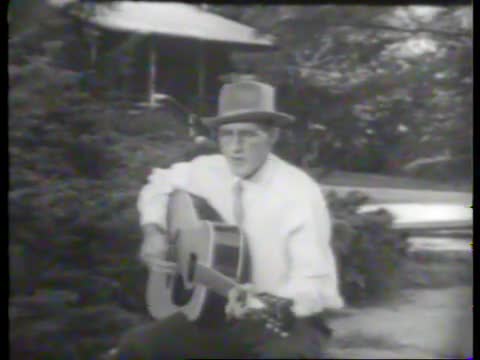
my man, all of a stretch to him. I'll let you all speak your heart and get away. Your heart even to that ease of grief. He thought it would be your grief. We're coming into him by the fall. He got me local all with me. Got hearty headers of this little one. In everything he wore a red. He followed, got hearted to the hanging ground. He got me on every other beat. I've been to the east and I've been to the south. I've been all in front of the ground. I've been to the river and I've been fast.
I'm on my hanging ground. We've got a treat for you on this show. You're going to meet Dr. McEdward Leach as one of the leading collectors in America. Dr. Leach has collected all over this country in Newfoundland and Jamaica as well and particularly in Virginia and Pennsylvania. We're going up to Pennsylvania, Potter County with him and see him collect from an informant up there. Mac, you've been a collector for a long time and I don't think I've really ever done any collecting. Do you think it takes a special type to be a collector? Not at all. All it takes is enthusiasm. Enthusiasm to get out in the bush and eat the kinds of food you find there and live the kind of life that the people are living there so that they'll accept you. I think that's the important thing, isn't it? Getting the guy to accept you and putting it on a sort of social basis with him. Do you ever pay these people to collect from him? It depends who they are. Sometimes you have to pay them, other times you don't. The Irish of Newfoundland would be insulted if you'd offered them money
for a song. It's a part of their general culture. They're singing all the time. On the other hand, there are other people who would feel that they are taking time away from their regular work and that they should be paid for. Well, I should think if you were giving somebody a dollar for every song, he'd be pretty sure he found a lot of songs up there. Oh, yes, you must guard against that. I had one girl, for example, in Jamaica who was telling me stories and between times she'd run in and got a school book and try to make up stories from the suggestion she got in the school book. You know, that points up something. That indicates how important the collector is because the scholars and the people who analyze and classify this stuff, they depend on the integrity of the collector, don't they? Absolutely. And he must know his material in advance so that he can know whether he's being imposed upon or not. And he can lay out his appliance. He should know what he's going to collect in a given region. The kinds of things, the songs or stories or whatnot. That should be there. And then he can search for them. Well, he'd have to know languages then perhaps. You know,
certainly. You should collect in the native language. Yeah. Well, that's very interesting because that would mean that certain areas are definitely closed off to search people for collecting. A number of people use informants as translators. And who helped them toward the informant who's giving the material. But that's not a very satisfactory. Well, these techniques of collecting have developed in America for about 50 years, I guess. And they all started, didn't they really with Cecil Sharp? Cecil Sharp. He came over here in 1914 from England, having got a tip from one of the missionaries down in Virginia. That there were great songs there. The Old English Ballads were still alive there. And he collected nearly 500 of them in various forms. And as a result of this came his big book, The Songs and Ballads of Southern Appalachians. And then this inspired John Lomax. Phillips Barry. And now almost hundreds of people,
right? Yes. It's a collector behind every bush now. Well, Mac, you can't talk because you go collecting every chance that you get. And the nice thing about this show is that we can go right along with you. We're going to show a film made in Kettle Creek State Park in Potter County, Pennsylvania in the winter of 1962. And it shows Mac collecting from an old lumberjack, a man named Hiram Kranmer. And Mac had already contacted this man through letters and had met him once before. So that the sort of social situation had been established. And that everything would run smoothly when he went up to collect from Kranmer. Now, you want to notice a couple of things about this collecting session. One is that Mac does not condescend to Kranmer at all. He's talking to him on his own level. Notice another thing that Kranmer doesn't sing his songs the way that you may be used to hearing folk songs sing. He sings them the way a field informants sings them. And notice that Mac knows quite a bit about the general culture out of which Kranmer
comes. Mr. Kranmer, I came up here to get some old stories and songs that the people used to sing and tell in this region. So that we can take them back, put them on tape, and put them in the museums and then the universities and colleges. So that the students will know what kind of stories their grandfather's and great grandfather's told when they settled this country. Stories about the country and about the people here and all that sort of thing. The engines, yeah. And spatially stories and songs that they brought over with them. Do you have any such songs? Well, I know. Well, you know a lot of them are part of myth, you know. You know a song like, well, let's see, Andrew Bardeen and
Martin, is he sometimes called? You know that song? What's that? Andrew Bardeen? Yes. Could you sing that song? Oh, yes. There were three brothers in Old Scotland, three loving brothers were they? And they all cast lots of sea, which as them should go robbing around the South Sea. The lots hit pedal to Andrew Bardeen. The youngest of the three, and he should maintain the other two brothers by robbing around the South Sea. He hadn't said long, glist -by to ship sailing. He came sailing and sailing far off to the little lake. She came sailing long side. Oh, there, oh, there, drive Andrew Bardeen. Oh, there, the sailing so nice. We are the rich little from Old England, if it's all the best, let us
pass by. Well, now a collector like Mack has collected a song like Andrew Bardeen many times, and it's a long song, and a collector has to sit through long songs like that. What he's really doing is using it as a means of getting Kranmer started. Now, we don't have to sit through the entire song, we can cut through to the end. And at the end it's important, because Kranmer will make comments on the song, and his comments on the song, even if the song is well known, are very valuable. They had not fought more than two hours, so Captain Joe Stewart gave orders. Gone, gone, the Andrew Bardeen. And tell your king for me, if he were ranking all on the dry land, if I were ranking at the... That's a good song. In England they call that Andrew Barton.
And it's slightly different, but your version is very like that. Where did you learn that? From your father's father when I was a little kid. And he probably had it from his father, and so on all the way back to England. Yes. This song that you sang about Bardeen is an old Scott song. Now, what about any old American songs? Have we ever sung a revolution? This Paul Jones. I didn't realize that the other people still knew that up in this region. What was that about? Yeah. Well, an American frigate from Baltimore came, where Guns Matter 40, the richer by name, the crew, and the channel of Old England. Well, the noble commander Paul Jones was a man. Oh, yeah. I hadn't said long before they did a spy. A large 44 and a 20 close by. They're both noble vessels. Well, late in the storm, we'll toss off the earth. A captain pursuant them to the
ball -jarks, you're sure. So the hour of midnight fears came alongside with a loud seeking trumpet. Who goes there? He cries. Quick, give me an answer. I've held you before. Or this very instant, the broadside outpour. Paul Jones, he exclaim, a brave boy will not run. Let every bowl seamen stand close to his gun. When a broadside was fired, with those bold English men, our baby, but can he road return to the gang? Five hours, we fought them. Five hours, most hot. Till 40, bowl seamen lay dead in the spot. Well, a fiercest loud cannon, the Richard did roar. A seamen, a frightened door, a captain, he came, saying, our ship is a sinking likewise, and a flame. Paul Jones, he exclaims in the heights of his pride, if he can't do no better, we'll think alongside. But a shot, two to six to take, enough sand, and we force the proud flag of great
Britain to land. Then the lion bore down on the Richard dead rake, which caused the brave heart of Paul Jones, for the wait. Now come a brave buck, he's taken a prize, a large 44, and a 20 likewise. There's no more vessels. Well, laden the sword, we'll toss off the can to our country once more. God helps the poor widows who sadly shall weep for the loss of their husbands, now sunk in the deep. But we'll drink to Paul Jones, who was sword and hand, was for most in action and gave the command. That's you. Oh, that's a good historical song, because it all actually happens. All actually happens. And they've kept history alive around all through the country by thinking that song. Well, of course, when they come on first with the phonograph, then they move it.
And then TV. You don't think that's spoiler, do you? No. No. But they think that instead of singing them old songs where they go to these... The movie's going to be a nickel in them in the old days. Then people sit around and sing these songs, and there are other kitchens and so on. Yes. After supper, and then all the time... That was the entertainment, didn't he? That's the entertainment, didn't he? Or else tell them all stories on the doll. And we've had two good songs about an English hero and an American hero. How about a story? Are there any stories about English heroes here in America? Anything? The Indian's new bother. Yes. There's two ledger concerns. King Arthur. I've just married a few miles above here up a... a ruined wall run at the... where... the mother make all her joins. And according
to the Indians... The horses here? Yes. According to... the Indians, he was the king of the Iron Man. They wore armor. And he came over here to drink out of this spring, where... because he was ill. And he kept him alive for 20 years. And these people he'd left as waiting for him to come back and... he'd went to a far land to be healed... a evil on the call. And his retainer went back and... they... knew he was buried over here. And that grave was underserved... from 537 A .D. until 1952. And somebody opened... was found with full of water. And it layed there? It And I'd seen it before when the...
the... the Karen of Stone was piled on it. And they had to take the sea stone to get them out. I think a grave is it. It was a... three... four -foot, eight -and -a -half inches, three cubits, wives, and five... six cubits long, which is nine feet five inches. And as cut yet to smooth, as that wall... they had good nations, then days. Evidently, he was dug and prepared under either direction. He's no legend of that. Before he dies, all he had to do was put him down in there and then... have their stone cemented in. And they... water filled up above, and then they put these flat stone over. And they... the Karen of rocks on top. It stood there from
537 to 1952. And they dug it out to see the full of water and it thought the grave was empty. And some politicians... fishing there weighed down the felon. And he had the forestry come up here and fill it with gravel. And the people in the neighborhood told this story. Yeah. And they got it from the Indian. What happened to Arthur's men that came with him? They went back all the 20 years. They carried the news back to England. Nobody's dug down there to see if he's still there. Nope. That's both the end. Only that politician that went in there and... got out. He thought that was too dangerous. That's an interesting story. Very interesting story. Yeah. An archaeologist ought to open that up. Somebody that knows what he's doing. Well, they have Arthur buried in all sorts of places. That's the
first time I knew he's in Potter County. Yeah. Yeah. That's one of the things that everybody's run the way and it plays ghost Potter County. Well, you've given us some songs and stories of historical caricatures, rather serious ones. What about the humorous song? But it won't. Things won't get any worse. Oh, yes. That's a very good song. Yeah? Changae took him to the grocery store. He was at the Pole Tribe. Hold them all. Things won't get any worse. They'll give me Yo. Tie him, or Terry, or whatever. Or there you'll wave them. I eat them, or hold them, or whatever. Or drink some dip, tab, wig, or whide. Nice tab, boop, judge. That'll get the stroke race. Things won't get any worse. They'll give me Yo. That's a close relation to Froggy and to Coarton. Well, it's a different version of him. Same thing. I like to refrain of that. Yeah, things are going to get even to came here. I'm out there all the way to wait. I eat them all, I'm a lot of them. I'm gonna ring some tib -tab with
white night cab boots. I tell you get some great things on. Get even to came here. Is it harder to remember a non -century frame like that? Well, I learned that in about five years old. You've never forgotten it. Oh. You learned that, you know. Did they sing songs like that to the children? Or did everybody sing a song like that? Well, all the children know it. There was all thought of them at home. There's an old English song that died by Ram. Do you know that one? Ram's this is brought over here 300 years ago. And then do you want to hear it? Yeah, sure. As I was going to the R .B .O. on the market day, I saw the biggest Ram's there that ever set on hay. His Ram, he had four feet to walk on. He had four feet to sand. And every one of these Ram's feet took up when they got a lamb. His wallet was so long, sir. It reached up to the sky. And the Eagles built an F there for her, the young ones crying. His horns were so long, sir. They reached up to the moon. The man went up in January. Even he didn't get back
until June. What does he all know about the man who's a hunter? Yeah, what's that? He's going hunting on the tracks. After them to go, I bent my gun on a circular and shot around the hill and out of five and 20, 10 ,000. I did kill. That's the Arkansas Travelers. Oh, that's a little bit different. Well, let's get back to English or go rather than American history. I was looking up the history books before I came here to see you. And I discovered the James Bird was born somewhere around in this region, near Kingston, isn't it? Kingston, he was over at Hong Kong. At the North Branch, just a few miles above Sunbury. Do they still have the story of James Bird here? Do they still know that? All along the Stitswick Inn here, it's still. But he left from here to go to... He left from Kingston.
What they marched up and then over the old Boone Road. This is in the War of 1812. War of 1812 has happened in the year of 1813. Oh, yeah. And then how do you want the song? Well, what? I don't exactly remember what they part of it. What, was he a resident for desertion? He was the ass after the battle. He stayed and fired the one gun that was left. Three times, though, the British didn't know. No, the others left the ship. He stayed. Yes, and he went to the Niagara, the biggest ship. And they fired three times. And the English didn't know that that... That Lawrence was deserted. And they had two other biggest ships that were firing into it, and both sides. And that enabled otherwise. They'd known that Boone Road of Men was going over there. It was a ferry. They would have shot at the boat. Did he catch it? That's it over here, Charlie.
And how was he... How was he fined to catch you? That's an item, over. Come on, boy. Come on here. You had some little cats. What is it? I say, how was he fined to catch you? Bird. How did the Americans get over? Well, he wasn't American. And the bottle was one in fifteen minutes. Oh, yeah. But he fired that gun three times alone. And then I cured him in desertion. And that's because... Yes, because he'd end him to death and death. Because he didn't go on the boat. But that was one American officer that got the most of punishment. Fifty years, fighting buttons. On the prison of the quarter -deck. And he couldn't go ashore. He wasn't allowed to speak to a sailor or sailor to speak to him. And he couldn't come down off in that quarter -deck unless he was with an
officer. And when that go ashore? Who was this? After... It was a ferry. All over the hazard ferry, the Commodore. And he was a man without a country. A man without a country. And made a song about that. Do you see people around here know that song? Do you know it? Son's a temperance, listen to me. And these daughters do give here. Here's a sad and mornful story. Ever told you now she'll hear. All you know, his troops are under. And if that's the last of the west. And our forces quick assemble. This invader to resist. Amongst the troops of March to Eerie. Where the kings and volunteers. Captain Thomas and commanding. To protect our west
frontiers. Soon the cameward oval ferry. Had assembled all his fleet. There's a gallant bird enlisted. Hoping soon the fold of me. Where is bird in the battle ridges? Is he in the strife or no? Now the cannon's roar tremendous. There he faced that curious fold. Are they old? There was a ferry. In the self -same ships they fought. Though his mates fall around him. Nothing can his soul of frighten. Are they old? The ball has struck him. See the crimson current flow. Leave the deck exclaim, Ray Perry. No crazed bird I will not go. Here on deck I took my station. The air will bird his color's fly. I'll
stand by you, Joseph Joseph. Till we conquer or we die. Him. So we fought for peace and leading. Till our efforts did of roll. All trumpets or our foes. Then did birds retrieve attention? Was he to his friends with swords? Did he ever to his bosom? Past the maid whom he adored. The whole there came most dismal fighting. From Lake Erie's distant shore. Better if for bird had perished. Mid the battle's awful roar. Here is parents of the letter. This will bring sad news to you. Do not mourn your first bill of son. Though this brings his last ado. I must suffer for
deserting. From the brigniagory. Brother sister read this letter. Hear the last you'll hear from me. Matthew didn't have much trouble starting that follow. I know darn well that some informants are a lot harder to start than that. Oh yes. Very often you find one who has a religious background that keeps him from singing secular songs. And I found a good way to start them is to let them sing religious songs. And finally they'll coast into secular songs because the tunes are really better than a lot of the religious songs. Well I've had informants tell me they have to get the wife out of the room or take her downtown or something in order to let the husband sing because she doesn't want those simple songs sung in the house. You have that experience constantly. You run into all kinds of interesting things don't you? Once in all it's a husband that has to be taken out of the house. I remember Bill Jansen saying that he spent a half an hour
listening to a fellow sing in the middle of a creek in Kentucky once. So I can see why this would be a very fascinating hobby once you got into it. And it's not a very expensive one is it? No because most of the museums are willing to give you a grant that will pay your expenses. In other words you got a very pleasant holiday all paid for. And then you send the tapes back to the museum. You send the tapes to the museum if you're collecting in Canada in America you send them the Library of Congress. That's the National Museum up in Canada right? And your problems aren't over though when you finish collecting because I know this recording of music and that sort of thing is very difficult with folks on. Yes then the hard chore comes in to sit down and and notate and to transcribe and edit these things that to take some many hours. Well Mac we're getting a little short on time and I know we could talk about collecting almost indefinitely because there's so much fun and there's so much to know about it. And I want to thank you for having given us at least a few of the secrets.
And I want all of you to remember this. That when a teacher like me makes a program on folk songs or if someone makes a lot of money out of folk songs on the hit parade or if a group of college youngsters sing them in a coffee house just for sheer enjoyment. We all owe a tip of the hat to the collector because without the collector there would have been no commercial boom in lyrics and legends. Once I wore my apron low and you call her to be great and slow. Well
now my apron string. you
- Series
- Lyrics and Legends
- Episode Number
- 3
- Episode
- Collecting Folk Songs
- Producing Organization
- WHYY (Radio station : Philadelphia, Pa.)
- Contributing Organization
- Library of Congress (Washington, District of Columbia)
- AAPB ID
- cpb-aacip-512-599z03005r
- NOLA Code
- LRLG
If you have more information about this item than what is given here, or if you have concerns about this record, we want to know! Contact us, indicating the AAPB ID (cpb-aacip-512-599z03005r).
- Description
- Episode Description
- Camera crews travel with Dr. MacEdward Leach to backwoods Pennsylvania, an area steeped in local folk idioms, for a demonstration of how collectors go about gathering material. This comes after Roscoe Holcome has opened the episode with a few authentic (i.e. non-doctored) folk songs, and Dr. Coffin and Dr. Leach have discussed briefly the history of collecting. In central Pennsylvania, on the northern banks of the Susquehanna River, Dr. Leach talks with Hiram Cranmer, a resident of that area, who sings some old local songs and gives us some local legends. (Description adapted from documents in the NET Microfiche)
- Series Description
- The intimate history of the life and thought of a people is found in its folks songs. Particularly fascinating are the folk songs of the United State, for these gathered from all corners of the world, reflect a variety of traditions yet remain close to the life and work of the new land. The fifteen half-hour episodes of LYRICS AND LEGENDS deal with the major sources and areas of folk material in this country. Ethnic, occupational, and regional songs and stories all receive attention. For some episodes, camera crews journey to areas where certain songs are sung. For other episodes, outstanding scholars and performers come into the studio to illustrate their specialties. Permanent host for the series is Dr. Tristram P. Coffin, who introduces guests and provides some of the authoritative historical background for the performers. LYRICS AND LEGENDS was produced in 1963 by WHYY-TV, Philadelphia, in association with the University of Pennsylvania and the American Folklore Society. (Description adapted from documents in the NET Microfiche)
- Broadcast Date
- 1963
- Asset type
- Episode
- Topics
- Music
- Media type
- Moving Image
- Duration
- 00:31:02.228
- Credits
-
-
Art Director:
Boyle, Pete
Cinematographer: Pickow, George
Director: Twaddle, John P.
Executive Producer: Burdick, Richard S.
Film Editor: Hentz, John
Guest: Leach, MacEdward
Host: Coffin, Tristram P.
Interviewee: Cranmer, Hiram
Music Advisor: Goldstein, Kenneth
Performer: Holcome, Roscoe
Performer: Cranmer, Hiram
Producer: Twaddle, John P.
Producing Organization: WHYY (Radio station : Philadelphia, Pa.)
Videotape Director: Beale, Bruce H.
- AAPB Contributor Holdings
-
Library of Congress
Identifier: cpb-aacip-02a1f48d9a7 (Filename)
Format: 1 inch videotape: SMPTE Type C
Generation: Master
Color: B&W
-
Library of Congress
Identifier: cpb-aacip-a29eb2c2ef9 (Filename)
Format: U-matic
Generation: Copy: Access
Color: B&W
-
Library of Congress
Identifier: cpb-aacip-77e56419594 (Filename)
Format: 2 inch videotape
Generation: Master
Color: B&W
If you have a copy of this asset and would like us to add it to our catalog, please contact us.
- Citations
- Chicago: “Lyrics and Legends; 3; Collecting Folk Songs,” 1963, Library of Congress, American Archive of Public Broadcasting (GBH and the Library of Congress), Boston, MA and Washington, DC, accessed June 9, 2026, http://americanarchive.org/catalog/cpb-aacip-512-599z03005r.
- MLA: “Lyrics and Legends; 3; Collecting Folk Songs.” 1963. Library of Congress, American Archive of Public Broadcasting (GBH and the Library of Congress), Boston, MA and Washington, DC. Web. June 9, 2026. <http://americanarchive.org/catalog/cpb-aacip-512-599z03005r>.
- APA: Lyrics and Legends; 3; Collecting Folk Songs. Boston, MA: Library of Congress, American Archive of Public Broadcasting (GBH and the Library of Congress), Boston, MA and Washington, DC. Retrieved from http://americanarchive.org/catalog/cpb-aacip-512-599z03005r