Front Street Weekly; 610
- Transcript
Oh. [Jim Swenson]: A look back at life on Rancho Rajneesh with a non-Rajneesh family who lived and worked among the faithful. "Now I know what working for the mafia would be like." ['Heard it Through the Grapevine' plays in the background] Word is out ??? and advertising agencies are on a roll. Top ad execs from L.A. to New York are wondering, "Who are those Portland hot shots and why are they getting some of our
business?" 'It's your funeral,' as the saying goes, so why not have it just the way you want it. "Each individual client expresses farewell in a different and appropriate way." Options for your last rights. The legacy lives and not just in story in cinema. We'll me what maybe the last master bowyer. Good evening from all of us at Front Street Weekly. I'm Jim Swenson. And I'm Gwyneth Gamble-Booth. A bit of Madison Avenue is thriving, here in the northwest. In fact, insiders in the ultra-competitive advertising world are calling Portland one of the hottest creative advertising markets in the country. Front Street's ??? takes a look at why. [Co-Tylenol commercial on the radio in the background] You gotta be allowed to take risks; you can't be afraid. The first problem that any ad had to deal with is there so many others out there already. How do you get through that clutter? How do you get noticed? You have to do something that's different. Nothing more than a way to wake people up. [Background music]
Every day we're bombarded by hundreds of ad messages. Studies say we ignore most of the commercial clutter; but lately, some ads have been catching more attention and they're being made right here in Portland. [I Heard It Through the Grapevine playing in the background]] Ads like this one, made by Portland's Clay-mation artist, Will Vinton, have helped turn the Rose City City into what experts say, is one of the hottest creative markets in the country. It's so hard to find a place anymore, where the idea matters more than all the political B.S. surrounding it. Dan Wyden of Wyden and Kennedy, says lack of big city agency bureaucracy is one reason behind the success of some Portland firms. I think there's a lot more freedom out here mainly because advertising is not taken quite as seriously. And so, what happens is there's a lot more experimentation going on. [commercial playing in background] Where you go to ???. [commercial playing in background]
Three years ago Wyden and Kennedy shook the advertising world by landing the 12 million dollar Honda scooter account, beating an LA- San Francisco Agency. National praise and prizes ??? followed. Today's billings of about 30 million dollars, its success has helped encourage other Portland ad firms to go after national accounts as well as attract talent here. We do a lot of recruiting. We're being able to pull major talent for the first time out of New York and Chicago, Los Angeles, to come to wor withpeople that want to come to work in Portland. Creative freedom and big city job burnout are among a host of reasons given for the success of Portland advertising. Others include the appeal of living in the Northwest. And the recent opening of an advertising repository. This is the American Advertising Museum located in Portland's Old Town. It opened last summer, and is the only museum of its kind in the nation. More than 7000 advertising artifacts are housed here.
It's hoped that more Portland commercials will soon be making at history but many say it'll take some time. The talent pool here is not nearly as deep as it is in L.A. or San Francisco and New York. Talent may be thin but there is a lot of fat too. About 165 agencies reside in the city. It's a 425 million dollar a year industry, but only a handful, no more than a half dozen, pull in top billing and only two have been getting national recognition for their work. One is Wyden andKennedy. [Ad playing in background] The other is run by this man, Bill Borders, of Borders Perrin Norrander. ??? He and his partner started their agency nine years ago. It's now considered one of the hottest on the west coast. Highly successful at picking up new accounts, Borders raked in about forty 48 million dollars in billings this past year, making it the largest agency in Portland. I'd say a good ad has to be something obviously that stops a reader. It has to be believable.
And, generally, somehow, I think it needs to be emotional; I think it needs to talk to people's hearts. In a business consumed by competitiveness and collecting trophies, Borders says there are still a lot of junk out there. He thinks a lot of it has to do with agencies playing it safe with clients. People frequently take the path of least resistance, which is doing something that will maybe test well, research well, but may or may not actually break through the clutter and sell. Breaking through the clutter will be the task of the 4 million dollar Henry Weinhardt account which Borders landed last year, beating out competition from San Francisco as well as Portland's Wyden and Kennedy. A full ad campaign is now in the works for Henry's light beer. This is how it starts. The creative staff working in teams to develop ads. What we would say? The point is, it's light beer that's not watery, right? How do you say that? We've never had the luxury of that much money behind the message, so we have to rely on that message.
Blitz Weinhardt officials say they picked Borders Perrin Norrander because their ads get attention. Whereas, where we run one 30 second commercial, our competitors may well run 25 or 30. So somehow that one has got to stand out and essentially be 25 times as good as their cumulative, generally it's the unusual, the untried that's going to work better. ??? unusual then try to work well for other boarder's clients. Those have included TriMet, Pendleton World, and Burgerville USA . You may remember these ads which were shot in 3D. To celebrate our 1961 birthday, Burgerville is bringing back 3 D. What we tried to do, and this is an example of trying to do something hasn't been done before is take an idea like the 25th anniversary and make it fresh and make it a little more unusual. Oh and you also get these glasses. Where do the people who dream up all this stuff come from? Not necessarily the Northwest. Borders as a transplant from L.A. And he says he recruits
almost exclusively from out of state. There is good work being done here; I think it, you know, could be a lot better, even. There aren't a lot of agencies contributing to the good work, I think. [Phone ringing, woman answers] Like most other businesses, it takes time to build a clientele in the outer world. Firms can spend long hours and lots of money pitching for a client's business, only to fail. Wagner Wiecks Smith and Lapel is a small agency, a seven person shot that started up five years ago; an agency that many say is on its way up. I don't know how long that credibility takes - it isn't there instantly. If you have some successes and you do some good work then that reputation swells. Behind what we see on TV and billboards is a lot of hustling. Market research and fact gathering; so much plotting, it would probably make any battlefield historian wonder at the scale of those marketing warfare. Wagner Wiecks Smith and Lapel best known commercial was probably four KEX
radio - ads targeted at an older audience. [ad playing] ' with lots of things' grown ups [garbled conversation] likely want to see out of my sometimes downtown. Come down the mall, you know with the boom box on the shoulder and, ah, we thought it would be fun to portray adults, grownups as having that much fun with their radios too. Ads are written and produced by Tom Wiecks and Vance Smith. For my money, the best kind of client is one that says, OK, you guys are the experts. Do it, if it doesn't work, you're fired. That lets you know where you stand very quickly. This is Portland advertising - a look, a feel, ideas experts say agencies here must now pitch outside the state for new client dollars. So stay tuned. Nothing more than a way to wake people up. Listen to yourself. Wasn't that fun. An update: Borders Perrin Norrander may lose the multimillion dollar
Henry's account. Henry's parent brewery is consolidating its advertising effort, meaning that those dollars may migrate to an ad agency in Chicago; a prime example of how quickly fortunes can change in the advertising world; still, experts say some of the ad work done here represents a trend toward creating bands that accent the soft sell rather than a hard one. Well a growing number of Oregonians, it seems are objecting to the hard sell when it comes to funeral services. Steve LaBelle reports that many of us are bucking tradition when it comes to ceremonies surrounding our final departures. A jazz musician has died. It's an appropriate sendoff. That's the way it has been. That's the way the musicians want it. Witnessing a New Orleans Jazz Funeral is to understand the trumpet player who said - I'd rather play a funeral than eat a turkey dinner. [Trumpet music playing]
But in more conventional circles; death has been forbidden discourse. Ever since the social revolution of the 60s, its discussion has come out of the inner sanctum. People are trying to make sense out of life's ultimate mystery. Funeral homes, like it has become nothing more than a magic act. It's not - the majority people don't feel like that but there are I would say 10 percent that do. Families are getting away from this sanitized approach to a funeral. They are breaking with tradition - a tradition that has always been for the living. People were going more for simplicity and were going to cremation as a means of disposition, was coming on more favorably, less formal structure. Funeral directors, memorial societies and thanatologists say, the break from tradition, developing an alternative funeral approach, is not solely based on economics. It all adds up they say to a more honest confrontation.
We learn that in many cases, not all cases but in many cases, what the public was really saying. I really feel uncomfortable and wish the [inaudible] here. We found people were objecting to buying merchandise - various items of merchandise. It is time for change. Time to better fulfill the needs of the family. I think above all though, as been the change from the funeral being a highly structured formality, changing from that to one of a more emotional type of simplicity where each individual client expresses farewell in a different and appropriate way. What is the appropriate way? That seems to be left up to the family. The purpose is to allow people, the living people
to go through a rite of passage. Families more easily are coming to grips with death by arranging a funeral service to suit their own standards. By incorporating special readings, music and song. And the location too, is significant. After all, the law and religion prescribe little regarding the conduct of a funeral. I think the danger is when people think that they don't need funeral service at all. Changing viewpoints show David Walker the necessity for his new service; Portland Funeral Alternatives. The main difference really is that we do not offer body present religious services. There is an exception in the case of a graveside service at a cemetery, but we don't have any body present chapel services and there is no viewing and there is no embalming. Walker's company will handle everything for about 450 dollars. There are some extras, however - the clergyman, flowers and the cost of the burial plot, all of which
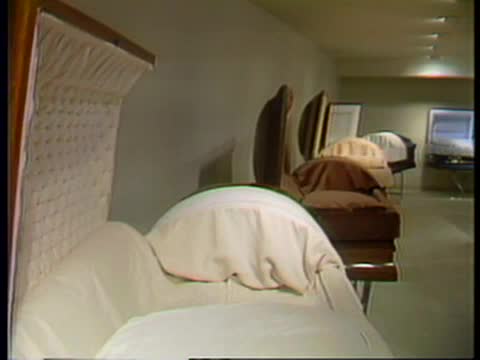
his company can usually arrange. I don't like to see someone have this kind of service, strictly for economic reasons. I like to do it because it's what they want. No matter which services and products are selected, federal law requires the mortuary to fully disclose its complete price list. Funeral homes routinely offer cardboard caskets and plain pine boxes. in contrast to the velour lined oak. There too is a place for the do it yourselfer in the funeral business. The family or the grieving parties get an opportunity, and I look at it as an opportunity, to actually gather together and construct the casket. I produce a kit called the plain pine box that makes it very easy. A kit from the plain pine box company can be built in about an hour. I feel that immediate therapy or near immediate therapy can really help a party to confront the loss.
Put it in perspective and go on with living. The American way of handling death is taking on the high tech approach. A Florida based company is ready to send up an orbiting mausoleum. ??? less this group will put up the remains of about 15 thousand people and 3,900 dollars to get you a ride to the heavens. Closer to home, lovers of the sea can have their cremated remains placed in the Tillamook Lighthouse, now known as the Eternity at Sea Columnbarium. I think it's ecologically very desirable. I mean I think you won't end up teeing off on the ninth grade when you have a facility like that. I think it give it kind of a remoteness this and some people like privacy too. When looking for a place to have their ashes don't want to have their relatives have to come out there and look every month and... When it comes to a decent burial; tradition, religion and common sense all stand aside. After all, the American Way of Death is a curious thing.
So it seems many people are choosing to leave life in a style approximating how they lived it. Well next, a never before told account of early life at Rancho Rajneesh. Bob and Glenda Harvey of Madras are not now and never have been followers of Bhagwan Shree Rajneesh. But together with their two children, the Harveys were the first to make the guru's followers feel right at home. The story they tell is of the commune's early beginnings, roughly the first two years of the Rajneesh's time in Central Oregon. Marilyn Deusch reports that as ranch foreman Bob Harvey at first went along with his bosses, later; ran afoul of their wishes. For me it's like coming back to a place I used to live that I don't really care to live again. It's almost spooky in a way. But once the 64 thousand acre spread in Central Oregon was what Bob and Glenda Harvey called home. They lived here before the
Rajneesh's came when Rancho Rajneesh was the Big Muddy and they lived here for the first 19 months of the Rajneesh settlement in Wasco, Jefferson County Now a self-employed mechanic, Bob Harvey was once the Rajneesh's ranch foreman. Now I know working for the mafia would be like. The sides helping the Rajneesh build their commune and sometimes serving as an armed bodyguard for the big lawn. Bob Harvey admits when the Rajneesh asked him to spy on some of their Central Oregon neighbors, he did that too. When you're getting paid to do a job, I do the job. That job paid Bob Harvey one handsome salary; 52,000 dollars a year to be at the beckon call of the Rajneesh's 24 hours a day. But the Harvey's were not simple hired guns and their relationship with the Rajneeshes ended in early 1983 after they helped a half dozen [inaudible] escape the confines of Nirvana. I go back to the night that they came to the house to ask us to help them get off the ranch. They were crying and I was on the verge of tears you know. In a Central Oregon snowstorm
the Harvey sped the Rajneesh away before dawn the next morning. The Harvey's returned shortly afterwards [inaudible] and [inaudible] accused the Harveys of theft and booted them off the ranch. Both sides filed lawsuits. A year ago the Harveys won back wages and damages. According to the Harvey's many [inaudible] wanted to leave the commune but had no money to do so earn no wages. Money sent to [inaudible] was often grabbed up by the commune leaders From the very beginning, the Harveys say, the object of Rajneeshee acrimony was Sheela. She was top dog and that was it. And people knew that from the start and resented it. Even before 1985 when she left. Well people hated Sheila in 1981 that lived on the ranch. That, of course, was not the picture Oregonians saw. We saw a united group of dutiful disciples building a city in the desert. We saw Rajneeshees greeting their master. We saw Rajneeshees enraptured.
raptured. But according to the Hardys there was always a strict and brutal division between a small elite ruling class and the thousands of other sanyasins. They weren't people as far as they were concerned. They were just a working machine. Somebody to do the, you know the gutter work. And that's how they treated them. Sheila never drove a nail. Sheila never dug a ditch. It was those other people that dreams' built this place; they, you know, they were going to live here the rest of their lives. [Group singing] Hardworking, generous, spirited, social dropouts. That's how the Harveys describe the Rajneeshes. Many were their friends, some still are. There was about 25- 26 people who were always at our house and we went through
a lot of meat. They weren't suppose to eat meat. They'd sneak up to our house and we'd have barbecues. [Group singing] But as long as they've known the Rajneeshes, one thing the Harvey say they've never understood is the sannyasins' devotion to the Bhagwan. I'd look at the old crinkly guy in the eye and I still haven't figured it out. It chemical [inaudible] but a lot of people worship for some reason. One morning 7:00 a.m. a Sinyasin knocked on the door of the Harvey's home announcing the Guan would be there in five minutes. But I didn't even have a cup of coffee you know I just wandered out to the car and he rolls the window down and he says Glenda something for your finger. And I said 'oh', you know, and he put the ring on this finger I guess it was. There are other stories too like the night the Guan ran away. Just off and split in one of his many
Rolls Royces. Crews of Sinyasins were sent to fetch him back. Bizarre stories and generous mementos from the Guan. Gifts to the Harvey's and their two daughters who went to school Rajneesh children. Becky and Kim were 14 and 11 when the Harveys left Rancho Rajneesh. You never worried about your kids being in that atmosphere? No. You saw people having sex? Yeah. In the rooms, out on the field. Next to the road. And the bathroom. Just Wherever. What did you say to your mother after you saw that? Try not to tell her. But looking back, the Harvey's say they have few regrets and they say the Rajneeshs are not the only ones to blame for the four years that shook Wasco county. Wasco County was just delighted they were the happiest town in the world. That all this money was coming in. Well let's face it. The ranch got away with what nobody else could get away with.
We built Rolls-Royce garages with farm use permits. Everything that we did that was while I worked for the ranch that was slightly legal, shady or whatever you want to call it, Was only done, I mean every county official, knew they were doing it. [People singing] Perhaps mindful of the Ranch's recent past, Glenda Harvey thinks Rancho Rajneesh would now best be used as a home for wayward children. Meanwhile, former residents of the Big Muddy are now coming home. Only this their deer tracks. Finally came back from the Big Muddy after being run off by 20 thousand people in red. We're going to be hearing more about the Harveys because next week reporter in Marylyn Doich has a story about sham marriages and the Harveys and the Rajneesh figure in that report as well. Well earlier on our program we looked at the high cost of advertising. In our final report is on a man who
doesn't need to advertise, his clients do it for him. Steve Bateman reports on the man who lives in the past to keep his craft alive for future generations. [Intro music] All you need to do is watch a film classic like Ivanhoe to see just how brutal medieval warfare really was. It was face to face combat, with men staring each other in the eye while hacking away. The most lethal weapon of war was a longbow, which historians believe originated in Wales around the 11th century. Experts say nothing has rivalled the longbow in terms of speed, range, or accuracy until the development of the semiautomatic rifle in the 19th century. The French used to joke about the English longbow, calling it a crooked stick. The jokes stopped when the longbow was instrumental crushing the French during the Battle of Crecy way back in 1346. In fact English held a long bow in such esteem. There was
actually a law requiring all the king's able-bodied subjects to practice with it. But despite its popularity, and the fact that the longbows were turned out by the thousands every year between the 13th and 16th centuries, only a few have survived. And that's what brings us forward in time in 1986, and in the small Oregon town of Elmira, nestled in the foothills of the coast range west of Eugene. Our story tonight is really about Don Adams. He may not be known to most of us, but he's on first name basis with English lords and members of the Royal Company of Archers, the Queen's bodyguards in Scotland and the oldest archer society on record. Don is a master craftsman of long bows, and many believe he is now the only one in the world earning a living from this craft. Don made his first long bow when he was in grade school. [inaudible] The start for us was just the love of the bow. Shooting bows and arrows as a young child, make it my own, if I wanted to have a bow to shoot I pretty much had to go out wittle about my south.
When Don was 15, his family moved to Elmira and he met Leonard Daly, the 1930 flight champion for the United States and one of our best Bowyer's. Adams worked with Daley for five years, learning the skills necessary to make a high quality long bow. Don eventually became an aircraft mechanic in California. But when the workday was over, he'd leave the cockpit and head for the workbench in his first love; making long bows. I think it was the contrast that was appealing. You know, technical world, everything's gotta work right. The airplanes all the systems and stuff that are going to be just exactly so-so, and I think it was the contrast of going back and working with such a primitive type of a craft that really was appealing when it was slow to the slow release. When Daley passed away. Don inherited most of his tools. In 1960, he decided to work at the craft full time and moved back to Elmira. One of the main reasons for the move back to Oregon was the Yule trees that grow in the Cascades. A bow was no better than the wood it's made from.
And as Archer discovered hundreds of years ago, Yule wood offer the best combination of strength and flexibility. Yule wood got this kind of mystique charm all of its own. Some of the old timers told me I was about 11 or 12 years old. I guess I'm going to try to make them out of Yule wood. So I found some new wood in the mountains and tried it and they were right. [Laughs] I did make a lot better bows. These yule staves are from logs cut by Don and his son Dave in steep mountain terrain at elevations of 3,500 feet or higher. Because of Don's high standards, only about one in 200 huge trees is acceptable. Once the wood has been carried down the mountain, it's air season for at least four years before it can be worked on. All you have to do is take a look at the finished product to see it's all worth it. The bow shine from a special finished, a secret formula Don developed to keep the wood tough but flexible. Even the tips show his attention to detail. The tips are carved cow horn, and the horn has to come from a cow that's had at least two calves. It
has something to do with the center of the horn being solid so it can be carved, then polished. And of course you can't have a bow without an arrow. Don also makes them. The arrows are custom-made using Port Orford cedar, which is very hard to find. Most of Don's wood was cut by Errol Smith 40 to 50 years ago. The process is a family affair. Once Don makes the arrow, his wife Vivian takes over. She works with the customers on the design for any special crest, then she painstakingly handpaints that crest on the shaft of every arrow. Despite all this work, the arrow will sell for just over three dollars each. Obviously their goal is not to get rich, and it's not to make the most accurate bow in the world. Don admits modern technology does that. Don sees himself as a craftsman, providing an alternative to the mass-produced, highly efficient bows of today. I would refer to a Morris shooting machine and bows of the latest technology with wheels and cables and problems with the compounds are perking some of the time so they're
efficient shooting machines, but in the process of all the technology they've kind of like reinvented the rifle again. The beauty and the romance and the charm drive to shoot a bow is gone. I want to see this craft reserve. That's my that's my effort. Well unfortunately, Don tells us he doesn't know of anyone willing to take over for him when he retires. His customers are aware of this and so Don is always just about a year behind in orders. And so that we won't be behind on time. That's all for this edition of Front Street Weekly. Goodnight. Join us us next week. Good night.
- Series
- Front Street Weekly
- Episode Number
- 610
- Contributing Organization
- Oregon Public Broadcasting (Portland, Oregon)
- AAPB ID
- cpb-aacip-153-58bg7h1n
If you have more information about this item than what is given here, or if you have concerns about this record, we want to know! Contact us, indicating the AAPB ID (cpb-aacip-153-58bg7h1n).
- Description
- Series Description
- Front Street Weekly is a news magazine featuring segments on current events and topics of interest to the local community.
- Created Date
- 1986-01-13
- Topics
- News
- Local Communities
- Media type
- Moving Image
- Duration
- 00:30:14
- Credits
-
- AAPB Contributor Holdings
-
Oregon Public Broadcasting (OPB)
Identifier: cpb-aacip-04982376a58 (Filename)
Format: U-matic
Generation: Original
Duration: 00:29:33:00
If you have a copy of this asset and would like us to add it to our catalog, please contact us.
- Citations
- Chicago: “Front Street Weekly; 610,” 1986-01-13, Oregon Public Broadcasting, American Archive of Public Broadcasting (GBH and the Library of Congress), Boston, MA and Washington, DC, accessed June 9, 2026, http://americanarchive.org/catalog/cpb-aacip-153-58bg7h1n.
- MLA: “Front Street Weekly; 610.” 1986-01-13. Oregon Public Broadcasting, American Archive of Public Broadcasting (GBH and the Library of Congress), Boston, MA and Washington, DC. Web. June 9, 2026. <http://americanarchive.org/catalog/cpb-aacip-153-58bg7h1n>.
- APA: Front Street Weekly; 610. Boston, MA: Oregon Public Broadcasting, American Archive of Public Broadcasting (GBH and the Library of Congress), Boston, MA and Washington, DC. Retrieved from http://americanarchive.org/catalog/cpb-aacip-153-58bg7h1n