The Picture Show; Cuts 25-38
- Transcript
I don't know how to do it, I don't know how to do it, I don't know how to do it, I don't know how to do it, I don't know how to do it, I don't know how to do it, I don't know how to do it, I don't know how to do it, I don't know how to do it, I don't know how to do it, I don't know how to do it, I don't know how to do it, I don't know how to do it, I don't know how to do it, I don't know how to do it, I don't know how to do it, I don't know how to do it, I don't know how to do it, I don't know how to do it, I don't know how to do it, I don't know how to do it, I don't know how to do it, I don't know how to do it, I don't know how to do it, I don't know how to do I don't know how to do it, I don't know how to do it, I don't know how to do it, I don't know how to do it, I don't know how to do it, I don't know how to do it, I don't know how to do it, I don't know how to do it, I don't know how to do it, I don't know how to do it, I don't know how to do it, I don't know how to do it, I don't know how to do it, I don't know how to do it, I don't know how to do it, I don't know how to do it, I don't know how to do it, I don't know how to do it, I don't know how to do it, I don't know how to do it, I don't know how to do it, I don't know how to do it, I don't know how to do it, I don't know how to do it, I don't know how to do it, I don't know how
The Pictures Show, presenting works of art from the permanent collection of the Sheldon Memorial Art Gallery, Lincoln Nebraska. Here is one of the first paintings of a famous American artist. He had no formal training when he painted it. He had no formal training when he painted it. The cloud and mountain motif is something he would use repeatedly. 33 years later, the artist paid a similar view of Maine. Again, we see mountains, sky, clouds, and water. Colour is applied in a special way that has personal meaning for the artist. This painting Mount Catardon is by Marsden
Hartley. It is loaned for exhibition more than any other work in the Sheldon Gallery. Between these two paintings is the story of much exploration of artistic styles. Marsden Hartley went through more phases of European modernism and American realism than any other important 20th century American artist. In Paris Hartley was influenced by the Cubus. At age 24, he painted still life with fan, a Cubus study of ordinary objects. Then he turned away from the logic of the Cubus to the emotional and symbolic expression that he found in Germany and he returned to a more relaxed style. Painting number one is one of the first abstract paintings by an American.
Hartley continued to explore various styles including American folk art. There were paintings of nature. But he finally returned to the landscape of New England. Soon he was back to mountains. Here is a volcano. And then, of course,
Mount Catardon. Accepting that he was best and happiest with his own unique way of seeing, he wrote, I am trying to return to the earlier conditions of my inner life. And to take out of them experiences as they have come to me in the intervening years. Thank you.
The picture show, presenting works of art from the permanent collection of the Sheldon Memorial Art Gallery, Lincoln Nebraska. A relatively small band of painters working in New York in the 1940s decided that the era of traditional easel painting was over. They created a style known as abstract expressionism. Abstract expressionism is really an umbrella term for a group of individual or personal styles. They are loosely tied together by a kind of family resemblance having
to do with a shared attitude towards painting. One of the styles is gestural or action painting. The artist's brush is clearly visible in the application of color. And it is tied to personal feelings or emotions. You can see it in this painting by Willem de Kerning. Robert Motherwell also applies paint vigorously. The number eight has a private meaning for the artist. The city by Hans Hoffman is a canvas laden with paint. In the upper right you can even see where the artist has taken his palette knife
through the many layers. Mark Rothko used color to stretch beyond personal emotions to a profound and universal meaning. Carefully controlled color zones replace the loaded brush. The same is true of horizon light by Barnett Newman. It is contemplative. The world is beginning a new day. Color field painters such as Helen Frankenthaler are second generation related to abstract expression is because of the dominance of color. But emotional meaning is absent. It is pure visual experience of the medium.
Large canvases of course make the immersion in color more overwhelming. Here we have ginger beer by Sam Chicaillian. And it looks like the title. We're swimming in ginger beer. In third stride, Jules Olitsky puts us in a sea of pink foamy stuff. He once remarked that for him the ultimate painting would be a mist of color that would somehow simply hover in the air. Methodically controlled technique creates the appearance of accident in burning stain by Morris Lewis.
And it is technique with color that won't let us forget when we see a color field painting. The picture show, presenting works of art
from the permanent collection of the Sheldon Memorial Art Gallery, Lincoln Nebraska. And that home is the Sheldon Memorial Art Gallery, now the most treasured work in the collection. The building dedicated in 1963 is made of travertine marble imported from Italy. Philip
Johnson, internationally famous architect, designed the building. It's the best thing I've done in what other part of the country would proportionate wealth be put to such use. Walking into the Great Hall, he said, I created this area, remembering that halls were the biggest rooms and castles. This is my stair hall. I want people to be always going up and down and across the bridge. People are all children at heart and it's fun to be on a bridge. The exhibition galleries are on the second floor. The walls are carpeted, an idea of Johnson's and used here for the first time ever in an art gallery. I used it on my own walls at home and tested it for a year.
Tails don't show, you could back him or shampoo it. With soft colored carpet on the wall, the brightest thing you see is the picture. Designing these rooms was so easy that I was afraid of being bored. The paintings are so good that they do the decorating. I spent more time on the balconies than any other thing. It's like being above a Spanish courtyard and the Great Hall is the patio you always refer back to. Philip Johnson created a place where
people feel at ease. So much so that the Sheldon Memorial Art Gallery has several hundred thousand visitors each year. There is now a proposed plan for expansion, another dream to be fulfilled. The picture show, presenting works of art from the permanent collection of the Sheldon Memorial
Art Gallery, Lincoln Nebraska. It began a hundred years ago, Lincoln Nebraska was a new town. Most people worked hard just for the basics. But one group of citizens, the Hayden Art Club, were devoted to art education. In 1888, the club had an exhibition, the first one ever held in Nebraska. From a New York gallery, they rented a single oil painting. The parable of the wise and foolish virgins by Carl von Piloting, it was nationally famous. The canvas hung on a large velvet curtain in the federal building, now old city hall in Lincoln. The Burlington Railroad offered special exhibition rates. People came from all over the state. It was a happy beginning for the Hayden Art Club, profits from
continuing activities established, the art department at the university, and purchased objects now in the Sheldon Memorial Art Gallery. To support early exhibitions, people donated prized possessions, a cup from the Chicago Fire, samples of marble from noted buildings in Athens, the shoe of a high -born Chinese lady, a growth of barnacles from the keel of the United States SS Ranger. In 1902, the Hayden Art Club became the Nebraska Art Association. One dollar gift certificates were memberships over a thousand Nebraska's joined. One member, Mrs. M. Evans, really took seriously the goal of reaching all Nebraska's. In the 1930s, she loaded her Ford with artwork. She spoke to schoolchildren and civic groups in every county of the
state. Living Pictures was an annual art association event for many years. Local people posed in costumes to recreate famous works of art. These occasions became so well known that they were featured in a 1942 issue of Life Magazine. Through the years, every extra dime from projects has been spent on art education and collection. From that first exhibition and the first major purchase, it has been a remarkable story. In 1987, it's sentennial year, the Nebraska Art Association collection numbered over 600 pieces. Here is just some of it.
Thank you.
Thank you. Thank you. John Thean works and teaches at Creighton University in Omaha. His work is figurative and abstract. You can also see an influence of Asian art. There is a feeling of motion in these multiple images.
The colors and balance sometimes create a somber, sometimes a delightful experience. There is a feeling of motion in these multiple images. John Thean
spent over 16 years as a printmaker working only in black and white and shades of gray. He says he was intimidated by the complexity of color, but today, color excites him. I love it. I love the sense of starting to go out and work with that sense of color. How do I develop color? It's all instinct for me. Again, I would say that if I'm working with worms, I'm going to find a cool someplace. You need for your own sense to be able to walk that tight rope and balance it out as you go along. This work, Soundfall 1, is a part of the Sheldon collection. In this early, triptych theme
shows to work in deep tones, dark shades and subtle colors. The effect is somber, mysterious and intriguing. Thanks for watching.
Thanks for watching. Thank you for watching. Thank you
for watching. Thanks for watching. James Eisentreger's paintings have several layers
of colors, shapes and designs. Using a ruler and a homemade compass and charcoal, he composes the basic geometric structure of the painting. By applying water soluble paint, he can simply change the structure of the painting by swashing it with a wet sponge and by overlapping colors, he can create a blend. By multiplying this process, he will produce a colorful multi -dimensional effect. Even some of his early figure paintings have roots in geometry. The baseball paintings that some people call them are, to some extent, geometric. There's a chick -tech tool field going in there. Part of that wasn't a mental
desire of mine, but a necessity in solving the paintings because there was capturing postures of moving figures, figures that can't be posed. And they would be radically different sizes. So I had to amalgamate these shapes of moving figures and then bumped into this grid. Actually, I would like to get back to representational things, but I keep bumping into phenomena and interesting mathematical concepts that cause me to still do one more year of this thing. Eisentracker looks at a painting as a mathematical problem to be solved. Lines in color are multiplied to create a design, but it is difficult for him to know when the painting is resolved. The ideas may become resolved to some extent, but what one doesn't know is such a vast thing. In trying to solve something, one bumps
into some more things, which then have to be solved. It's a pleasant thought. I mean, I'll never be able to work. Matt Teese said, if I quote him correctly on his deathbed, that if he had six more months, perhaps he could get it right. . . . .
. The picture show, presenting Nebraska artist in the permanent collection of the Sheldon Memorial Art Gallery, Lincoln, Nebraska. Patrick Rowan, Professor of Art at the University of Nebraska, Lincoln, uses this large space as his classroom and his studio. In this space are the results of Professor Rowan's wanderings in nature. There are pieces of wood, bones, fossils, rocks. He spends time in the southwest wandering through the areas where the ancient people were hunters and gatherers. Patrick Rowan's ideas are influenced by prior cultures and their respect for the environment. You could say, or I could say, that for me
it's a religious experience, and it is my religion, and it's my way of life, and it's a lifestyle, and that's what it is. I'm beginning to like some of the things that I'm doing to prayers, and I don't mean to sound facetious or dramatic or anything like that, but that's what they represent to me. Patrick Rowan tends to work against traditional techniques. His work is distinguished by his extraordinary use of materials from his environment, and he does environmental art. In this shaded area of the East Campus of the University of Nebraska, Lincoln, he created a special garden. He contained vegetables,
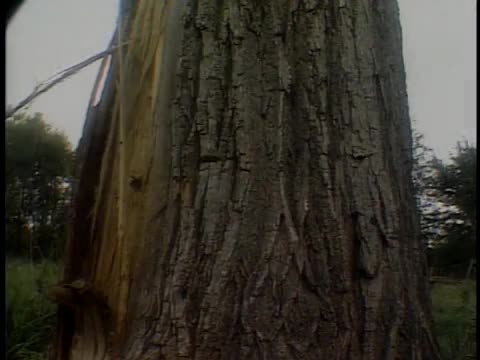
steaks and rope, mirrors, and was laid out according to the movement of the sun in the summer sky. And I was trying to even try to plot, or carefully, path the sun across that particular piece of that site. But again, it was fairly common phenomena, if you refer to more ancient cultures, because they were very dependent upon the movement of the sun. This work was dramatically altered during a storm when a lightning bolt struck one of the giant trees, and the explosion shot pieces of wood, hundreds of feet, like spears. I mean, I got the definite impression that somebody was trying to tell me something. But I did collect those
pieces, and I felt that I had to do something with them. Again, using them in what I would consider to be a more respectful sort of way, but in a more appropriate sort of way in that they're presented as being almost like weapons, because I felt threatened. Patigrone is represented in the Sheldon Art Gallery by Spirit Boat. It is a tribute to an ancient people, a past civilization. Music Music
The Picture Show, presenting Nebraska artist in the permanent collection of the Sheldon Memorial Art Gallery, Lincoln Nebraska. Music The Art of Glass Blowing has remained almost unchanged since ancient times.
Carny artist Ray Schultz uses this process to transform sand into transparent beauty. He creates his designs by a process he calls off -hand glass blowing, which simply is shaping glass with a blowpipe. Ray Schultz is interested in this art form began after years of working as a bronze sculptor. For him, heating metal to 2 ,000 degrees to cast bronze has a parallel to melting sand, and he also enjoys glass blowing for the free forms which he can create. Music My primary
objective is to make a piece that's interesting to look at to the eye, and also the tactile experience is very important to pick up a piece, to even to pick up a coroff, for example, to feel it, to feel it while it's being used is very important as all part of the aesthetic experience. Music Music The Picture Show, presenting Nebraska artist in the permanent collection of the Sheldon Memorial Art Gallery, Lincoln Nebraska.
The town of Aurora in East Central Nebraska is home to artist Ernest Oaksner. From his combination home and studio atop a downtown building, he has a view of the town and its people. Music His painting is interpreted from photographs. He has taken thousands of stills, but only a few make it to campus.
Music Music Music Music Music Music
Music Music Music
Music Music Music
Music Music Music
Music Music Music Music Music
Music Music Music Music Music
Music Music
Music Music Music Music
Music Music Music
Music Music Music
Music Music Music
Music Music Music Music Music Music
Music Music Music Music Music
Music Music Music
Music Music Music Music
Music Music Music Music Music
Music Music Music Music
Music Music Music Music Music
Music Music Music
Music Music Music
Music Music Music
- Series
- The Picture Show
- Episode
- Cuts 25-38
- Producing Organization
- Nebraska Public Media
- Contributing Organization
- Nebraska Public Media (Lincoln, Nebraska)
- AAPB ID
- cpb-aacip-c502aee2143
If you have more information about this item than what is given here, or if you have concerns about this record, we want to know! Contact us, indicating the AAPB ID (cpb-aacip-c502aee2143).
- Description
- Episode Description
- Cut #25 Marsden Hartley Cut #26 Abstract Expressionism Cut #27 Sheldon Memorial Gallery Cut #28 Nebraska Art Association Cut #29 John Thein Cut #30 James Eisentrager Cut #31 Patrick Rowan Cut #32 Ray Schultz Cut #33 Ernst Ochsner Cut #34 Robert Weaver Cut #35 Dave Routon Cut #36 Gladys Marie Lux Cut #37 Gary Day Cut #38 Ed Dadey
- Series Description
- THE PICTURE SHOW is a series of short visual essays examining some of the permanent works of art residing in, and artists represented at, the University of Nebraska-Lincoln's Sheldon Memorial Art Gallery. The series of one-and-a-half to five-minute programs is narrated by actor and art aficionado Vincent Price and presents a variety of different artistic subjects.
- Created Date
- 1987-08-05
- Asset type
- Episode
- Genres
- Documentary
- Rights
- Access to material from Nebraska Public Media’s archival collection is for educational and research purposes only, and does not constitute permission to modify, reproduce, republish, exhibit, broadcast, distribute, or electronically disseminate these materials. Users must obtain permission for these activities in a separate agreement with Nebraska Public Media.
- Media type
- Moving Image
- Duration
- 01:06:00;12
- Credits
-
-
Producing Organization:
Nebraska Public Media
- AAPB Contributor Holdings
-
Nebraska Public Media
Identifier: cpb-aacip-5ceaafa9c2e (Filename)
Format: 1 inch videotape
Duration: 01:02:00
If you have a copy of this asset and would like us to add it to our catalog, please contact us.
- Citations
- Chicago: “The Picture Show; Cuts 25-38,” 1987-08-05, Nebraska Public Media, American Archive of Public Broadcasting (GBH and the Library of Congress), Boston, MA and Washington, DC, accessed October 4, 2026, http://americanarchive.org/catalog/cpb-aacip-c502aee2143.
- MLA: “The Picture Show; Cuts 25-38.” 1987-08-05. Nebraska Public Media, American Archive of Public Broadcasting (GBH and the Library of Congress), Boston, MA and Washington, DC. Web. October 4, 2026. <http://americanarchive.org/catalog/cpb-aacip-c502aee2143>.
- APA: The Picture Show; Cuts 25-38. Boston, MA: Nebraska Public Media, American Archive of Public Broadcasting (GBH and the Library of Congress), Boston, MA and Washington, DC. Retrieved from http://americanarchive.org/catalog/cpb-aacip-c502aee2143