Woman; 420; Masculine, Feminine, and Androgyny
- Transcript
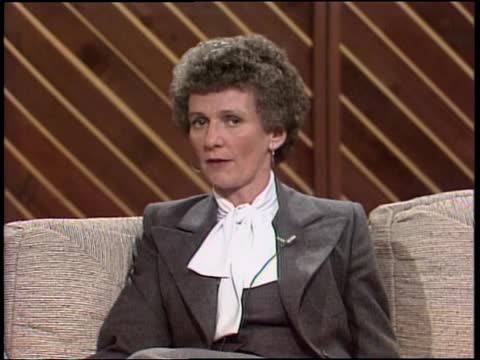
Hey woman. Good evening and welcome to woman. Tonight we're going to discuss a theory of androgyny its meaning and its possibilities. My guest this evening is Joan being Joan and dean of Wheaton College in Norton Massachusetts. She's also a professor of psychology. She is the co-author of Beyond sex role stereotypes toward a psychology of androgyny. Welcome Joan. Thank you. One of the things that really drove me crazy researching this show was the various definitions of androgyny that I ran into with I was reading various people's books. There seems not to be a consensus. I think you're right. There is not a consensus in any sense of the word because it's been used
in such a variety of ways. For example the concept itself is as old as the Greeks. Andrew the first part of the word means male Gyi in means female. And the Greeks thought about it in terms of a hermaphrodite that is an individual who had both male and female characteristics and one of the problems with that Greek debt definition is essentially that when the Greeks thought of this construct that was a mythical creature and in the contemporary sense we would like to think about it as a very real person. But androgyny historically has come from the Greeks into the Renaissance so that in the Musee de Cluny in Paris you can see the old book of ours which has a representation of male and female throughout the whole book itself. And so if you think of it as going almost all through time into young Ian when
Young was generating his theory essentially he has an androgynous part to it where the female part was the opposite of the male. That is a male was confronted in his life time integrating that the female had the male part which was the MS. which was to be integrated in a mature person to be what Jung would call in some ways a self-fulfilled or self-actualize actualized adult. And it even occurs as you probably know in the Bloomsbury Group. With Virginia Woolf on through to 1971 when Sandra been a psychologist at Stanford University in the summer of 1971 asked the question where have all the androgynous people gone. Historically. I think they've always been with us. It's just that social scientists really have not recognized them for a variety of reasons that we might be able to get
into at this point. But maybe it might be better to continue with the definition. Well I want to know which definition you have written a book on right I think and what you think androgyny how it applies to us. Androgyny in the way that we've used it is a relatively scientific definition that is we're trying to think of it and we're trying to think we are thinking of it in terms of a balance of male and female characteristics. Only the balance isn't static. It's really a dialectic it's an interaction between the masculine parts of people and their feminine parts. And we've added another dimension which we call transcendence. That is where people move out of what have been those polar ends masculine and feminine to another plane. That brings those two together. It's a little bit hard to talk about because we don't have the linguistic symbols. For example if you say that dependency has been typically the
female part of a poll let's say of a personality trait and independence has been the male part of the poll How do you bring those two together to talk about them in a transcendent sense that interdependence doesn't quite work. There isn't a word that you can think about that represents both the thesis and the antithesis of a particular characteristic and synthesizes them together. So the symbols present us with some real problems. That's why even when you try to think visually of how you would present an androgenous being you're really at a loss because that person is moving from male to female and female to male all the time and there isn't a way to think of it as a static single visual or verbal symbol. I'm not even sure that if we had the linguistic symbols there too. They're too static to really think in terms of because the process of being or becoming interaction is is really a dialectic process where one is moving between the other all the time without losing the characteristic that you're
talking about well why are we thinking so much about this at this point in time. I mean we're beginning to see articles in popular magazines. There are now three books on the market including yours which are selling rather well on the subject. We keep hearing writers refer to androgyny androgynous characters and so on. What's happening to make it such a hot subject at the moment. I think that we've been searching or at least Well women have been searching for a model for a longer time and social scientists have been searching for it. But there's an interesting history to sort of lead up to what you've just asked me. The history is that if you only look at things in dichotomies Let's take masculine feminine which has been of interest to psychology of sociologists anthropologists and writers for a long time. Nobody had been ever able to characterize what happened if you weren't one of those male or female what if you fell someplace in between in the middle and there were people who and there were people who did that
and there were some individuals in fact mad slow. Abraham Maslow writes about them being the tour coping creative productive people seem to have although he didn't have any empirical data seem to have the characteristics of both male and female. There were some empirical data that nobody thought about interpreted as androgenous Frank Barron at the University of California did some research on highly creative people engineers architects or just mathematicians. OK from both what might be viewed as being very male kinds of careers in very female types or contents in careers. And he found that highly creative people. If you were a female mathematician and you took what was then what it was then it still called the Minnesota multiphase Personality Inventory. The old Im in PR and it had on it a scale of masculinity femininity and he discovered that these highly creative people
find so by their peers. More in fact would show up as the opposite on these tests. When you looked at this particular scale. So in effect what you found was that very creative people in our society turned out to have characteristics that were in fact masculine and feminine. In fact it's a nice support for the fact that hit 200 as people have been with us for a long time. It's just that we've never seen them as being those kinds of people or if you look at the book that was written by get souls cradles of eminence looking at 400 eminent people and you read excerpts from biographies autobiographies Diaries people frequently described themselves as having the characteristics of males and females and writers write about them as if it were the case that behaviorally they had those characteristics in addition to simply a psychological role in what does androgyny have to do with one's sexual preference is that when of this sort of
misunderstandings about androgyny that it is homosexuality or bisexuality or something like that. Yes yes. Or it's simply the case that people think of it as unisex you know and how dull that would be and how that would be certainly not anything interesting Unisex is not a construct that's associated with androgyny really in the way that we've used it nor in the way that other people have used it in contemporary terms. But I think some people have interpreted it as being that or they've interpreted as being bisexual. In our book we do not deal with the sexual aspects for a number of reasons. First of all our laboratories are simply not sophisticated enough to look at the relationship between hormones and sexual behavior or sexual preference. John Money at Johns Hopkins University has done a great deal to look at what happens when infants and older with endocrine logical problems. And you carry out a surgical procedure in
addition to counseling. What is the most powerful variable that shapes sexual preference or sexual behavior or simply sex type behavior. And I would say although I'm not sure he would agree with me in my interpretation of his work is that it's really the environment. And that shapes a great deal of what is sexual preference with regard to how you would apply Indrajit. I read The honestly feel it's too soon to tell. I don't know. I mean is it the case that certainly Freud would have argued that the androgynous person is indeed the bisexual person. That's an early stage in development where we are in fact y sexual. We really have not even grappled with it mostly because I feel that we're just beginning to probe the promise of androgyny and that we don't want to get carried away in the sense of saying hey here's a model and let's sell it abroad. It happens to be one model that right now is very attractive.
Where did you begin to be interested in and begin to study it because you saw it as a solution. I saw it as a way and if there is this old the schtick in psychology that one always researches the things that. Have either provided you with some conflict in your own life or that there are things that unconsciously you really are trying to work out for yourself. I'm not sure that that has any reality but clearly as a woman. Spending 17 years at home child rearing and now going through a real career change by going to graduate school. My sense was I had been in what had been a very traditional female role and I was now moving into a very competitive area of academe. Learning how to be a researcher learning how to do computer and data analysis in the integration of those two parts of my life were they occupied a lot of my psychic energy to say the least. But in addition to that I was interested in how to fit those two things together I'd been part of a two
person career. That is where I was part of a man who was making it in the world and now I was stepping out to do that other side so I was interested in how one might fit those together. And there weren't any models. I mean we didn't have to were one or the other questions that lots of women are asking you know how do I saw that dilemma. So you see androgyny as an answer for us. I see it as an answer cautious I'm cautious about it I'm cautious for a number of reasons. One is that the radical feminists have really had a superior critique of us. That is of the model of androgyny in peace and how I want to talk about the model before you talk about their critique. OK the model itself came about as a function of Sandra Benz interest in the sense she really is our form mother at Stanford. And when she generated the question where have all the Indrajit its people gone she decided that being a psychologist. One place to put your political Eminence is into your own research
to make it instead of a rhetorical argument rhetoric to really do some empirical. That's really what she'd been trying to do. Do some experimental research. So what she did was to construct a scale called the Behm sex role inventory where she generated a set of descriptive adjectives that ranged from what might be viewed as very masculine aggressiveness to feminine submissiveness to some neutral the Scripters. That was in 1972. And the first thing she did was let's see whether there are any around. And the operational definition then of the theory of androgyny is as you take this scale and you describe yourself like this describes most of the time or at least of the time or not at all. If you equally indorse male and female characteristics on this instrument the scale then you are androgynous. Operationally. Now there have been some fights about this it was done early
on. It was the first breakthrough. People are still using it and it's been a really a major shift in psychology. To move away from the masculine feminine polar ins. OK it's one way. It may be a weak way but there are still a lot to recommend it because the nice way of validating the whole theory and the scale is to say OK so you have one third of your people are androgynous. Turns out by the way that's of her all her college sample at Stanford in a local community college one third of her sample is androgynous. OK one third is sex typed. That is you're male and you're masculine on the scale or you're female and you're feminine on that scale. And the other set is sex reversed. And that's very interesting because most of the sex reversals are with women where they're endorsing more male characteristics than they are endorsing female characteristics. Anyway when she had done that that was a step one the next step was to see if
behavior had anything to do with the scale. So what she did was to try and set up what might be viewed as again masculine and feminine experimental settings. So if you know somebody is androgynous Let's see how they handle a mechanical task. OK. A female or let's see how a male handles holding a new baby in taking care of a new baby for about five minutes. OK those are two albeit the psychologists think of some kind some very pseudo arrangements but at least that was an experimental and controlled way to see does this scale have anything real to do with behavior. And what happened was she found that androgynous people in her sample already defined by the scale could engage in both those tasks with equal ease. That is what males he was who she was using for the test group. Were they aware that they had these qualities. I don't think they were aware in the sense that one in doing experimental research one doesn't
say we're not going to do is I want to see if you can behave in an androgynous way. You usually don't say much about what the experiment is about. No but I mean the people involved in the experiment that they don't know. I mean do they see themselves any differently. I don't know in typically of course psychologists don't do follow ups like that after experiments I mean they it's a lovely thing to do to say hey what did you think this was about. You know you think the study was about and sort of get a bead on what kinds of things they had in their head. And I would suspect that if you took the BAM sex role inventory you might view it as simply a personality inventory. It might not appear to have anything to do anything related to sex rules itself. And that's always a problem. I mean how naive are the subjects. You know when I was a real hero to know how aware they were that they were operating slightly differently than from what we have considered as the norm.
Eventually they knew very well because of course she's published her research every place and in addition to being around the country a great deal. And then the next thing she did was to look at OK let's let's see what sex type people do in these situations. And in the task mechanical males who were high sex typed identified me adults very comfortably did the mechanical tests but were terribly uncomfortable and some simply could not tolerate some simply refused to deal with this infant who was essentially to be cared for for something like five minutes. Women who were high sex typed in feminine ways had no trouble handling the female infant. OK but had a great deal of trouble dealing with the mechanical aspect of the task. There was one very striking thing that happened in the set of experiments and that was that high sex type females and high sex type males really had a great deal of difficulty relating to peers who needed help. I mean just simply like
your roommate comes to you and want your support for something that's happened at home or they've just split up. How do you counter that all friend. It's it's unique in the sense that a number of people including them and we have or do the saying that high sex type people have a lot of difficulty because they're rigidly stereotyped. The flexibility is very slim for them. They can't move between that masculine feminine test that she set up once you set up the situation. What surprised us was that the few males were not more supportive in a kind of cry for help. You know I need help would you please help me. But they were not more supportive but it sort of suggested at one level that people who are high sex theory of type have a lot of trouble either supporting other people. And Paul Musson is another person at Berkeley who's done a lot of research historically although he would never interpret it stated this way. When you follow up males in the long the two new Berkeley studies which are old and important studies in psychology males who are high sex
identified adolescents turn out not to be quite so healthy psychologically. By the time they're at middle age. So you're saying I guess you know what all this leads up to in the book and everything is that we would be in better shape as individuals and as in it as a society if we were more androgynous or if we were androgynous rather than. So totally masculine defined in feminine defined essential that is what I'm saying. Although being and not a typical academic I want to immediately cut that off and say but but but what about it. But the generalization is pretty much there and I keep thinking to myself we're currently writing another book. I keep thinking to myself things like. There may be more models than we even have a sense of yet. This is number one. There may be two or three in the offing but this is the one we're trying to grapple with here and it looks very provocative but it's very threatening right. I think it's very threatening in the sense that
when you look at for example clinical populations women who are really trying to get their androgynous persons together are having a lot of difficulty doing that. Well either people who are consciously trying to do that and labeling it as such. I don't think so because I don't think yet. There is as much awareness of the of the sort of androgenous consciousness that we would think about it. That's the thing I'd like you to do because it when we were talking earlier you mentioned things to me that you felt aspects of society and even people that you felt were androgynous and you know things that never would have occurred to me. And I think there really is a shame that it is around us to a larger extent than we had managed as is you know incredible very consciousness raising. I think it's very surprising when you think in terms of for example Dan Levinson's work with males. When I think in terms of the work that I did with Corporation executives that male corporation
executives who are judged as being successful by their peers much like the Bear used the same kind of method the Baron used in the creativity study were in fact androgynous males. That is they had both male and female characteristics. And if you think about it for a moment in order to be a successful manager executive organizer you have to be interpersonally skilled with individuals. You have to be cooperative but you also have to be fairly offshore Aetate of person. You have to be a decision maker. But on occasion you have to be submissive. You have to be aggressive. If you put it all together into some conglomerate you could argue that androgyny is the best of both worlds. You really are bringing together those positive things about males and females that allow for creativity and success. In fact there's some early data that male high IQ males and high IQ females may indeed be androgynous. And that's
interesting because we haven't even started to talk about what would the development of an androgynous kid look like over time. I mean what would what would be a new development a lot of how an individual would learn androgynous beauty here. We have so little sense of that I think there's some evidence of that in that in the present youth culture rock movement. I think one could look at the sort of external characteristics. Some of the sense of dress of hair. Of colors of softness. Of course I'm always weary of looking at that. It's also a reflection of attitudes and behavior because I think it can sometimes be a little bit surprising both in our expectations for what that might mean. But I think that I see some evidences of moving that way. Just the idea that women are seriously considering careers or trying trying and I say trying to integrate those feminine
characteristics of compassion and caring into confidence in competition. I mean those are areas that I think are really people are working hard within the not the notion of androgyny in some way seems totally irrelevant but the fact that they're trying to integrate those those parts of their lives I think is very important. Being at a women's college it's interesting to see this shift historically. When I look back and read older records about what the alumni from Wheaton College are doing and what I see our students in last year's annual report that it's remarkable. I mean the change in the shift is so startling that it almost in four years the turnaround in two careers in moving out and long term commitments is a stunning thing to say. Think about the benefits to the individual. You know we did as a society and it seems to me not to first of all I would
say right away but flexibility OK. When this is a very trivial example but think in terms of being in a restaurant and the waiter is up noxious or a waitress is obnoxious to you and you're you're sort of a passive female and I'm an that guy or woman should really get get some feedback. Right. But you have to have your act together. In order to do that you have to be through a little risk taking make it kind of a scene. I think that that's a very simple example of if you're rigid you know if you really walked into being a passive lady you're going to do that. You put your white gloves and you go so far as to say that it that possibly a move toward androgyny might be more beneficial to women than to men. That were beneficial but more readily accepted by women and by men. I've argued something like that. We have only have two minutes. I know that's a big question. My sense is that
women have have in the sense a been more more flexible they've had to learn more behaviors. OK. And in learning more behaviors their adaptability may be greater than males. OK. They have models around them both male and female so to males but males know very early on that in order to make it. They're going to have to commit themselves to some kind of career. I mean they don't have a choice. Women don't know that but they learn how to manipulate themselves through the environment to deal with all kinds of inputs from the environment and to move with situations perhaps sometimes a little bit too much. And perhaps they will have an easier time integrating and moving towards the model of androgyny males may have a lot more difficult time. I want to talk about in terms of we only have one minute now mental help. I mean you obviously obviously see that and drudging this person would be more mentally healthy.
I would because you have greater degrees of freedom for individuality. You're not locked into a stereotype a stereotype essentially that says to you hey you can't do that. You're a woman or to a male. You can't do that. That's Woman stuff. And I think in that sense to be able to shift and to be flexible in a society that that hopefully will allow you that flexibility in that's another issue we didn't talk about how they control that behavior is really a healthier way to be. It allows you more room to move. And I think that's critical in this contemporary society. The one thing we know is going to be with us is change. And if you can move with that instead of being locked into a role I think that the advantages for growing in being are simply much greater. Thank you. I think I understand a little bit more. Thank you for being here. Thank you for watching and good night. This program was produced by W. and soley responsible for
its content. Your funding was provided by public television stations additional support was provided by unrestricted general program grants from the Corporation for Public Broadcasting and the Ford Foundation.
- Series
- Woman
- Episode Number
- 420
- Producing Organization
- WNED
- Contributing Organization
- WNED (Buffalo, New York)
- Library of Congress (Washington, District of Columbia)
- AAPB ID
- cpb-aacip-81-708w9q5x
If you have more information about this item than what is given here, or if you have concerns about this record, we want to know! Contact us, indicating the AAPB ID (cpb-aacip-81-708w9q5x).
- Description
- Episode Description
- This episode features a conversation with Joan Bean, the Dean of Wheaton College in Norton, Massachusetts. She is a Professor of Psychology and is co-author of "Beyond Sex Role Stereotypes: Toward a Psychology of Androgyny."
- Series Description
- Woman is a talk show featuring in-depth conversations exploring issues affecting the lives of women.
- Created Date
- 1977-01-06
- Asset type
- Episode
- Genres
- Talk Show
- Topics
- Social Issues
- Women
- Rights
- No copyright statement in content.
- Media type
- Moving Image
- Duration
- 00:28:59
- Credits
-
-
Producing Organization:
WNED
- AAPB Contributor Holdings
-
WNED
Identifier: cpb-aacip-36977dbb938 (Filename)
Format: DVCPRO
Generation: Master
Duration: 00:28:59
-
Library of Congress
Identifier: cpb-aacip-5343a0d33e8 (Filename)
Format: 2 inch videotape
If you have a copy of this asset and would like us to add it to our catalog, please contact us.
- Citations
- Chicago: “Woman; 420; Masculine, Feminine, and Androgyny,” 1977-01-06, WNED, Library of Congress, American Archive of Public Broadcasting (GBH and the Library of Congress), Boston, MA and Washington, DC, accessed October 14, 2026, http://americanarchive.org/catalog/cpb-aacip-81-708w9q5x.
- MLA: “Woman; 420; Masculine, Feminine, and Androgyny.” 1977-01-06. WNED, Library of Congress, American Archive of Public Broadcasting (GBH and the Library of Congress), Boston, MA and Washington, DC. Web. October 14, 2026. <http://americanarchive.org/catalog/cpb-aacip-81-708w9q5x>.
- APA: Woman; 420; Masculine, Feminine, and Androgyny. Boston, MA: WNED, Library of Congress, American Archive of Public Broadcasting (GBH and the Library of Congress), Boston, MA and Washington, DC. Retrieved from http://americanarchive.org/catalog/cpb-aacip-81-708w9q5x