New York Voices; 808; Main Street Harlem
- Transcript
[-beeping-] This is an extraordinary opportunity to guide appropriate and stimulated development on one of the world's most famous thoroughfares. I further believe this plan allows 125th Street to grow with the rest of New York City. (indistinct crowd) (indistinct crowd) What are you doing other than changing that residential corridor that business corridor Harlem's main street into a residential enclave of luxury houses. New York, one voice at a time. New York Voices
Voices is made possible by the members of 13. Additional funding by Michael T Martin and Elise Jaffe And Jeffrey Brown. Welcome to New York Voices. I'm Rafael Piromon. You know Harlem is the capital of black American culture. On 125th street with such landmarks as the Apollo Theater and the former Teresa Hotel is its main street. But this historic corridor may be in for big changes since the city council is considering a rezoning plan which could eliminate existing retail stores by creating new office space and housing. As you're about to see the debate over whether or not to rezone 125th Street has ignited strong feelings about the future of the entire neighborhood. Harlem councilwoman Inez Dickens holds the most influential vote in the rezoning battle community. The current law must be changed. It offers absolutely no protections for my Harlem. I reject though, what the administration offers. It to is not acceptable. That was two weeks ago at another council meeting this morning Dickens spoke in support of the
plan. At this time I humbly ask my colleagues to stand with me today and support the rezoning plan with my modifications. Dickens' changes included more affordable housing, reduced height limits in assistance to small businesses that are displaced. It is my opinion that all of the components that I have worked so hard to secure to protect my community will honor Harlems past, reclaim Harlem's present and provide for Holland's bright expansive future. But to be inclusive of all of us that have lived in Harlem for years. But many Harlem residents are deeply opposed to the plan. At a recent meeting on the rezoning held by the Department of city planning two people were ejected from the room. What are you doing up other than changing that residential corridor, that business corridor Harlem's Main Street in to a residential enclave of luxury housing.
At the April 1st city council hearing many people testified against the plan [guest] this plan is to be scrapped absolutely, nobody need to discuss it any further. Inez you have not been present. You are putting my loved ones out. You talk about if we do nothing that jobs will be lost. Honestly and frankly I must say who cares when the community is constantly being bleached out. So who will the jobs be for because as it stands now we are losing our community. Amanda Burdon the director of city planning says that if the rezoning plan isn't passed Harlem is far more likely to lose its identity. The effect of doing nothing would be that there would be no affordable housing that there would be no increase in jobs that there would be no are in increased arts presence. So there really is nothing to really protect the essence of this street and build on this very important
corridor that's Harlem's Main Street. The rezoning plan would impose height restrictions to preserve the historic brownstones on one hundred twenty fourth and one hundred twenty six streets. It would also promote new development and a hundred Twenty fifth street allowing some buildings to rise as high as twenty nine stories. This rezoning will result in a rich range of retail and arts and entertainment offerings creating an economic engine for Harlem with over two million square feet of office space and more than 8200 jobs. To enhance Harlem's cultural offerings developers would be allowed to build taller buildings in exchange for leasing space to arts groups. We believe strongly that the arts bonus will allow for more of our colleagues to create synergy in this important street that really does speak to the history of the arts of our community. To promote an active street life storefront along 125th Street would also be tightly regulated.
For example banks would be prohibited from opening branches on the ground floor. The city would also provide a high bonus to developers who build affordable housing. This is an extraordinary opportunity to guide appropriate and stimulated development on one of the world's most famous thoroughfares. I further believe this plan allows 125th Street to grow with the rest of New York City. The Department of City Planning spent two and a half years working on this rezoning plan including extensive community outreach. This is a product of the most consultative and solicitous process that I have personally witnessed in my seven years on the commission. While my vision is for 125th street to be the premium cultural destination for a New York City. Barber Askins is the president of the 125th Street business improvement district and a supporter of the plan. The arts bring in the history. It brings in more of the culture and it also preserves what is
dying. And if you look in other communities that have developed the arts have been pushed out. It's a feeling it's a pulse that you get when you walk down 125th Street that moves your body because you're walking on history. You're feeling the history of a people and you know you can change the future without hurting the history of the people. Frank Parry is the chairman of Harlem community board 10 and he was opposed to the original rezoning plan. If you read the plan and in total I mean part of it alludes to the fact that displacement is happening already. So why not more displacement. Well we don't like displacement at all. Unless there's an opportunity for those people who are being displaced to find other housing. One family being displaced is not acceptable. But after today's modifications Perry says that every concern that the community board had, has been addressed including its call for lower height limits more affordable housing and aid for local businesses. After Dickens spoke in favor of the rezoning at this morning's meeting
a subcommittee of the city council voted in favor of the plan. The full council will hold another hearing on the rezoning plan tomorrow and then must vote on the issue before the end of the month. So stay tuned. Meanwhile Manhattan real estate prices continue to soar despite the faltering economy. Here's a look at what the real estate boom has meant for Harlem. My name is Willie Kaplan (indistinct). I moved to Harlem in 1985 and this is what we sell. (indistinct) It's changed a lot since '85. We're now at the point where if you walk around in Mount Morris Park on a Sunday afternoon in the summer you think you're in Paris because you're listening to people speaking French. Some of it's French Creole because they're from Haiti some of it's French because they're from France. We're from the Upper West Side we've been living there for years and we love Manhattan. And we recently had a family a year and a half ago
and we needed more space. (softly "wow") We paid, um, around, you know, n..no problems, we paid somewhere in the 800,000 range for this place. But in this neighborhood there's places going for a lot more than that. How long I've lived in Harlem? I'd say forever. I'm part of everybody here in Harlem. Many years ago we had drugs. All the negative things. Many of us on account of that emotionally left Harlem and went other... wuh... places. And by staying here we did what was necessary. Eventually it was like a diamond. You take a diamond it would be rough. Start polishing and polishing it and then it start to sparkle all over the world. My goal was actually to live in Harlem. My husband I was trying to find a brownstown. But we kept getting priced out. So as we were thinking about
instead of living here how can we be a part of Harlem. It's hard to shop for wine when you're used to living in other neighborhoods where there's a wine shop in every other block to have to go through the bulletproof glass and sort of point to different things. (music) My name is Rene Kalvo and I'm the owner of the Harlem Flop house. And also the cook and the chambermaid and uh, pretty much everything. I closed down this place in July of 2000. It had been turned into a flop house in 1917 and pretty continuously had been run as one. From the very beginning I had a lot of European guests. Japanese guests've kind of slowly grown. In fact some my Japanese guests have told me that this is the famous destination that I I'm very kind. (music)
In 1985 nobody cared who bought the house that was empty they were just eternally grateful somebody bought the house and was repairing the house. Well we've seen as the prices have gone up is there is resentment on the part of some of the younger African-Americans who grew up here. You've had unfortunate incidents, horrible incidents where, we're out with customers who happen to be non African-American and one of the kids will say well gee why don't you go buy somewhere else. And we say there just looking and they have a right to buy here just as your dad does. The influx of people coming up from different nationalities that's what makes New York New York. I'm a New Yorker. People who come now we don't have static with anybody coming here in. They're greeted like you're, like a neighbor. We think as long as people have something to bring into Harlem that's good for Harlem. And I think right now the people up here are mainly concerned with the color green. I think we've had no concerns moving into the area. But people we know always
say on Long Island you know they think we're potentially we're crazy to live in Harlem but people have lived in the city I think if I know what the city's about then it's no different up here. I do think that Harlem is at a crossroads. But the key issue with being at a crossroads is do you alienate or isolate some of the people that really created and are part of Harlem's history. I told my husband 20 years ago that Harlem was never, it was not going to remain the way it was then. We had too much to offer up here and I told they're you going to come back. They're going to rehab. People are going to move back to community and here it is. Well I mean things are changing in Harlem really fast and there's a lot more middle class than just really wealthy whites moving into the neighborhood. I don't know what that's going to mean ultimately. (music) With all the changes going on in Harlem what's the word on the street. We want to find out in this
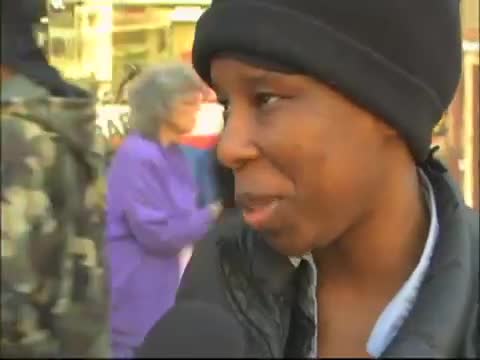
week's New York nerve. I see a lot of changes, besides the, um, law enforcement I see like they reconstructing buildings that was abandoned here and, um, I think more people is moving and Harlem is Harlem again. Now we've got people from all over living in the same neighborhood and I think it's nice. Hope they clean up the streets the stores are better they're nicer. Stores have just popped up one after the other. All of the developing and everything of, uhh, new buildings. I'm very happy about it. Pretty decent. It's been real quiet around here, not too much danger, not too much, ya know shooting. Before was just a lot of you know a lot of crack heads going crazy. Now everything is being fixed up, ya know go away. The change that's going on, I mean. Hopefully it be for the better. Hopefully it bring jobs to the neighborhood.
I mean they need to make more affordable housing. They're not taking into consideration the people that live here in Harlem. I, we have nothing against building up Harlem. Take the people into consideration instead of just that, the, um, millionaires that want to make money. A lot more's happening though, in regards to I guess commercial businesses. I don't know if it's good it looks but many times it's really bad for the people who've been here and they pushing out. Harlem is beautiful Harlem is wonderful. Even with the new buildings and the new stores and all the stuff that they doin and that's what's bringing people back to Harlem. I think the rich history continues. People come from all over to see Harlem. They're not going to see Harlem anymore. I think they need to take the spiritualness of the people that live here you know and have a lot of respect for those who have been here for years. Cuz they can tell some history. Harlem's got a great history.
My grandparents passed their history to me. I can tell you some history about Harlem. Harlem is always Harlem (indistinct) I mean come'on. New York is known as the Big Apple. And Harlem is known as the core, the seed. As long as they don't change the Apollo (music) (music) I think we have one of richest cultures in the world and by riches I mean popular among other people. A kid does something here in Harlem. And you'll see it on a campus and in England within six to seven months. It's amazing how any sort of cultural thing that starts here picks up in white communities. A lot of artists came from out here and umm you know it's very cultural and it's you know Harlem is beautiful. You know it's the place to be. There's always something to do in Harlem. There's always something going on. It's a kind of place where even sitting in a corner I could be bobbins you guys and (indistinct)
carrying on. And I was no one's gonna walk up to me and say "Hey you crazy or what" they would say, "hey, she's feelin' good". She's here in Harlem on 125th street. And it's all right. And that's a nice feeling. Well the rezoning plan for 125th Street help or hurt Harlem. We like to know what you think. So please log onto our Web site and cast your vote at 13.org/newyorkvoices And turning now to another real estate story. If you drive on the west side highway you probably noticed architect Frank Gehry is on usual all glass office building. Here's Paul Goldberger architecture critic for The New Yorker on how this new structure has changed the landscape and mindscape of Chelsea. (music) You know I think you could describe the IAC building as a kind of glass palazzo almost because it-it has the proportions of a renaissance palace or something. It's wider than it is tall. It's a building that kind of sits there with a presence. But
unlike a classical building it isn't symmetrical. It isn't made of stone. It's made of glass. And the shape kind of oozes a little bit and curves in a lot of interesting ways. Frank Gehry is an adventuresome daring creative architect. And New York has not always been hospitable to adventurous, daring and creative architecture. Frank Gehry has worked primarily in metal. Some wood. Glass has always been a part of his buildings but until the IAC building he'd never done a building entirely sheathed in glass. That neighborhood of course is coming alive in a phenomenal way. A lot of it is renovated lofts and factory buildings that have been turned into new uses. And we have the Highline which will be an extraordinary elevated park on the old rail
line. It's going to be a very different neighborhood. It's pretty obvious that this is not a standard corporate box. But it isn't really a standard Frank Gehry building if there is such a thing. Gary is so associated with the sort of curving metal shapes of buildings like the Guggenheim Museum in Bilbao Spain or the Walt Disney Concert Hall in Los Angeles. That one sort of expects that. The building was commissioned by media mogul Barry Diller CEO of Interactive Corporation otherwise known as IAC. The interior spaces were designed by studios architecture to achieve Diller's goal of housing his 60 companies under one roof. We were hired on this project specifically to make sure that we would bring the voice of the IAC to that. That would be the IAC interior. We were looking at here's an organization that has a lot of parts and pieces. And here is a building that is very expressionist that has a lot of angles and curved sides to it. And probably
our first guide was that we were going to have to try to find what was the simple solution that united that organization and that building. I think that we found very quickly as we got into it that in fact what we needed to do was celebrate the diversity and the eclecticism. So that was a little bit of a process of discovery. One of the early decisions on the project was to give the open space the best views. The best views happen to be on the serrated edge. So by nature we were planning the open space against the more organic part of the building and the rectilinear offices in the more rectilinear part of the building. What we then discovered when we began to layout the workstations in that area that if you did anything rectilinear began to fight it so we knew we needed another level of invention. And that we actually needed to develop workstations which were also organic and played more against the building. The first thing you have to do in the morning is go to the ninth floor which has the best view to get a cup of coffee.
The building sits back on the sixth floor and becomes a terrace of the executives rather than being on the top floor or in the middle of the building and the building nicely then divides between the smaller upper floor plates and these larger lower floor plates. The conference rooms throughout the space are all different they have different kinds of technology in them. So for instance if you want to do particular kind of video teleconferencing you know you go to the prow on the fourth floor. So that's also a way that helps groups interact. One of the things that you'll see as a feature in studios work over and over again is a lot of times today, uhh clients are very interested in the message of the space. And IAC is not a technology company it's really an information company. So we're trying to incorporate the technology into the architecture so in fact you see the information not the technology. The lobby was intended really to serve a dual function. You might even say a triple function. The
first is the obvious one to get people in and out of the building. The second is as an event space. The video wall can become a great communications tool and backdrop for programs for parties so forth. And then the third purpose the video wall communicates to the outside it serves as a constant form of entertainment, advertising obviously for the company and it energizes the building in a certain way. One of the issues on this project was how to push the boundaries again of how big an image you could get in space. How good you could make the resolution of the screen so that the glass is actually the kind of glass that you would see on a flat screen TV. There's a whole series of of cameras that overlap mirrors different sort of lighting. And IAC has gone on to develop different programs for that wall. Everything from very artistic videos to rollout of different products. Gary did something very interesting with the glass. It's what's called "fritted" glass which is
glass with tiny enamel dots on it which create a very subtle pattern that looks almost like smoky haze. But he didn't apply the frits uniformly through the glass. They are mostly at the top and the bottom fade out so that in the center area the glass is essentially transparent. So you have this beautiful sort of fading quality of each piece of glass which gives the whole building this slightly blurry quality. I think it's wonderful that there's a building in New York that is getting people talking. For Gary there was the challenge of building in New York which is difficult enough. And building in a way that proved that he could do something that was distinctive and at the same time would have the
flexibility and at least some of the economics of a more conventional office building without literally being conventional. That was the challenge to how to walk in between those things. I think he pretty much did do it. We're close now with an excerpt from the series that covers the best cultural offerings in the city. It's called Sunday Arts. And it airs every Sunday afternoon. Take a look. This is a Leo Levy and Shelby White court for Roman arts. Center of the new display of Hellenistic and Roman art that opened recently at the Metropolitan Museum. My name's Elizabeth Melaka. I'm associate curator in the Greek and Roman department here at the Met. And I'd like to show you today one of my favorite works in this new installation. This is a Roman bedroom. It's known as (indistinct) And it is from a villa that was buried by the
eruption of the volcano Mount Vesuvius in '79 A.D. What the young artist has tried to evoke here is the sumptuous wealth and beauty of palaces. It's very sophisticated decoration. Because this is a small room. But we feel restful here. But the color you see in their brilliance are exactly as they were when painted. Hecate was the goddess of the moon. On the whole a good person to have in your bedroom at night. Now here you really see well on this side, this golden shield with these star of Macedonia. I really love these columns. I love them because thery're so wild, these columns.
Infinite variety here. And richness in detail. This umm, cool grotto with just a glimpse of little statues around this pool. I think that's just magical. It's a beautifully poetic little touch almost. I love that. I particularly love the Griffins these long elongated white animals. You are getting closer here really to the ancient world to the thinking and taste of the ancient world than almost anywhere else here. Please come to the Metropolitan Museum of Art and come to the new Greek and Roman galleries. And don't miss the Roman (indistinct). I know Elizabeth Miller associate curator of Greek and Roman art.
And this is my choice. And that's it for this edition of New York Voices. For board tonight's program or to vote on this week's online question we'll rezoning 125th Street help or hurt Harlem. Log on to our website at 13.org. I'm Rafael Piromon thanks for watching. We'll see you next week. New York Voices is made possible by the members of 13. Additional funding by Michael T. Morton and Elise Jaffe and Jeffrey Brown.
- Series
- New York Voices
- Episode Number
- 808
- Episode
- Main Street Harlem
- Producing Organization
- Thirteen WNET
- Contributing Organization
- Thirteen WNET (New York, New York)
- AAPB ID
- cpb-aacip/75-547pvvtw
If you have more information about this item than what is given here, or if you have concerns about this record, we want to know! Contact us, indicating the AAPB ID (cpb-aacip/75-547pvvtw).
- Description
- Episode Description
- One of New York City's oldest and most venerable neighborhoods is going through a renovation. And not everyone is happy about it. Today an important City Council Subcommittee approved a major rezoning proposal that would transform 125th street. The full City council will likely cast a final vote on the issue tomorrow. If you drive down the Westside highway, you've probably noticed an all-glass building off to your left. The unusual structure -- architecture critic Paul Goldberger calls it a "palazzo" -- was designed by Frank Gehry and commissioned by media mogul Barry Diller. We look at how this new structure has changed the landscape and mindscape of Chelsea. We present a curator's choice of the Greek and Roman Galleries at the Metropolitan Museum of Art.
- Series Description
- New York Voices is a news magazine made up of segments featuring profiles and interviews with New Yorkers talking about the issues affecting New York.
- Broadcast Date
- 2008-04-15
- Asset type
- Episode
- Topics
- News
- Local Communities
- Media type
- Moving Image
- Duration
- 00:27:17
- Credits
-
-
Producing Organization:
Thirteen WNET
- AAPB Contributor Holdings
-
Thirteen - New York Public Media (WNET)
Identifier: wnet_aacip_18883 (WNET Archive)
Format: Digital Betacam
Generation: Master
If you have a copy of this asset and would like us to add it to our catalog, please contact us.
- Citations
- Chicago: “New York Voices; 808; Main Street Harlem,” 2008-04-15, Thirteen WNET, American Archive of Public Broadcasting (GBH and the Library of Congress), Boston, MA and Washington, DC, accessed October 4, 2026, http://americanarchive.org/catalog/cpb-aacip-75-547pvvtw.
- MLA: “New York Voices; 808; Main Street Harlem.” 2008-04-15. Thirteen WNET, American Archive of Public Broadcasting (GBH and the Library of Congress), Boston, MA and Washington, DC. Web. October 4, 2026. <http://americanarchive.org/catalog/cpb-aacip-75-547pvvtw>.
- APA: New York Voices; 808; Main Street Harlem. Boston, MA: Thirteen WNET, American Archive of Public Broadcasting (GBH and the Library of Congress), Boston, MA and Washington, DC. Retrieved from http://americanarchive.org/catalog/cpb-aacip-75-547pvvtw