Villa Alegre; 164; Music, Music, Music
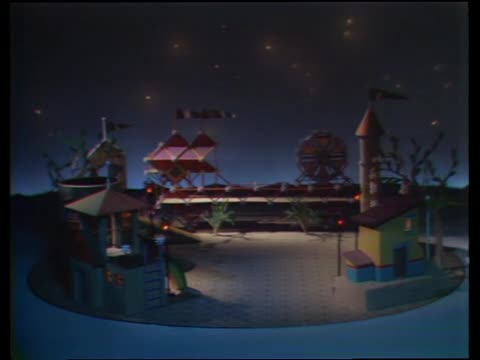
- Transcript
I'm sorry I music music,
Music music, Music and take your things. I
don't know what to say. Rafael, where did music begin? Yes, where did it come from? imagination and heart?
I like that! Music is allegory, tambienes harmonia, com musica te canto, esta cancia maria. Harmony, happiness, imagination, com musica te canto, esta cancia maria. What kind of music do you like best? Oh, that's nice!
What kind of music do you like best?
I don't know what you like best, they're all so beautiful.
Oh, that's nice!
This sound is made stronger or resonated
by the two parts of the drum. Drums are divided into two classes, those which have a definite pitch and those which do not. For example, the snare drum has strings or snares as they are called across its underside. These strings vibrate against the drum head giving the snare drum its special penetrating sound. The bass drum is much larger than the snare drum and it has no strings. Both of these drums have metal rods that can be adjusted to change the amount of vibration. Konga drums are the simplest of drums. The vibrations produce in the variation of sound of these drums is controlled by the skillful use of the hands and fingers.
The timpanies or kettle drums produce another type of drum sound. They can be tuned to different pitches by means of screws and pedals. The timpanies are the only drums with pure musical tones and are used in symphony orchestras and concert bands. The drum is the oldest of all musical instruments. In the drum while the egg is, I said yes sir. Thank you. The drum has served throughout the egg as man's means of expressing his instinctive love of rhythm.
Look! Oh, Marcos, they're beautiful. Now we just have to wait, huh? That's right, until the hamburgers are cooked. But first we have a surprise for all of us. We're going to have some entertainment. Rafael is going to help. Come in, kids. Come on, come on. Come on. Yes, on.
Come on, come
Oh That was nice, but I hope
it won't be long before we eat. Pascencia, paciencia, marcos! He means, will we eat before the rain starts? Rain! I guess you've been too busy to learn so to bit clouds up there. Oh! Rain! Rain!
I can do so many things by myself. I can offer something. Everybody can offer something. We can do so many things together. Rain!
Rain!
- Series
- Villa Alegre
- Episode Number
- 164
- Episode
- Music, Music, Music
- Producing Organization
- Bilingual Children's Television
- Contributing Organization
- Library of Congress (Washington, District of Columbia)
- AAPB ID
- cpb-aacip-6a4783ff6da
If you have more information about this item than what is given here, or if you have concerns about this record, we want to know! Contact us, indicating the AAPB ID (cpb-aacip-6a4783ff6da).
- Description
- Series Description
- Villa Alegre (Happy Village) is the first national bilingual (Spanish/English) program in the United States. It was produced with the goal of teaching Spanish to English-speaking children and English to Spanish-speaking children, and was produced by Bilingual Children's Television as its inaugural project on the company's founding in 1970. Villa Alegre debuted on Public Broadcasting Service (PBS) public television in 1973 and ran there until 1981.
- Copyright Date
- 1974
- Asset type
- Episode
- Genres
- Children’s
- Media type
- Moving Image
- Duration
- 00:30:33.532
- Credits
-
-
Producing Organization:
Bilingual Children's Television
- AAPB Contributor Holdings
-
Library of Congress
Identifier: cpb-aacip-6e59e065af5 (Filename)
Format: 2 inch videotape
Duration: 00:30:00
If you have a copy of this asset and would like us to add it to our catalog, please contact us.
- Citations
- Chicago: “Villa Alegre; 164; Music, Music, Music,” 1974, Library of Congress, American Archive of Public Broadcasting (GBH and the Library of Congress), Boston, MA and Washington, DC, accessed October 14, 2026, http://americanarchive.org/catalog/cpb-aacip-6a4783ff6da.
- MLA: “Villa Alegre; 164; Music, Music, Music.” 1974. Library of Congress, American Archive of Public Broadcasting (GBH and the Library of Congress), Boston, MA and Washington, DC. Web. October 14, 2026. <http://americanarchive.org/catalog/cpb-aacip-6a4783ff6da>.
- APA: Villa Alegre; 164; Music, Music, Music. Boston, MA: Library of Congress, American Archive of Public Broadcasting (GBH and the Library of Congress), Boston, MA and Washington, DC. Retrieved from http://americanarchive.org/catalog/cpb-aacip-6a4783ff6da