Hugh Milton: Thank You America
- Transcript
You You You You
Fellow Rotarians guests, visitors, Quantians, it's for the very great pleasure that I introduce Hugh Milton. When I approached Hugh last month and asked him if he would speak before the group I suggested a topic, I said we're not going to ask you what to speak about. We said if you would like to speak your topic will be thank you America. And he turned and he said of course you know that's one of my favorite topics. Hugh Milton, born in Kentucky, Lexington, graduate of the University of Kentucky, Professor of Mechanical Engineering, Dean of Engineering at New Mexico State, President of Mexico State University. President of New Mexico Military Institute in Roswell. Assistant Secretary of the Army.
Under Secretary of the Army. Hugh served in both world wars. He emphatically told me that did not include the Spanish American War. Lieutenant, second lieutenant in the first world war, moving to Major Lieutenant Colonel, Chief of Staff of the 14th Corps in the General Oscar Griswall. Made Brigadier General, and then in 1951 Major General, General Hugh Milton. Thank you very much. Thank you. Thank you. You're so gracious. Greetings to everyone. But I cannot say what I want to say until I pay tribute to that beautiful rendition of the Lord's Prayer. How wonderful it is as a part of America that she can come in here and give us the Lord's Prayer and the Greek language. Greek language.
I think it was very moving. To say that you're an iron honored at being here is to put it mildly. This is Thanksgiving Day. 75 years ago in the schools in this country, there was a reader about the fourth of the fifth grade in which there was a poem which started out when the frost is on the pumpkin and the corn is in the shock. Now three-quarters of a century makes the memory fade, and I don't remember the rest of it, but a part of it was over the hill and into the woods we go to Grandmother's house. But that was a celebration of a tradition which is 360 years old. It was born with the pilgrims on Pilgrim Rock, the second year after a hard winter. And it has been so strongly a tradition that even though the President of the United States tried to change the date,
there was so much resistance that he had to back down. And tomorrow, America is going to sit around the festive board, and the cornucopia is going to spill its vions upon the table, meats and fruits and vegetables, and we'll eat to our fill and many of you to your overfill. And then when you think you've had just about enough, here comes a great old American apple pie. And we'll bow our heads in reverence and we'll ask divine blessing, and we will give thanks for a bounteous harvest, and for the other physical conveniences which we enjoy. And we'll let a thought drop, too, for those in our land and in far distant lands that do not enjoy the same things as we. And at this particular moment,
I think we ought to stop and think of the Thanksgiving 200 years ago when the war that propelled this Republican orbit had just ended, a war that was the second most devastating in percentage of killed in action of any of the wars in which the United States has engaged. But I'm wondering if, when we render thanks tomorrow for the physical blessings of life, if there isn't something deeper in the American heart, it's something that is somewhat intangible, or it's something that you feel when you see the boys marching down the street going out to foreign countries to fight for their the American way of life. It's not what you feel when you sing the star-spangled banner and see the waving of the flag. Let's call it the spirit of America if you please. Maybe it is so ingrained into us that we think that it is manifest destiny.
A thought that was born in 1654, but John Indycott, when he said the spirit that will dominate this country, will dominate the entire world. And I think that in our heart of hearts we think that we are endowed by divine providence to first find the way of life for free then and then to disseminate that way of life to the remotest corners of the world. You know, it seems to me when I speak of manifest destiny, which was Indycott's expression, that is somewhat like the Nebulae in the cosmos. It was revolving around out there, pulling to it other Nebulae, and finally it solidified in the planets, such as Saturn and Venus and all the rest. And hasn't manifest destiny solidified first into the republic of the United States. And then through that republic isn't it going out to ends yet unborn?
History is to the social order, just like a catholic is to the human body. As it brings a white and red blood vessels into the proper relationship, so history brings into focus those virtues which made a nation strong. So let me call upon the spirit of those who made a road where there was no path. Come in, Mr. Jefferson. You who gave us the declaration of independence and the Bill of Rights. What was fundamental in your thinking? And from out of the ether there comes a response, freedom of mind. And he reminds us that upon the altar of Almighty God,
he swore eternal hostility against all forms of tyranny over the minds of men. And says he wasn't it that which brought your great nation into being, and wasn't it the crystallization of that thought that was the inspiration for the sublime French Revolution? Wasn't it the same crystallization of that message that caused the Mexicans to throw off the tyrannical yoke of Spain in 1821? Isn't that freedom of thought that unharmed his mind that gave you the power to put a man on the moon and to send the orbiter out past the rings of Saturn? Isn't it that same freedom of thought that permits your own state university to make grass grow on the Sahara where there is no moisture? And you're General Washington, what did you give to the bloodstream of America?
What did you pray for when you knelt on the frozen shores of the Delaware? What did you ask of divine providence? Says he, I ask that wars would be no more, and that this nation would lead the other nations of the world to a utopian peace. And Mr. Washington, General Washington, and valley forwards you slept in the snow with your men. And at Yorktown you got down and dubbed trenches along with them. Why did you, who had the rank of the commander in chief, stooped to such as that? I wanted to impress upon all people then and now and in the future that it makes no difference what you wear upon your shoulder to the medals upon your breast or the cowl upon your shoulders. We were all equal and a leader has a sense of humility
and he is only the first among equals. And Mr. Madison, you who gave us the Constitution of the United States. What did you do to add to the strength of this nation? We the people, I started the preamble that way, says he. And when I framed the seven articles of the Constitution, I made the first article, the legislative, because that would express the will of the people. And then I divided that article into the first section, which I gave to the House of Representatives because that is nearest to the people. That was my contribution. And Mr. Lincoln, you who held this nation together, what did you contribute to the bloodstream, the arterial system of this great nation? With my list toward none, with charity, for all with face in the right as God gives us to see the right. And it gets burned as I look to that field of unmarked graves.
I wasn't speaking just for that day. I was speaking for all times. When I said it is for here, for us to be dedicated, and the American people must always be rededicated, to the unfinished task which lies before us. And we here highly resolve to a new sense of responsibility that, and then I use the words of Mr. Madison, says Lincoln, that the nation of the people, by the people and for the people, shall not perish from the earth. And you, Teddy Roosevelt, who brought this nation in at the beginning of this century, what contribution did you make? Says he, I could see the acceleration of the industrial revolution. And I could see the natural resources of this country. And oh, how I pled for prudence.
I told the American people then, and I repeat it now across the ether, that your natural resources are not inexhaustible. Your fossil fuels will disappear. Your land will disappear unless you control the erosion. And in foreign relations, I said, don't draw unless you intend to shoot, and always carry a big stick, and I endorsed Woodrow Wilson's plea for the United Nations. And Mr. Franklin Roosevelt, what did you do? Well, I gave you the four freedoms, and I said that the greatest of these was freedom from fear. Now, under this canopy, a humane philosophy, our nation opened its doors to the struggling masses, longing to be free. And we pushed our borders westward, and the prayers became fuels of standing corn,
and of rolling wheat, and the deserts were watered, and Oasis sprang up. And the dead minerals of the earth were brought into the puddling furnace, and iron was made that made the iron rables, and the wheels that carried the iron horse across the rivers, and across the plains and the prairies, and through the mountains to the gold coast. And we took the rocks from the hills, and we powdered it, and we mixed it with the sand, and we made concrete, and out of it all a great nation came together. E pluribus unum, out of many one. As you look back down the corridor of time, two centuries if you please, two hundred years, we realize that the life graph of this nation was not a straight line.
It certainly was not a straight horizontal line, because it has been upward for two hundred years. But instead of a straight line, it was an oscillating curve, the asymptote in engineering terms, was upward. But there were crests and there were troughs. There have been times of war. There have been times of peace. In times of war, we mustered all of our resources to preserve our way of life. And when we were on the crest of peace, we lay down forgetting that upon the plains of apathy bleached the bones of the victor who sat down to rest. We have had oscillations in all of the fields. We have had periods of orthodoxy, and periods of extreme liberalism. We have had periods of great plenty, and periods of great warmth.
We have had periods of hard money, and periods of soft money. And our institutions, too, have changed. Way back yonder in the early days of our country, a little village church, where the Sexton told the Nell of parting day, and where orthodoxy was entrenched, and through that trying period of disputes between fundamentalism and higher criticism, and up through ecumenicalism, today you have all of the churches throwing open their doors to people of all sex and color and creed. And instead of that little church in the wildwood, you have your massive orthodox cathedrals with the carolans playing their sympathy in tune with the crepuscular shades of even tide. And a little red schoolhouse where the teacher taught from a guffees reader,
five classes in one room, could not keep pace with the education of the people, and a great educational system was evolved, culminating in our great universities which are reaching out now in all phases of human life. I hope all of you heard Gerald Thomas last night, where he gave his program, all the way to China and to South Africa, bringing to people of all the world a desire to pull themselves up by their own root straps. And then when you look down the corridor time, you think of the massive number of people who gave us classic documents, homes, law, grittier, Whitman, Frost, and all the rest. And books were made cheap and they were made free for people from the public libraries. And they're so cheap that you and I can have our own library.
And at night, after a hard day, we take from the shelf our chosen volume, and we choose there from the poem of our choice, and we read it over and we get solace and we lend to the poor the beauty of our own voice. And then art and music is all a part of the American scene. Sometimes I think of the strains of Stephen Foster plaintiff, yes. But they've given way to the massive strains of the symphony. And even the opera, the musical opera has played his part. Even Mary Toppen is a part of the American scene, in Northern Marietta. And you know, many times I just sit and think and I'll wish I could hear again, Jeanette McDonald and Nelson Eddie sing old mystery of life. That too is a part of the American scene. And we think of America too, we must not forget.
That large number of people who built their homes on the mainstream of history. They too have etched their niche in the heritage of man. They who long days of labor and nights that were devoid of ease, they still heard in their heart the American melody. Can't you hear them down through the court of time as the axe fell the trees to build the wilderness cabin? Can't you hear the clang of that hammer on the anvil when it shaped the shoes for the hoops of the horses that drove rattling wagons over cobblestone streets? Oh yes, toiling, rejoicing, and sorrowing, onward through life they went. And we owe them a great debt. For the lesson that they taught,
that at the flaming forge of life, our fortunes must be wrought, and on the sounding anvil placed, each burning deed, and thought. Now mel all of these together my good friends. And you have the symphony, the syndrome of America, if you please. Serene, yes. Serene has rolling hillsides of Kentucky. As powerful as the blast furnaces of Pittsburgh, and we hope is ever flowing as the mighty Mississippi. About two weeks ago, Jo and I attended a concert out at the university. It was one of the combined symphony of lost cruises and the university. And the orchestra was standing, and Mary Ann Gabby came in, and she took her place on that little four before stand. And I don't know whether she realized how dramatic she was or not, but in a gesture which in itself was impressive.
She pointed to that drummer, and the ruffle sounded, and you know that crowd spontaneously jumped to its feet. And they sang the star-spangled banner as it had never been sung before. I thought Gerald Thomas was going to have to reconstruct Zones theaters the next day. It vibrated so. And I said, this is America. It's so strong that it resembles Atlas, that old mythical God that had the weight of the world upon its shoulders. And I said in the strains of Sir Walter Scott, his lay of the last menstrual, I think it is, is a man with souls who did, who doesn't take pride in his country. I won't give you the rest of the poem, because the time is short. But tomorrow, when you sit around the festive board, and you've had your fill, and you offer your thanks
for the physical blessings of life, the material things of life, thank divine Providence for bringing in to existence a great culture, a new experiment based upon the freedom of the mind. It's a divinely endowed republic. And thank him for the divine endowment, and then give just a thought to what the republic itself has meant to you. And I end on this. Thank you, O miracle, for the courage that you have given us to face this digitian darkness when the underlating curve of human emotions throws us into the trough of despair. Thank you, O miracle, for giving us the strength to reach out and grasp that unreachable star.
Thank you, O miracle, for giving us the vision to dream the impossible dream and the persistence to make that dream come true. And thank you, O miracle, for that warm heart and generous hand that goes out to other peoples of the world and gives them our expertise so that they, through time, may enjoy the same sense of accomplishment as do we. And thank you, O miracle, for the confidence that we have that the hull of this old ship of state is so strongly built that it can meet the waves head on, that it can resist the tides, the ebb and flow of the tides. It can avoid the shells and the hidden reefs and sail safely into that harbor where human achievement is directed toward the better of man, the betterment of man, and where there is peace among men and comity among nations.
Thank you. Applause. Thank you. Applause. Applause. Applause. Applause. Applause. Thank you. Leo Valdez will respond to the program. Applause.
- Program
- Hugh Milton: Thank You America
- Producing Organization
- KRWG
- Contributing Organization
- KRWG (Las Cruces, New Mexico)
- AAPB ID
- cpb-aacip-6599877d7ef
If you have more information about this item than what is given here, or if you have concerns about this record, we want to know! Contact us, indicating the AAPB ID (cpb-aacip-6599877d7ef).
- Description
- Program Description
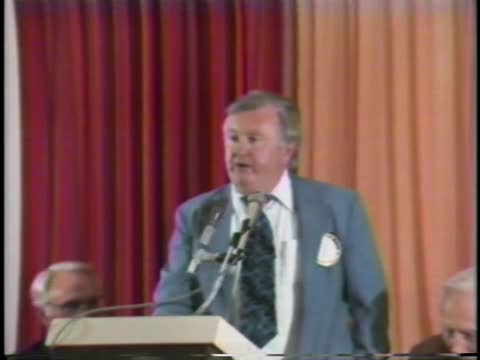
- General Hugh M. Milton II, honored ex-president of NMSU, giving a speech at his retirement party.
- Created Date
- 1985-11-14
- Asset type
- Raw Footage
- Genres
- Unedited
- Event Coverage
- Media type
- Moving Image
- Duration
- 00:25:43.397
- Credits
-
-
Producing Organization:
KRWG
Speaker: Milton, Hugh M.
- AAPB Contributor Holdings
-
KRWG Public Media
Identifier: cpb-aacip-6cb866fd976 (Filename)
Format: 1 inch videotape
Generation: Dub
If you have a copy of this asset and would like us to add it to our catalog, please contact us.
- Citations
- Chicago: “Hugh Milton: Thank You America,” 1985-11-14, KRWG, American Archive of Public Broadcasting (GBH and the Library of Congress), Boston, MA and Washington, DC, accessed June 9, 2026, http://americanarchive.org/catalog/cpb-aacip-6599877d7ef.
- MLA: “Hugh Milton: Thank You America.” 1985-11-14. KRWG, American Archive of Public Broadcasting (GBH and the Library of Congress), Boston, MA and Washington, DC. Web. June 9, 2026. <http://americanarchive.org/catalog/cpb-aacip-6599877d7ef>.
- APA: Hugh Milton: Thank You America. Boston, MA: KRWG, American Archive of Public Broadcasting (GBH and the Library of Congress), Boston, MA and Washington, DC. Retrieved from http://americanarchive.org/catalog/cpb-aacip-6599877d7ef