Let Them Eat Cheese
- Transcript
This program the third in a series of community forums is a joint presentation of the San Francisco Foundation and KQED. When I was down in one of these mostly less money present going I was both. And as a president I'm fully committed to fitting in the nation and that's our job and the Job story. It is a situation that so many American families are facing right now. Hunger is on the rise in the richest agricultural nation in the world. Scarcity is not the problem. Government warehouses are bursting with surplus food and the amount of produce discarded or left to rot in
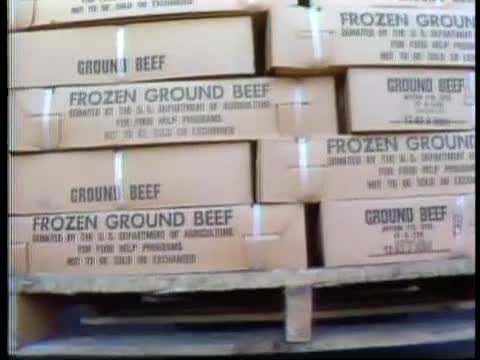
California could tire cities the poor are hungry in a land of plenty and few people seem to care. A major contradiction in our country today. There are some 32 million Americans living below the poverty line. That's about one in every seven and many of them are hungry and malnourished. At the same time the U.S. Department of Agriculture is stockpiling record surpluses of food commodities like cheese and butter. If everything stored in warehouses across this country were divided. Each poor person in America would get. 13 pounds of butter. Twenty six pounds of cheese. Forty three pounds
of milk and 62 pounds of rice. Most of the enormous surplus is stockpiled in these limestone caves in Kansas City on July 4th about 30 protesters erected a tent city near the caves. They began a hunger strike vowing to fast until the government released more surplus food to the poor. My religion teaches me. That whenever there which one cannot read one must pass. We fully expect that there's going to be a change in the government's policies and we don't intend to leave here until it is. The mountains of government surplus originate on modern fission farms which produce enormous amounts of food not more food than the world needs but far more food than can be sold profitably in the marketplace as a result. Many fruits and vegetables are left to rot in the fields while surplus grains and
other foods are salted away in warehouses. Take the example of cheese. Under the dairy price support program the government pays farmers for the milk butter and cheese they can sell to encourage production and to please the powerful dairy lobby the federal government raise dairy price supports to record highs during the 1970s. Dairy farmers loved it. They expanded their herds cranked up the milking machines churned out the butter and collected their hefty government chaps. Today the government buys one third of all the cheese produced in California. Dairy farmers are prospering but the government is holding billions of pounds of dairy products and warehouses while taxpayers foot the storage bill. We spend right now in excess of 300 million dollars a year
to maintain surpluses. A lot of those foods go to waste. They simply get rotten after a long period of time. That makes no sense to me. When there are people who are hungry the circus has to be distributed. There's no two ways about it. The administration is sitting on a time bomb that's growing under them. The time bomb is hunger hunger in the land of plenty. The War on Poverty promised to eliminate hunger in America and the food stamp and child nutrition programs of the 60s and 70s did go a long way toward fulfilling that promise. But in the 1980s hunger like poverty is stalking the streets again. We've seen quite a big increase ever since 1979 and even in the past year there's been an increase of 2000 meals on over the previous year. Brother Victor Nolan runs the St. Vincent de Paul soup kitchen in downtown Oakland where they serve free hot lunches to more than 800 people a day. Skid Row
Drifters the newly unemployed who have exhausted their benefits. Single mothers and their children the elderly are living on meager fixed income. He's arguing for public support of donations so that's always always always. Now as that as some are more able to come it takes more and more. At St. Anthony's in San Francisco's tenderloin they are feeding as many as 2000 people a day. One of the things that we need to look at is well why are these people on the streets and why are these people hungry and why don't they have apartments or homes in which they can prepare their own. One reason of course is unemployment still the worst it's been since the Great Depression. The Census Bureau recently announced that the number of Americans living in poverty has risen to thirty four point four million. Fifteen percent of the country. The highest percentage in 17 years. At the same time the Reagan administration has cut back all the federal programs
designed to feed the hungry. Three million children had to drop out of the school lunch program last year after the White House reduced eligibility. An estimated one million food stamp recipients were eliminated by budget cuts in the first two years of the Reagan administration and the government has frozen the program depriving millions of pregnant women and infants of important nutritional supplements. As a result of some cutbacks that have taken place on those programs as a result of the serious recession we've been through we suddenly see that curve of hunger on the rise again. Congressman Leon Panetta Chairman of the House Subcommittee on nutrition held hearings to determine how serious a problem hunger has become. We went to Cleveland we went to the south and Birmingham went to Los Angeles we got reports from throughout the country in every instance we're finding the problem of hunger increasing by 400 500 percent. And the congressman was not the only one warning about the hunger crisis.
The U.S. Conference of Mayors recently declared that hunger is the most prevalent problem facing American cities today. In Oakland alone there are said to be 30000 hungry people not being cared for by emergency food programs. Now the irony is that right here in the heart of one of the poorest places in the country the government is stockpiling surplus food commodities in warehouses like these. The warehousing of surplus food in poverty areas like East Oakland and San Francisco's Hunter's Point was too cruel an irony for a number of Bay Area public interest groups who began pressuring President Reagan to release the cheese before it went to waste. It looked as if the cheese might be as one USDA official suggested be dumped in the ocean. They couldn't find a solution. So we did some. Constructive pressure. And.
We were successful. December 23rd 81 when the. President finally responded with great fanfare Reagan ordered a cheese giveaway program just in time for Christmas. It was a dramatic gesture. But coming from a president who had just drastically cut the food stamp program it seemed a hollow gesture. Let them eat cheese. Today. But the administration's large gas didn't last for long. The cheese industry still collecting its government subsidy checks complained that the free cheese distributions of the poor was hurting cheese sales in the supermarkets by as much as 15 percent. That was hotly debated. But the president sided with the cheese lobby and the cheese distribution program was cut from 60 million pounds a month to 30. That's nothing. That's nothing. And I personally resent it. And I
protest it. And I hope that there be enough people protesting so that the government will change its policy and go back at least to the minimum level that was established before and hopefully beyond that. Others did protest in Washington. Congressman Pence introduced a bill which would require the secretary of agriculture to increase the distribution of government surplus cheese milk honey butter rice and flour to soup kitchens food banks schools daycare centers and senior citizen programs. The Pennetta bill also authorized 50 million dollars in badly needed funds to help states and local communities distribute the food to the needy. The House approved the bill overwhelmingly but the president refused to budge. And by mid summer the bill was mired in the Republican controlled Senate. Why is the Reagan administration opposed to that bill. I think there's there's always a problem with the amount of money that's provided with these pieces of legislation. So there's one thing to provide commodities and little thing to provide you
know federal monies to go along and encourage the distribution. And I've argued with the secretary of agriculture on this issue. I've said that from. From what we've seen through the hearings that we've held throughout the country simply setting up these trucks and then dispersing cheese is not working. As a matter of fact we've had a number of agencies that said unless we get some some money to cover the cost so that we can do it in a humane way. And be able to care for the food refrigerated disperse it in a careful manner. We simply are not going to participate in this program any more. Meanwhile a congressional delegation supporting the Pineta Bill went to Kansas City to inspect the caves larded with surplus food by bringing the news media along they hope to draw public attention to the swelling surpluses instead. They were not even allowed inside. What do you. Wish For. We just don't want. Dollars. Also there's there's nothing. The American people they have the right to know they certainly don't have the right to see the American people
saw the amount of food stored here. It is appalling in view of the hunger situation that so many American families are facing right now. A few days later the community for Creative Nonviolence and a hunger strike in support of the bill with emergency food programs across the country begging for more surplus commodities. The pressure was building on the Reagan administration. Do you think that the Department of Agriculture position and begin to release more. Well so right now we're trying to grapple with the question of commercial displacement. But the Department of Agriculture did change its position just a few days after we taped this interview announcing a small increase in hunger had again emerged as a national issue and politics if nothing else compelled the administration to do something. Good evening. President Reagan today ordered the creation of a White House Task Force on
hunger and gave it 90 days to produce what he called a no holds barred report on the causes of hunger in the United States. It really means that the president continues his deep concern about hungry people in this country. And because of a lot of talk and a lot of apparent need for food he wants to take a close look at it and have people go out and come back and report to him. The fact of the matter rather than trying to base some conclusion on a lot of rhetoric. I would say that the president hasn't been aware of the problem. And for these people it's obviously there's no light at the end of the tunnel at this point. The only thing they know is when they stand up they get clamped down. After announcing the presidential hunger commission. The White House also withdrew its opposition to the Pennetta bill and the Senate approved it. That means for the next two years the Department of Agriculture is required to distribute surplus food to the poor and to provide money to the overworked mostly volunteer
community groups distributing the food. The hunger strikers in Kansas City who are lean and exhausted after a month of fasting one this round they folded their tents and went home celebrating passage of the Pennetta bill. And unfortunately the problem of hunger is not so easily vanquished. And. If the poor are lucky enough to live near a well-run distribution center. They will now get more processed American cheese to eat as well as a limited number of other surplus foods. But providing the poor with regular nutritionally balanced meals is a more intractable problem. I don't see food banks as a long term answer I think that we're a real band aid situation. It may only be a Band-Aid but Larry Sly's food bank in Contra Costa County
is providing vital emergency relief to victims of the recession. Like other emergency food providers we talked to. He favors a comprehensive food stamp program over hit and miss cheese giveaways. But his job at the moment is scavenging as much food as possible from anywhere he can. The main thing we do is to distribute agricultural products. We're getting donations of onions lettuce here we've gotten donated from. Santa Cruz County. Nothing whatsoever wrong with it it's just the wrong size. You know there are grading standards that the industries the lettuce industry industry imposes upon themselves so that the consumer gets standard product and knows what they're in for. They don't want to buy large onions they don't want to buy small heads of lettuce. So the industry says these are not good for the market. They're certainly fit and there's absolutely nothing wrong with this backgrounder. They just plow back over and get back into the ground again.
Yeah. Right. Each week the Food Bank delivers one hundred fifty bags of groceries to senior citizens in downtown Richmond and to 10 other brown bag sites in the county. All of them have waiting lists. The average income of the people we're serving over there is less than $500 a month and I don't understand how a person lives on $500 a month. You know we're dealing with people who don't have enough income to purchase the food that they need and for whom the brown bag program is a great supplement. A little extra food is a big asset to them. San Francisco has a newer smaller scale Food Bank sponsored by the Council of Churches. The statistics from the latest census say that about 20 percent of the population in San Francisco lives below the poverty level. That. Accounts for about 100000 people many of them are seniors or women with children under six. So it is very great. Our statistics show that we possibly
reach a quarter of those now. Because we don't have enough food and enough facilities to reach the rest of them. But the potential is there. They were at a grocery convention to show their product to the retailers and then all of this was left over. You know you've. Got. The San Francisco food bank desperately needs more delivery trucks and better warehouse space at the moment they're stuck on the third floor of an office building. But even with that handicap they manage to provide food to dozens of city soup kitchens and food programs like this weekly bread distribution at the visitation Valley Community Center. How many people come here now over 200. 200 people. Yeah so you think there's a real need for it when you're a freak. Yes it is a lot of people are out of work here. Unemployment stop there's a lot of things that are. Crap. Food banks play a kind of Robin Hood role scavenging
food from the rich and wasteful and giving it to the poor. In doing so they highlight one of the most irrational aspects of the American agricultural system the phenomenal amount of food grown that never makes it to the table. You know there's a geo report that says 20 percent of the food produced in the United States is wasted and I wouldn't have any reason to question anything that's 20 percent Yeah I made the same charge. That 25 percent of the food grown in California never reaches the consumer. Well they last. They said that was an exaggeration and they asked where I got my figures. And I said I talked to farmers. The Livingston Farmers Association is a central valley co-op of plum nectarine and peach growers. These women soared and packed the co-op's fruit. Like many California fruits and vegetables are in surplus this year.
To keep the market price high. The growers in cooperation with the state set up marketing orders to respect the number of nectarines going to market. They must be just the right size just the right weight the appropriate color and of course absolutely no blemishes cosmetically perfect. The result is that tons of perfectly nutritious and tasty Nectarines are discarded. Now the Livingston Farmers Association happens to be a progressive co-op. So instead of just dumping these nectarines or feeding them to the cows they don't eat a lot of them to the food banks. Once a week a driver from Larry bank makes the law to collect the plums and nectarines so that senior citizens and Richmond can eat what otherwise would be thrown away. Valuable rescue mission. But it's merely the surface of discarded food. Take the case of Mark Perry what happened on this
same thing is happening with this. With this bear here. That's hail damage in late March up storm pelted here orchards on his farm north of Sacramento. A burst of hail. But that was long enough to scar the young pairs and the tiny scars rendered the fruit unacceptable. So if I cut this hair and I have. Half of it is OK. Because nobody's going to buy. Fruit. So this is going to be thrown away. Now nutritionally there is nothing wrong with that affair. It's not a right to be a bit of a parody. It's just cosmetic. Absolutely. In an effort to salvage some money out of his last pair of Fiat is selling some of the pairs to Gallo who believe it or not use pear juice and.
Why is it that people won't buy them. Oh it's easy to say we're spoiled or maybe we are we. We've been. Developing a good product in this country for so many years. That people used it the best. And I know that there must be somebody watching a program like this one who says. Wait a minute I'm not I can't afford the best they can get. But the problem is getting it to that person. Sometimes food waste is caused by weather and the restrictive marketing standards of the growers themselves to keep the prices high. But sometimes the growers are victims of an economic system they have no control over. These are some of the tougher times that I've seen in my adult life of farming.
The past couple of years been a strain I think for the whole economy but in agriculture we certainly have felt it. Henry Vos is a peach grower near Modesto and president of the California farm bureau. He's a successful farmer. But the high interest rates and low prices which are doing in so many small farmers have affected him too. Last year two days before he began harvesting his 20 acres of low Del peaches the cannery he had a contract with went bankrupt. Suddenly he was faced with the loss of his entire crop. We made several calls around other processors trying to sell them. We. Tried to market them through the marketing association we belong to. And when that didn't succeed we called some of the church groups grey Panthers type organizations and offered the food to anybody who they would supervise and send out they can. If you turn right back but when you've got hundreds of tons of it already it's a lot of fruit and you can't get too
much of it away at one time because the logistics of things a lot of people are like I've had it but there are 300 miles away and becomes difficult. The enormous waste of fresh nutritious food is the dirty secret behind California status is the most productive and wealthiest agricultural state in the nation. And while estimates of ways range as high as 25 percent no one knows for sure and no one in the state has developed a systematic plan to salvage that waste and get it to people who need it surplus food means food that is being grown and processed for delivery to a consumer which never reached the consumer. State Senator Nicholas Petrus from Alameda County has introduced Senate bill 875 known as the nutritional Bill of Rights. In addition to promoting a study of nutrition among doctors and teachers the Petrus bill would for the first time establish a state commission to determine how much food is wasted in California and how it can be salvaged and channeled to the hungry.
Because we have this terrible contradiction in our society of the wealthiest state. In the wealthiest country in the world whose primary source of wealth is agriculture. That's our still our biggest industry not being able to devise a method of transportation and economic distribution that brings us enormous wealth and this enormous surplus of food to people who need it. And we have people who are really hungry in the state of California. The rate of inflation declined sharply over the past two years and that means generally lower food prices. But ironically the poor often pay more than middle class consumers for the same food item. The reason is that the commercial food distribution system is abandoning poverty areas. Supermarkets are filling the inner cities for the more lucrative suburban shopping malls. This doesn't get into the media. Unless it
is dramatized by some of us who are concerned about it. You know that there hasn't been a single supermarket. Built. In an inner city area in California in more than 10 years. There has. Never been a large supermarket in West Oakland any time. Carol Jenkins a food activist in West Oakland sees his community forced to shop at high priced mom and pop stores since. They don't leave the farm at this price. 29 is it only when the bomb is right. When he buys the farm labor don't get paid is going to these meetings the go is going that is the money that it costs the price that.
The nectarines that sell for 35 cents each at this corner store in West Oakland sell here for about 11 cents. This is the heart of the city farmer's market established two years ago in San Francisco's Tenderloin District with supermarkets abandoning the inner cities. The search for alternatives has led to a revival of farmers markets. This one operates every Sunday morning with about 30 farmers and 6000 mainly low income customers. We mainly serve the Tenderloin and that's a very depressed community one of the most depressed San Francisco and range of people a very wide Filipino black elderly use the whole gambit runs the whole gamut. I give you my number. A few years ago there were only three farmers markets in the state. Today there are 82. It is a grassroots movement a lifeline for the small farmer and a low income consumer.
Helps us out of a place where we can sell it. Very good. People get good buys. They're always fresh. There's a jazz market our own fruit have control of it. What do you think of the farmers. I think is great. Yeah. The problem of hunger in our country today is not a problem of scarcity. There's plenty of food to go around. In fact there is an embarrassment of riches more food and surplus now than ever before. But for the 34 million men women and children living below the poverty line most of that food is beyond reach and the programs designed to help everything from food stamps to school lunches are being slashed. We can boast of the most productive agricultural system in the world. But something is seriously wrong when we can't feed the growing number of hungry people while at the same time we are paying a staggering 21 billion dollars a year to subsidize farmers sometimes paying them to
produce more. Or as in the case of wheat farmers paying them not to produce at all. There is something fundamentally irrational about a food system that pays farmers not to grow food while poor people go hungry. And it's a problem that won't be solved just by letting them eat cheap booze.
- Program
- Let Them Eat Cheese
- Producing Organization
- KQED-TV (Television station : San Francisco, Calif.)
- Contributing Organization
- KQED (San Francisco, California)
- AAPB ID
- cpb-aacip-55-1v5bc3t41c
If you have more information about this item than what is given here, or if you have concerns about this record, we want to know! Contact us, indicating the AAPB ID (cpb-aacip-55-1v5bc3t41c).
- Description
- Program Description
- Food federal food subsidies
- Created Date
- 1983-08-22
- Asset type
- Program
- Media type
- Moving Image
- Duration
- 00:30:01
- Credits
-
-
Producing Organization:
KQED-TV (Television station : San Francisco, Calif.)
- AAPB Contributor Holdings
-
KQED
Identifier: cpb-aacip-859ab6a6691 (Filename)
Format: U-matic
Generation: Master
Duration: 0:30:00
-
KQED
Identifier: cpb-aacip-4f671066f0a (unknown)
Format: application/mxf
Duration: 0:30:00
If you have a copy of this asset and would like us to add it to our catalog, please contact us.
- Citations
- Chicago: “Let Them Eat Cheese,” 1983-08-22, KQED, American Archive of Public Broadcasting (GBH and the Library of Congress), Boston, MA and Washington, DC, accessed October 14, 2026, http://americanarchive.org/catalog/cpb-aacip-55-1v5bc3t41c.
- MLA: “Let Them Eat Cheese.” 1983-08-22. KQED, American Archive of Public Broadcasting (GBH and the Library of Congress), Boston, MA and Washington, DC. Web. October 14, 2026. <http://americanarchive.org/catalog/cpb-aacip-55-1v5bc3t41c>.
- APA: Let Them Eat Cheese. Boston, MA: KQED, American Archive of Public Broadcasting (GBH and the Library of Congress), Boston, MA and Washington, DC. Retrieved from http://americanarchive.org/catalog/cpb-aacip-55-1v5bc3t41c