Over Easy; 3031
- Transcript
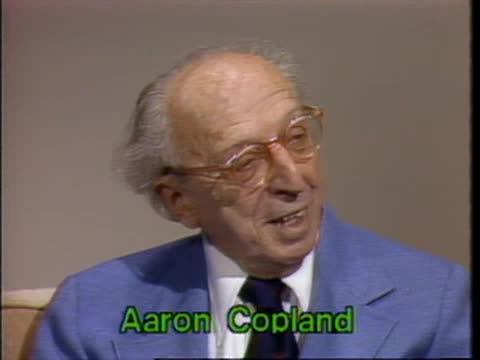
You know it's not often that we spend an entire program exploring the life of one individual but it's not often that we need a person with enduring creative vitality of the renowned American composer Aaron Copeland. It was Aaron Copeland who brought a distinctively American style to modern classical music. And for more than half a century he's been a leading force in the development and appreciation of American music throughout the world recently overeasy traveled to New York to talk with the distinguished composer about his rewarding creative life and shortly afterward we learned of an outstanding film called Copeland portrait which has never been seen on television. And today as America's greatest living composer approaches his seventy ninth birthday we want to share with you selections from our New York interview and from Copeland for an overeasy special tribute to Aaron Copeland. Is the sound of a nation and its people. His compositions for symphony opera film and ballet are a tapestry and
music of our history a way of life and it made him the most significant American composer of our time. You are of the undoubtedly the most influential American composer of the century which probably is to say the most influential American composer. And your music is internationally popular classical music. What motivated you and how did you achieve uniquely American in your music. JE I don't have any flaw. I couldn't tell you precisely how I went about trying to suggest. About my music. But I do worry about but that when I was 18 and just beginning the French writing music that nobody could have been with the German and the Russians of Russia and the British were pretty British and it seemed very odd to me that
Americans who could have created jazz with the whole world recognizes and I couldn't do that in the field of so-called serious music symphonic music. I was born in Brooklyn in November of nineteen hundred. Families. I don't think any musician. Or I get
all that because I wouldn't have the life of some of the world. Remember when I thought my father of wanting to become a composer you get to and I really don't know where I got it myself. That's really cool. But it was really. Rather.
In writing in The difference between writing for something that is well it's a program music as opposed to absolute. And you've done both. Which is I guess I should say easier. Is it easier to write something for a specific player choreography or movie or to write a tone for misinforming Oh I think it is easier is
an easy subject matter makes it easier. After all if you're writing concert music so to speak concert music. There's no subject matter other than the actual scenes and rhythms and the thing that the music gives off that you have to work with your to build it in the air so that it's hard to really derive piece of so-called absolute music that is the basis of well. I'm in the back of a
place. And I was right and it was a pretty conservative one expected expected over some people which were now accepted. When you wrote Felicia spring and the prize that it really deserved. Did that give you a feeling of having accomplished something in your in your work or mine is of course one of the ones I love most is about is mostly because of Martha Graham. I was really putting Martha Graham to music when I wrote that ballet for I knew her dancing style of dancing I knew her as a person and she has the personality. It was comparatively
easy. And I wrote all that music you know without knowing what she was going to call the ballet or really there was no there was no name in the first time when I was rehearsed the ballet I said to a mother what if you called it and she said Appalachian Spring or I said what she said. And they have a poem by a crane that says with the poem have anything to do with the ballet. No I just like the name of the Appalachians. So. And. People.
Exactly the cost of the plate is the need for support of. The new generation of musical creativity. When we began trying to get media we were talking about the limitations of music that had to be played on tape. Yes
we would have. Of course in Paris before you came here in the 20s and things because 56 concerts too terribly exciting. Head up about it came a bit later. If you
or somebody asked you to do the score would you do it. That's quite a long time to be given to its precious self. The fact that the very most. Stock your farm you do. Don't forget I was a wild modernist when I was in my 20s. I used to get consistently bad reviews in The New York Times when he would introduce one of my words my father was the New York Times. You have had to write that they would have said things of
conventional stuff that's out there which I wrote in 1926. I used jazz elements of that in that piece. Well the reaction was scandalous. For jazz it's all either by heaven. What is it doing in Symphony Hall. Well I guess you have to going to be ahead of your to have to write the music you want to write you can't write music to somebody else. You know come from inside and really express what you want to express. One generally works with ideas you have to get musical nuggets. With such such you or you rarely
have an idea for a composition. In the journey takes the form. Of a lot of gaiety or idea something that seems full of possibilities for development and once you get enough of those together that's the way I would join in the larger form begins to suggest itself. And the final the great day comes when everything seems to run naturally follows another and then there will always be the spot where they don't connect and where you have to really sit down and work to make the connection seem natural. No one will be able to tell in a piece where your inspirations speak. Stopped and where it began. Preoccupied
of course you have a away from music because you're very active in conducting and it's a great sport. It worked like that.
Naturally.
Why. You're looking at something that fascinate has brought Aaron Copeland
continuing fulfillment throughout his life and given a world of lasting treasury of music and song with his vitality and zest for life he is an example for everyone and for all of us as to what our later years might be able to hold for the great American poet Ralph Waldo Emerson wrote Every commanding moment in the annals of the world is the triumph of some enthusiasm and the triumph of Aaron Copeland's enthusiasm will always be with us. We hope that you enjoyed our special program today. We'd like to thank the creators of Copeland portrait Terry Sanders and Frida leave mock for allowing us to share their award winning film with all of you. That's it for now you're down say so long. Thank you from all of us all over easy.
- Series
- Over Easy
- Episode Number
- 3031
- Producing Organization
- KQED-TV (Television station : San Francisco, Calif.)
- Contributing Organization
- KQED (San Francisco, California)
- AAPB ID
- cpb-aacip-55-085hr394
If you have more information about this item than what is given here, or if you have concerns about this record, we want to know! Contact us, indicating the AAPB ID (cpb-aacip-55-085hr394).
- Description
- Series Description
- Over Easy is a daily magazine hosted by Hugh Downs and featuring segments about aging and other topics of interest to older people.
- Description
- Aaron Copland
- Broadcast Date
- 1979-01-01
- Asset type
- Episode
- Genres
- Magazine
- Topics
- Local Communities
- Media type
- Moving Image
- Duration
- 00:29:21
- Credits
-
-
Producing Organization:
KQED-TV (Television station : San Francisco, Calif.)
- AAPB Contributor Holdings
-
KQED
Identifier: cpb-aacip-d7f643fc20a (Filename)
Format: U-matic
Generation: Master
Duration: 00:30:00
If you have a copy of this asset and would like us to add it to our catalog, please contact us.
- Citations
- Chicago: “Over Easy; 3031,” 1979-01-01, KQED, American Archive of Public Broadcasting (GBH and the Library of Congress), Boston, MA and Washington, DC, accessed October 4, 2026, http://americanarchive.org/catalog/cpb-aacip-55-085hr394.
- MLA: “Over Easy; 3031.” 1979-01-01. KQED, American Archive of Public Broadcasting (GBH and the Library of Congress), Boston, MA and Washington, DC. Web. October 4, 2026. <http://americanarchive.org/catalog/cpb-aacip-55-085hr394>.
- APA: Over Easy; 3031. Boston, MA: KQED, American Archive of Public Broadcasting (GBH and the Library of Congress), Boston, MA and Washington, DC. Retrieved from http://americanarchive.org/catalog/cpb-aacip-55-085hr394