Black Journal; No. 610
- Transcript
This program was made possible by a grant from PepsiCola company. Music This edition of Black Journal is dedicated to the San Francisco son reporter, a member of the crusading black press, serving San Francisco, California,
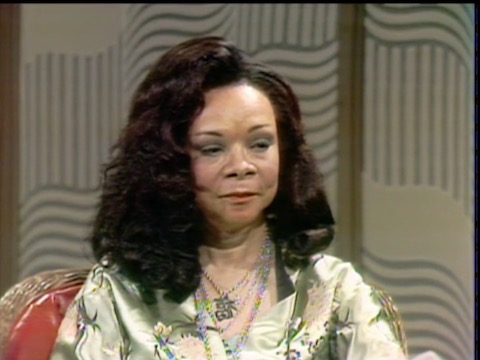
the 12th largest black community in the United States. On this show, our theme is black centennial, but we really don't mean 100 years of living. What we have in mind is the black presence yesterday and today. On this edition, we will take a look backwards at the psychic predictions about America's future from 1776 and to look forward at America and the world's future from 1976. Our guest today are Lillian Cosby, a psychic and Dr. Edward Peters, author of Witchcraft in Europe. Welcome to Black Journal. Dr. Peters, before we began, you were explaining to me the difference in the meaning of the word psychic in the 18th and 19th century. Yes, 70th and 18th century. 18th and 19th century and the current. What is that? Well, the way we use the word psychic, when we all generally assume that we mean someone who deals with extra sensory perception in one form or another, we're dealing with a word and a usage that really only dates from the very late 19th century. When we talk about psychic phenomena or extra sensory perception, before the 19th century, before say 1840,
we have to remember that we're dealing with, we have to consider the individuals we're dealing with, the religious culture out of which they came, because there is no general public interest in what we call psychic phenomena. We have to ask whether a person is a quaker, whether they're black and a slave or free, whether they're a member of an evangelical sect such as the Methodists, whether they're interested in it from a philosophical point of view and so on. The 18th century has a great spread of variety. The 19th century, we begin to see some types emerge, a few common types, the spiritualists, the medium, the sort that we recognize now. Well, now let me ask this question. In other words, you're saying that in the 18th and 19th century, there was no such thing as a person who was a spiritualist or during that period they would call something else. Well, they wouldn't have been used, they wouldn't have used the word psychic. There would be seer or prognosticator or someone interested in animal magnetism if you were a philosopher or a follower of mesmerism. Well, let's say a person was a seer. I'm trying to get around the colonial period in America, at least before the contemporary period. What kind of paraphernalia would a person have used? What would they have done?
Well, again, it depends entirely on the local culture out of which they emerge. If they're a New England Calvinist, they would express their sight in terms of the Bible. If they are political prophets of the kind that we do see a bit of around the revolution, their language would be much more influenced by political literature and maybe the book of revelations, which is a gold mine, of course, for psychics from the 1st century AD on to now. Why the book of revelations? Well, the rich prophetic color of the book of revelations is a, and it's full of everything, of course. You can find anything you want in there and people have and used it again and again. One of the most interesting stories in Western intellectual history is how the book of revelations has been used. From the very time it was written about 100 AD right down to the mid-20th century. Now, you've written a book witchcraft in Europe. What prompted you a scholar to write on a subject commonly, certainly not associated with scholarly activities such as that? I guess it's an interest in the underside of the way societies hold themselves together and exclude elements that they are afraid of or feel are dangerous.
I've done books on political theory and witchcraft seem to follow naturally as a study that underside of political order, the order side in law and order. And, of course, the witchcraft repressions and the way the witch was conceptualized was a major part of the way early modern European states took shape. Well, is it accurate or inaccurate to assume that people that we read about today who were called witches? Is it inaccurate or accurate to assume that they actually may have been psychics? Well, the question of, we're using the term in the modern sense now. I think the answer is maybe. Certainly not all of them. Was it anyone in the 18th, 19th century, refined the question? Who we have documented evidence was able to predict the future during that period of time? Well, there are a number of people. One of the most famous was Caliostro, the famous Italian charlatan scoundrel, maybe psychic, a number of other less wholesome things, who in the course of a long and checkered and not altogether honorable career did seem to predict the French Revolution at one point.
He did? In a letter to the French nation in 1768 or so. A number of other people seemed to have predicted the French Revolution, but on the whole, psychics tend to predict either for the individual who's consulting them or for the horizon that they live in. Did this gentleman, I'm using the word, advisedly, make any other predictions that you have been able to document during that period? Oh, there's a large literature on him. Again, he tended to work for private individuals as a great many people who we would alcohol psychics did. They were, in a sense, household servants of great lords who were very interested in the future. To a large extent, because life at court wasn't all that secure, and you needed all the help you could get. And if you had a seer or someone who claimed to have second sight or a poisoner or a bodyguard, it's an interesting group of people who surround the powerful and help them feel more secure than they. Do I detect, in your analysis, a scientific skepticism toward the phenomena of psychicism as we know it today? I think I can keep an open mind on modern research into extra-sensory perception. It's very hard to talk about, I'm much more interested in the way in which society saw these people.
What you have seen, you have worked, you've appeared on television programs before, and you know Mrs. Cosby. You are familiar with the kind of phenomena that she's involved in. Would you categorize that as ESP? I think it might be, but I'm really not qualified to talk about ESP. There you need a psychologist who's working on it. Do you have any evidence, a modern day of evidence, of anybody that you've observed at all, that you feel that there is the element of the potential, that it may be more of an exact science than we normally are led to believe? Not on my own life, but again, historically, when you're looking at these figures like Kelly Austro or like the various prophets and mediums of the 19th century, who proliferated in America, it's hard to make a final decision because we just don't have the kind of data about them that we would have say if you were testing a modern psychic in a lab with a Faraday cage and all the sorts of things. Mrs. Cosby, is this the gentleman that you were telling me during your research you found, you used the body of another person to speak through? That was in the 1765, yes. He used like a glass vessel and he put water in his two candles on the side.
And he used a young boy as his medium, they call him as a medium. It's like going through the channel or using a person as a transformer to get his message across to the person sitting in front of him. And reason I was so interested in that part of the research because I have used my granddaughter when she was six months of age and set her there and read through her body to the person sitting in front of me. It seems like a clean, clear avenue or vessel to go through without any obstructions. When you say a medium, do you mean that you in some way use the vocal cords of the person that you refer to as the medium? No, no. In those days they used the vocal cords and called themselves a medium talking through someone. No, in my experiences was not like that. I don't know how to do anything of that sort. But that child was like a transformer to me. It gave me a clear avenue to the person sitting before me. But there was no voices coming from the person or nor did I perpetrate her voice. But that's what struck me as an interest in that research.
I guess it's kind of obvious that I am driving at some evidence of credibility because when we discuss psychicism or ESP or any of this phenomena, it's always subject to, let's say it's a very skepticism, in that respect we have some footage of two appearances of Mrs. Cosby on Black Journal previously, in which she did successfully make a number of predictions and we'd like now to take a look at those. Who do you think will be elected president in 1972? Well, at this moment it is quite questionable. Our president Nixon is doing a tremendous job, I say, in keeping into the public's eye. And that is also things he's doing is quite favorable and unfavorable. But being a politician was a very good move. Let me say this to you, making a very broad statement. If he becomes elected, I do not feel strongly that he would serve his four ears. But there is-
You see some illness. He has a illness that is quite secret from the public that he is trying to take care of now. But I also see a dark horse. Someone we don't know right now that will come up in the presidential election. What about the one we didn't have? Well, there again, our president will make a very strong stand just before the presidential election, to free our boys, to bring them home. But to me, I get it just coming home in one door, but war being another door almost simultaneously. You mean we will get out of Vietnam and immediately become involved in another war? Well, when we say the word war, there are many kinds of wars. We have all kinds of wars now. The drug war, economy war, all kinds of war.
What about Africa? What do you foresee as the future of Africa and international relations? Well, there was a lot of cleaning up to be done there before we can get that together. Africa has its own personal problems. And right now, United States has there so much that I don't feel that United States is going to be a great assistance to Africa or kind of need or help that Africa should have. Africa is going to do a lot on their own. They're using their mind tremendously, trying to get their thing together. We, in the Western world, play short our concepts of what our mind can do. We're so busy using our body and our hands that we forget to use our mind. I do not see President Nixon able to fulfill his year. When I say his year, I mean his term, he will not be impeached.
He will not even be moved by law, but his health is in very bad shape. The man has come through such terrific times, but yet there's going to be a lot more, much worse than Watergate after June of this year. We're also going to be able to find out why the first Watergate even came about. And you will notice from the end of March or even the end of February that he's going to give his counterpart, Gerald Ford, and someone else, a lot more responsibility because he will not be able to function. He's not even functioning properly now. Unfortunately, he's still going through some more critical times and they're going to be very prominent after June of 1974. Last year, I saw that Nelson Rockefeller
will not become our president for 1976. I guess I made that very clear statement before, but he will make a tremendous reaction on the public, which will hit the news media. It would make headlines. It's something he's going to do. It's going to be sort of fantastic to make a stand-up and take notice, even though he's seen as if he's driving towards becoming president, but he won't make it. You mean he's going to do this after he loses? No, this is leading up to 1976 election. Also, I see that a very prominent black figure. He could be a religious figure, but he's somebody very prominent. We attempt on his life. If someone is trying to assassinate him, I'm very disturbed about this. It could be a black minister. I hate to even put it in the narrowed down to that degree, but if someone I feel very strong,
this will happen in 1974. And also, Jerry Lewis should be very much concerned about his health. There will be a comedian that was seen to pass away in 1974. I can't say it's going to be Jerry Lewis, but I just see this happening. One of our movie stars, one of our black stars, I see she's going to be Ms. Tyson. Ceasely Tyson? Yes, she's going to be very prominent. I see her coming up very, very fast. There's going to be a lot of problems in our banking system. Unfortunately, there's a lot of scandal here, which is linked to our stock market. I don't like to create any problems here or make anyone panic, just don't panic. There is some definite problems in the banking system. Mrs. Cosby, we've seen some of your previous predictions, and I'd like now to submit to you some questions about the future forward from 1976. You have given me a list of things that you've predicted,
and I'd like to help clarify them for the audience. You've said that President Ford should be very careful because his position as President of the United States is in trouble. The people will rise up. The President should be very careful with his health. Early in 1976, he could have some surgery of some kind. What do you mean when you say that the President should be very careful of his position because his position as President rather is in trouble? By that, I mean, the way he handled his office, that his decisions that he makes, it seemed a little shaky at the moment, and the people of the United States is going to call the shots, where he would have to straighten up and follow a certain path to go in order to execute the power that he has in his hand. And as I see it, if things did not shape up for him, favorably by July, he doesn't have a very good chance as I see it in November elections. And I still do not see him being elected to President again. So even now, between now and July,
it's going to be a lot of problems for him, a lot of personal problems also, which will hinder his health. Great deal. Then, can I ask you, do you have any feelings as to who will be the next President of the United States? Well, Tony, I was thinking strongly, because this year is a very deceptive year as far as the elections are concerned. But if Ted Kennedy really makes up his mind to get into the race, he will win without a shadow of a doubt. And I see it now, it would be to his advantage to get in the race now, and to run now, rather than to run in 1980, and 84 because, therefore, it would be cut off through health reasons or some terrible danger about his life. So if he's going to run, this is the time that he should do it. What, do you believe that he will run? Yes, I really do. You think he will run in 1996? Yes, I do. And you think that if he does run, he'll be elected. He'll be elected without a shadow of a doubt. What about Ronald Reagan? You made a prediction a year or two ago
about Reagan's chances in the 76 election. Yes, he had a very powerful chance, but it has been spoiled. He has spoiled his chances now. He has spoiled his chances himself. Right. Certain maneuvers, political maneuvers, that he got involved in. So I don't see him winning, but he probably would have a very good political position or a national position into the country, but I don't see him as President of the United States. Do you think President Ford, who you do not believe will be reelected, do you believe he will get the Republican nomination to run for president? I do not see that. No, I don't. What about Governor Rockefeller, Vice President Rockefeller, rather? Do you think he has a chance of getting the Republican nomination? No. No. I think he made himself very clear as a prediction I made last year that he would not even want to stay as Vice President. I think that has been clarified already. Yes, you did predict that. Yes, so things is different now with Senator Rockefeller. We're going to be back in one moment
by Mrs. Cosby after we look at this message from Frederick Douglass on some important issues. What kind of advice did he give Abraham Lincoln? American history doesn't tell us, but being close to Lincoln, he knew what many of us have recently come to realize. We fully comprehend the relations of Mr. Lincoln, both to ourselves and to the white people of the country. Truth is proper and beautiful at all times, and in all places, and it is never more proper and beautiful in any case than when speaking of a great public man. He was pre-eminently the white man's president. They, our white fellow countrymen, are the children of Abraham Lincoln, while we are at best only his stepchildren. For while he saved for them a country,
he delivered us from a bondage, which according to their own Thomas Jefferson, one hour of which is worse than ages of the oppression, their father's rose in rebellion to oppose. We were talking just a moment ago about your feelings as to our ability to have talked this way in the 18th, 19th century. Well, a good example of the difference that I mentioned earlier between psychic phenomena now and then is that political prophecy was absolutely forbidden in most countries of Europe, but in some cases, up to the 20th century. You just did not make public or even private prophecies about the lives of kings or queens or especially about questions of succession. The future was a very insecure thing, in the case where the psychic phenomena were real or not. People took steps to make sure that it didn't get around. You couldn't have had this past conversation. We've talked about the presidency of the United States. I'd like to ask you about some black personalities. In New York City, Percy Sutton is the president
of the Burrow of Manhattan. What do you see in his political future? It's very good. If that's what he wants, I see him as a great possibility to build a strong leadership for the city of New York. For being the mayor? That's right. Great, great opportunity. And I do see that whether he wants to, his peers and so forth, and the people behind him is going to push him in the foreground. Do you see Reverend Jesse Jackson having much of a role or a significant role in the political arena during this election year? Yes. He's going to change his format. I can't say he's been a low-key person, but he's going to be more forceful and executing some of the things of his personal conviction and it's going to be beneficial to a lot of people. All right. Do you see the bicentennial celebration being basically a positive force in improving America and the life of America, particularly bringing poor people up to equality and bringing non-white people into the mainstream?
Well, let me say this to you, Tony, about that. That's a long range. When I think of the bicentennial, I do not think of 1976, so I can't say precisely for 1976. This is a long range project that I would hear this. I mean, do you feel the activity during 1976 are going to change the course of this country? Yes, because it has been working in that area for some time and because it's a bicentennial year, it's going to be more noticeable. For instance, even though it's sort of negative about the Angola situation, but there again, the non-white will have very powerful position as far as economic is concerned and the financial structure because the resources will come from the non-white because it has been kept quiet that there are things that we need, like oil and et cetera, it has been very powerful in the black nations and now the black nation is going to be at the table bargaining for the benefit of non-white people. So this is what I'm saying,
this is a fantastic year for improvement. You've said in your predictions also that Russia would try to seize control of oil from the Arabs. Right. Yes. We may not see this right now, but it's going to be very obvious, Tony, before the end of this year. You also have predicted that Caroline Kennedy is in a strange lifestyle. She should be very careful. Her mother should bring her home at once. Yes, she should. She should bring her home now because she may get into the stream that Patty Hearst was involved in unconsciously. She should try to bring her daughter home as soon as possible. You had also said that Mr. Henry Kissinger is on his way out. Yes, well, I felt that early part of last year that the strategy he was portraying has not been beneficial for a lot of people, so therefore he will not be a key person in the structure of our United States. Also, you predict that do you foresee any great strides being made by blacks from 1976, if so, in what areas? Well, I think in policy-making positions,
for instance, Barbara Jordan. Oh, she has a fantastic and beautiful future, not only for herself but for everybody, not only for the white or black, it's for people. And even though she may be sort of low-key in one area, but I do see her becoming the first woman president of the United States, probably in 80 or 84. You also predict that the Governor George Wallace from Alabama might be Senator George Wallace from Alabama. Yes, he's working towards that. I don't see him becoming president, no. Would you see him having an effective role in the presidential race? Oh, yes. Yes, definitely. In January 1975, you predicted money woes would make the news. During the last months of 1975, New York's money problems made headlines. What do you see for the future of New York City's financial posture? Well, it's not improved to the point
where New York can be completely on their own. I feel that the government will do a lot to help subsidize New York and it will be under control of the government more so than it was before. Are you saying that New York City is going to be under control of the federal government? Yes. Yes, I do. So you're seeing... It has appeared to me before they were quite independent. Now, the government is going to step in and give a lot of help here. Dr. Peters, do you have any questions you'd like to ask? Well, not questions, but a comment. Again, the style of your interrogation of Ms. Cosby is a very 20th century style. Generally, you asked a psychic or a person who was a seeer or a prognosticator, something in an area that this person was known to specialize in, either finding lost objects or love filters or contact with the dead. But we've now gotten to the point where psychics are in a sense universal, and then you can ask one psychic a lot of the whole range of questions. That, too, is a historical change for our age,
as opposed to the even the 19th century. I do have another one I'd like to ask. You've predicted that worldwide war is possible near the end of the summer of 1976. Oh, yes. We're in the heat of it now, Tony. Even though we don't want to realize there's a facet, but we're in the heat of a worldwide war. And that's different than World War II and World War I, because you're going to find many areas of the nation being involved in war, and we are in the hub of it all. Is the Angola area, the springboard? Absolutely. That's where you see a war beginning. That's right. What do you see as the conclusion of it? Well, I still see that the Angola will have its own power, what it's really want in the first place, but it's going to be very messy. You see America getting involved with troops? Oh, absolutely. You see American troops going to fight in Angola. It's because we did not move in the proper manner that we should have, and I don't see any way they can avoid it at this point. Would you see any particular countries involved?
Russia's involved. That would be involved in the war that you are predicting. Other than United States, I can't name the country. It's more than one country. Also, Asia has something to do here. I don't understand why, but... A country in Asia. It's very confusing. We have a short period of time. I'd like to ask you, if you have any predictions that you can make in that short period of time, that I have not covered with you. Well, Tony, I think a lot of time... Well, I think the world thinks it's hard sometimes to predict because there's so long range and so many things to cover. But I want to say things that I feel here for your program. It's very positive. I see you going into some other areas also, and as far as your new sponsor, you're going to broaden your horizon quite a bit for Black Journal. Dr. Peters, I'd like to thank you so much for being with us on Black Journal.
And Mrs. Cosby, thank you again for being with us. And next week, we will return with our regular format with co-host Melvin Van Peoples, special guest, Dick Gregory, who was recently made a Mississippi colonel, music co-host Billy Taylor, and Adam Wade, who is the host of our Afro-American quiz game, Can You Dig It? Join us on our next edition of Black Journal, Goodbye from the Black Journal family. And God bless you. Music Music Music
Music Music
- Series
- Black Journal
- Episode Number
- No. 610
- Producing Organization
- WNET (Television station : New York, N.Y.)
- Contributing Organization
- Library of Congress (Washington, District of Columbia)
- AAPB ID
- cpb-aacip-50dcd3ad473
If you have more information about this item than what is given here, or if you have concerns about this record, we want to know! Contact us, indicating the AAPB ID (cpb-aacip-50dcd3ad473).
- Description
- Episode Description
- This episode of Black Journal examines the Black centennial and revisits psychic predictions from 1776 and looks forward at what's ahead from 1976.
- Series Description
- Black Journal began as a monthly series produced for, about, and – to a large extent – by black Americans, which used the magazine format to report on relevant issues to black Americans. Starting with the October 5, 1971 broadcast, the show switched to a half-hour weekly format that focused on one issue per week, with a brief segment on black news called “Grapevine.” Beginning in 1973, the series changed back into a hour long show and experimented with various formats, including a call-in portion. From its initial broadcast on June 12, 1968 through November 7, 1972, Black Journal was produced under the National Educational Television name. Starting on November 14, 1972, the series was produced solely by WNET/13. Only the episodes produced under the NET name are included in the NET Collection. For the first part of Black Journal, episodes are numbered sequential spanning broadcast seasons. After the 1971-72 season, which ended with episode #68, the series started using season specific episode numbers, beginning with #301. The 1972-73 season spans #301 - 332, and then the 1973-74 season starts with #401. This new numbering pattern continues through the end of the series.
- Broadcast Date
- 1976-03-28
- Created Date
- 1976-02-02
- Asset type
- Episode
- Genres
- Magazine
- Topics
- Race and Ethnicity
- Media type
- Moving Image
- Duration
- 00:29:10.583
- Credits
-
-
Guest:
Cosby, Lillian
Guest: Peters, Edward
Host: Brown, Tony
Producing Organization: WNET (Television station : New York, N.Y.)
- AAPB Contributor Holdings
-
Library of Congress
Identifier: cpb-aacip-f28f37fd0f2 (Filename)
Format: 2 inch videotape
If you have a copy of this asset and would like us to add it to our catalog, please contact us.
- Citations
- Chicago: “Black Journal; No. 610,” 1976-03-28, Library of Congress, American Archive of Public Broadcasting (GBH and the Library of Congress), Boston, MA and Washington, DC, accessed October 14, 2026, http://americanarchive.org/catalog/cpb-aacip-50dcd3ad473.
- MLA: “Black Journal; No. 610.” 1976-03-28. Library of Congress, American Archive of Public Broadcasting (GBH and the Library of Congress), Boston, MA and Washington, DC. Web. October 14, 2026. <http://americanarchive.org/catalog/cpb-aacip-50dcd3ad473>.
- APA: Black Journal; No. 610. Boston, MA: Library of Congress, American Archive of Public Broadcasting (GBH and the Library of Congress), Boston, MA and Washington, DC. Retrieved from http://americanarchive.org/catalog/cpb-aacip-50dcd3ad473