The NewsHour with Jim Lehrer; December 11, 2006
- Transcript
I'm Jim Lera. Today's news, two more Iraq ways, the poison politics of Russia, the Obama political meteor and an animator Fleming S.A., all tonight on the news hour. Good evening, I'm Jim Lera.
On the news hour tonight, the news of this Monday, then, as President Bush continues his own Iraq policy review, we look at ways forward with analysts Elliot Cohen and David Rothkoff. Special correspondent Simon Marx reports from Moscow on Russia's poisoned politics. Historian Michael Beshloss and Dan Baltz of the Washington Post observed the political phenomenon that is Barack Obama. And essayist and Taylor Fleming ponders the growing economic gap that is highlighted by the holiday season.
Major funding for the news hour with Jim Lera is provided by, there's a company that builds more than a million vehicles a year in places called Indiana and Kentucky. One that has ten plants from the foothills of West Virginia to the Pacific coastline. The company is this Toyota, a company that long with its dealers and suppliers has helped create hundreds of thousands of U.S. jobs, a company proud to do its small part to add to the landscape of America. What does the future hold? Will you have the choices to make your world better? To live the life you dream of? At Pacific Life, planning for a better tomorrow is what we're all about. This wife for over 135 years Pacific Life has offered millions of people a world of financial solutions to help them live well now and plan well for the future. Pacific Life, the power to help you succeed.
And by BP, CIT, the Archer Daniels Midland Company, the Atlantic Philanthropies, the National Science Foundation and with the continuing support of these institutions and foundations. And this program was made possible by the Corporation for Public Broadcasting and by contributions to your PBS station from viewers like you. Thank you. The American death toll in Iraq kept growing today as U.S. officials worked on a new strategy that three soldiers were killed by a roadside bomb on late night patrol in Baghdad. 46 U.S. troops have died so far in December. Elsewhere in Baghdad, gunman dressed as Iraqi soldiers stole one million dollars from a bank truck. In Washington, President Bush began making the rounds to hear more ideas on Iraq. He and Vice President Cheney met with Secretary of State Rice today.
They talked about diplomatic and political options and got a briefing from people on the ground in Baghdad. I appreciate the advice I got from those folks in the field and that advice is an important part and an important component of putting together a new way forward in Iraq. Like most Americans, this administration wants to succeed in Iraq because we understand success in Iraq will help protect the United States in the long run. Later the President met with several outside experts on Iraq and tomorrow he'll talk with the U.S. ambassador to Iraq. On Wednesday, he heads to the Pentagon for meetings there. White House Press Secretary Tony Snow said today the President wants to announce decisions by Christmas, but he said it could be later. You and Secretary General Annan criticized the U.S. today. For the way it's waged the war on terror, he did so in a farewell speech at the Truman Presidential Library in Independence, Missouri. President never mentioned President Bush by name, but he urged the U.S. to act with care.
This country has historically been in the banguard of global human rights movement. But that lead can only be maintained if America remains true to its principles, including in the struggle against terrorism. When it appears to abandon its own ideals and objectives, its friends abroad are naturally troubled and confused. Annan also warned the United States against unilateral action, but he said his statement should not be seen as an attack on America, and in steps down at the end of the month after 10 years as Secretary General. A new round of talks on North Korea's nuclear program will begin next Monday in Beijing. The Chinese government announced it today. The talks include the United States, Japan, Russia, China, South Korea, and North Korea. North Korea boycotted the process for more than a year over U.S. financial sanctions.
It carried out a nuclear test in October. In Chile today, the death of former dictator Augusto Pinochet was mourned, celebrated, and even protested. He died Sunday from heart failure. We have a report from John Irvine of Independent Television News. In Santiago, none of the flags are at half-mast, because officialdom here has no interest in marking the passing of Augusto Pinochet. But these, on the other hand, are die-hard supporters, waiting in the hot sun to file past their hero and thank him for their affluence. For the most part, they are well-off, well-wishers for who Pinochet could do no wrong. I am in favor of Pinochet, and everything he did, everything he did. But in truth, Pinochet was a polarizer, and these demonstrators are from the other end of the spectrum. They hated them.
They marked his passing by gathering on Santiago's main boulevard. At times, they clashed with the police for while they are delighted he's gone. They're also frustrated he cheated the hangman over his many human rights violations. Pinochet sees power in a military coup in 1973. Quickly he banned trade unions and free speech. He killed and tortured thousands of his opponents. Many of them in Santiago's main sports stadium. But what set him apart from other South American dictators was his economic reforms, which made Chile a Latin American powerhouse. But at what price? Pinochet will never find out for sure for he escaped any prosecution. Today's government regard him as an embarrassment, and so the funeral will be a hasty affair. It's planned for tomorrow morning. A good stop in Pinochet was 91 years old. A Dubai company will sell its operations at six U.S. ports to a U.S. asset management
firm, Dubai ports world announced the deal today with AIG Global Investment Group. It involves ports in New York, Philadelphia, Baltimore, Miami, Tampa, and New Orleans. Sites were the company, Handles Shipping. D.P. world ran into a firestorm of criticism earlier this year, opponents in Congress had having an Arab-owned port operator could pose a threat to U.S. security. On Wall Street today, the Dow Jones industrial average gained 21 points to close at 12,328. The Nasdaq rose five points to close at 2442. And that's it for the new summer tonight. Now two more ways forward, politics, Russian style, politics, Obama style, and an anandtator Fleming essay. More alternatives to the Baker Hamilton way on Iraq and Erase Suarez. The Iraq study group report has provoked reactions around the world and across the American
political spectrum. The report is starting to raise new questions about the American role in the Middle East, whatever the Iraq outcome. We get some of that reaction from analysts who have written opinion pieces in the past few days. Elliot Cohen is a professor of strategic studies at Johns Hopkins School of Advanced International Studies. He was among those meeting today with President Bush. His critique in the Wall Street Journal is called No Way to Win a War. David Rothkoff is a Clinton administration official, author, and scholar at the Carnegie Endowment for International Peace. His article in The Sunday Washington Post is called Will Be Back, Anticipating a Third Gulf War. Elliot Cohen, No Way to Win a War. You were scathing about the process that arrived at the report. What was the problem that you saw? Well, the problem with the process was first and foremost. It was driven by consensus. And intrinsically, this is an extraordinarily difficult problem, which serious people are going to disagree.
I think the commission would have done a much better job if they had laid out several different options and explained to the American people the strengths and the weaknesses of each. They decided not to do that consensus, which is another word for group think instead it took hold. The other thing was I think simply the procedures that they used to try to dig into the problem were terribly flawed. They spent all of four days in Iraq, all of those inside the green zone, this little bubble of palaces and offices in Baghdad. Only one member of the study group, Chuck Rob, Marine Combat veteran, went for one day to Fallujah. I don't see how you can really come to grips with the war unless you're willing to go out there and see it. And even in terms of their consultations, talking to some members of the military, their senior military advisors, well, they had one two hour session with them and never talked to them after that. So as a way of really getting to the heart of what's going on in the war, I thought it was a deeply flawed way of going about it. Well, Mr. Rothkoff, you're less critical of the Iraq study group than Mr. Cohen, but concluding we'll be back even if we get out based on...
Well, I mean, based on history, based on the fact that this has been a region in tumult for decades, based on the fact that we've already been there in another Gulf War once before with another President named Bush and that we've been involved in one way or another in the conflicts of the region for decades. I think, regardless of the flaws within the process of the ISG, one of the flaws within the debate in the United States right now is that we're very short-term focused, we're very focused on action by the United States, and we're not looking at the longer term. If Iraq was a mistake to enter or it was not, it's certainly not the whole picture. And focus on pulling out and not focus on all the other issues, whether it's terrorism or succession struggles in other countries or Iranian nukes or the Arab-Israeli issue is to make a mistake and to lead to deterioration in those other things, some of which, by the way, is caused by what we've done in Iraq.
We've inflamed a number of these situations in Iraq, and that inflammation and the problems caused by that inflammation is not going to evaporate simply through the redeployment of American troops. Do you agree with that? This process, the very process of going there and being engaged there, has made the situation worse? Probably in some ways, yes. I mean, look, there's room for a long and searching debate about whether or not it was a good idea, terribly executed, whether it was simply a bad idea, also terribly executed. At the point, of course, is where we are now and what do we do from here? I very much agree with David Rothkup that we need a much bigger picture as we think about that part of the world than just Iraq, but Iraq is where our soldiers are engaged, where we're taking casualties, and it really is the focal point for a lot that's going on. And the stakes there are very, very high, which is why we need a much more searching kind of debate than the one that the ISG provided for us. What about Professor Cohen's point that any process that mandates consensus is going to get
you watered down results rather than a menu of really plausible steps that can constitute a way forward? Well, I'm afraid you may have consensus here. The reality is that what a president needs is choices. He shouldn't have all the different political points of view mushed together into a kind of homogenous, lowest common denominator-based solution. It may make it easier for the members of the ISG to present themselves to the public or to have political legitimacy in terms of the discussions that they participate in, but it doesn't give the president the options that he needs to have. And I think that what we need to do is we need to break it down into our near-term goals. How do we achieve as much as we can prior to a significant redeployment, our medium-term goals? What do we do in terms of that redeployment with an eye to the future and then get back
to our long-term goals? What did we do in terms of our Israeli relations? What do we do in terms of Afghanistan? What do we do in terms of terrorism? What do we do in terms of proliferation of weapons of mass destruction, recognizing that all of those pieces are connected together? So, they may not be organized the way that you just stated would have been your preference, but don't the 79 action points that conclude the report constitute some of that that you were looking for? I think they do constitute some of that. I think that there are a number of suggestions within the ISG recommendations that are good suggestions. I also think the fact that we're having this debate about how do we change our processes, how do we move forward, how do we acknowledge what was wrong and then identify a path that may be more successful is extremely healthy. It's just to take it purely in terms of the Washington politics of it, which is what so many of the reports that I've seen about the report have been about, the Republican
versus Democrat elements of this thing or the America only elements of this thing misses the bigger point, which is here's a region of the world upon which we depend. And in which we have a whole host of problems, and this is just one of those problems. If I could just say I think finally we do get a little bit of disagreement, I think most of the recommendations are not helpful. Some of them are simply silly, you know, saying we should repair worn out equipment. Well, you know, I don't think you need today an expensive study group to tell you you need to repair worn out equipment or retrain troops, but there are other parts of it which are, I think, you know, profoundly implausible to say the least. For example, the study group recommends this new diplomatic offensive in which we'll somehow persuade Syria and Iran to bail us out. And if you look at it, it's implausible is a kind word. It's absurd. There's a proposal there that we cut a deal with Syria in which the Syrians not only
help us out of Iraq, but they also agree to stop supplying weapons to his ball in Lebanon. They stop interfering with Lebanese politics. They turn themselves in over the Hariri assassination. And they persuade Hamas to recognize the legitimacy of the state of Israel. This is fantasy. And it's dangerous fantasy because we have real and serious problems. And I think by holding out the hope that by some master stroke of diplomacy that hasn't already occurred to people in the government that we can fix this thing, we're simply going to be deluding ourselves. We're in a very difficult situation. The choices before us are all bad. I think we have to be very clear about that. And all costly. And I think the study group would have done much better to say, here's a bunch of bad options. There's one other, I think, quite severe problem. The study group holds out the hope of, it's more than a hope, I think, in its view of a very, very substantial withdrawal of American forces by the first quarter of 2008. And I think even if you see a very substantial shift to the training mission, which is in
some ways already underway, there's no way that you can hope to have success in Iraq, even as defined by the study group, with a very minimal level of combat forces. I think that's also profoundly unrealistic. It's holding out hopes, which we just really can't achieve. David Rothkov is Professor Cohen setting the bar too high by saying that these action points should be something that hasn't occurred to people in the government already. Doesn't the document exist on other planes as well to give context to the public, to tell them things, in fact, that they haven't heard from other sources? Well, I don't know whether you're studying the bar too high or not. I think the reality is that this has been an issue that's been discussed to death, has been debated by lots and lots of people. The best minds who think about these things have been thinking about this. But I don't think there are a lot of ideas that are available that haven't been out there in the open and discussed in this particular case. So looking for something brand new in this report may be setting the bar too high.
Having said that, we know that what we've done in the past has not worked and that we do need to come up with a new formulation. And whatever you may say about each of the recommendations of this group, if it is catalytic in moving us forward to a new approach, one that recognizes that we're going to be unable to achieve the originally articulated goals of the Bush administration. One that recognizes that there is not unlimited political will in the United States to stay in this particular conflict in Iraq. And one that recognizes that there are a whole host of other issues that we need to address. And so therefore, we cannot leave this region. We can't just put this behind us, tie a bow on it and say, it's over. It's not Vietnam. It's a very, very different situation where the United States is going to remain actively, politically, economically, diplomatically. And in certain situations, militarily involved in the Middle East for decades to come in all likelihood.
And we need to think of it in that context. It's not to say we should be invading countries, breaking international law, wreaking havoc on the region and undercutting our moral authority as I think we've done in Iraq. What it is to stay is we need a new plan, and this whole debate is very healthy and long overdue because I think it may lead to some changes that may improve the situation somewhat on the ground and lead the United States in a position to begin to undo the damage that's been done by ill-conceived and remarkably badly executed policies on the part of this administration. Do you agree that with David Rothkov, that the United States is going back into that part of the world, even if it extricates itself from this particular encounter, for Gulf War III? Well, I think I don't know whether Gulf War III, but I very much agree with him that we're going to be there for a long time, one way or the other. This is a profoundly, profoundly troubled part of the world. I think what we learned on 9.11 is, in a way, if we don't go to visit it, it's going to come and visit us.
And there's no way that we can pull back and build a wall around it and hope to insulate ourselves. And we're going to be engaged there. And, you know, I think we would be having this debate about what to do about Iraq, even if there have been no Iraq study group, you know, you just have to read the newspapers. And I agree the execution of the war has been in many ways quite dreadful. But I think a lot of people realized that well before the Iraq study group produced its report. Professor Cohen, David Rothkov. Thank you both. Thank you. Now the politics of Russia, as reported from Moscow by special correspondent Simon Marx. In the shadow of the Kremlin, Russians are having fun this winter. A massive ice rink fills red square a gift to the people of Moscow from one of the city's largest department stores.
It has the look and feel of Rockefeller Plaza in New York, and the Muscovites slipping and sliding on the ice say life is good. This is just superb. It's a great place to go and have fun. And there's never been anything like this on red square. I hope this happens every year. The ice rink sits on the cobblestones of red square over which Soviet tanks used to rumble during the annual May Day Parade. It is red and of a new Russia emerging under the leadership of President Vladimir Putin. Prosperous and confident thanks to an oil fueled energy boom, but to some, for boating and cold. You know, people feel that no one could feel himself safety. So all of us feel that life is nothing. Vladimir Rishkov is one of the last remaining democratic reformers in the Russian Parliament, the Duma.
He has been outspoken about a series of unsolved murders and assassinations of prominent Kremlin critics that he says are spreading fear through political circles in Moscow. Many critics of regime in Russia is now in the risk, political orders in Russia that today is normal instrument of political life and political struggle. And this is the main danger thing. And I think that if you take a list of victims, all of them are liberals, liberal critics of regime, so that means that violence mostly oriented against liberal philanthropic Russian politics. The most recent death to hit the headlines is that a former KGB man, Alexander Levignenko, poisoned in London by the radioactive substance, Polonium 210. On his deathbed, he accused President Vladimir Putin of personally ordering his assassination. He previously claimed the Russian leadership was behind the October murder of Anna Pollitt
Povskia, a prominent journalist who wrote critically about Russia's military campaign in the breakaway region of Chechnya. She was gunned down in an elevator in her Moscow apartment building. Also murdered this year, Alexander Kosloth, the deputy chairman of Russia's central bank, shot to death in the midst of waging a campaign against money laundering. The Kremlin denies any involvement in any of the murders, and President Putin himself has warned the British not to create what he called a political scandal over the death of Mr. Levignenko. Arkaded Vorkovich heads the Department of Presidential Experts, accounts of advisors that reports directly to the Russian leader. I think it's only a way to consider most of this case, especially a case related to Andre Kosloth, who was one of my friends, actually, that it is just criminal thing.
It's not related to politics at all. Do you preclude the possibility that at some level, power structures here were involved in this? Yes, I believe there is no chance at no ground, it could not be possible the Russian authorities were involved in this, it's just impossible and is not true, I would say, and I would say that any reasonable person would agree that it was no sense for Russian authorities to do things like this. Despite those denials, the murders have cast a dark shadow over the Kremlin and over the political elite here.
Lilia Schafftzova is one of Russia's most prominent political analysts, and she's written extensively on the Putin era. Oh, Moscow is full of rumors, speculations, and creeping fear, very nasty fear. She says that in spite of the Russian President's desire to project an in-charge image, recently he was even shown on Russian television participating in target practice. Their killings may be a reflection of his relative weakness, the Kremlin she argues is consumed by infighting ahead of the transition to a new leader that's due to occur in 2008. Putin and authorities, of course, they understand that these murders, these assassinations are a kind of blow, very heavy blow, not only to their reputation, to their position and to their power, and I would assume that if this assassinations especially abroad really are being made by Russian perpetrators, Putin is losing control over the situation. And if the situation fears and anxiety concerns, complexes will be only multiplying, and
people will be scared to talk, to move freely, to suspect the authorities, to criticize the authorities, and in the situation of creeping fear, anything might happen. The sense that almost anything can happen in Russian politics these days has been boosted by a series of changes the Putin administration is making to the rules of the political game. The laws governing Russia's elections have been revised. There will no longer be any minimum turnout required for an election to be declared valid, and negative campaigning about any candidate's record is now banned, though the phrase is very vaguely defined. We're just moving to consent direction, those are contested during their history. So if you're talking about negative campaigning, on paper, the rule is good, I would say. The most important thing is that it should be used not beautifully towards parties.
So you acknowledge there's a chance that it could be? Certainly there's a risk, and there's always risk when any restrictions are being set in any sphere. Economic and political sphere, the restrictions can be used with abuse of law. So we need, by the work of civil society, to prevent possible risks. But some of those very civil society groups have found themselves snared by a host of new regulations governing their activities in Russia. In October, non-governmental organizations like Human Rights Watch were ordered to complete voluminous paperwork in order to register with the authorities. They also had to file highly detailed plans of their proposed future work and expenditure that could leave them vulnerable later. If God forbid, there is a serious human rights crisis that starts tomorrow, then an
our office would want to engage with that problem. Of course, since we didn't predict that it wasn't in our annual plan, since we didn't know about it a month in advance, we couldn't inform the authorities of the change. So it really does take away the possibility to sort of do emergency response. Lawmaker Vladimir Rishkov argues that taken together, the Kremlin's moves are aimed at further sidelining democratic reformers. They suffered enormous losses in elections two years ago and are in no position now to launch any viable bid to succeed Vladimir Putin in the Kremlin. There are no any conditions for honest and free elections in Russia today, that means that next parliamentary elections and the next presidential elections will be totally manipulated. And it will be very simple. Putin will nominate his successor as a candidate and this successor will have huge enormous resources for to be reelected.
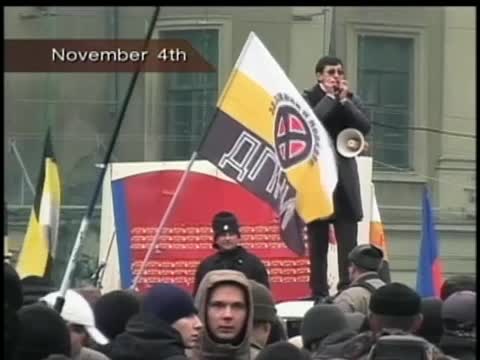
Resources that include a virtual Kremlin's stranglehold on Russia's broadcast media. All the country's national television networks are now owned by state-run entities and the Russian government is even funding an English language network that broadcasts news from Russia to the rest of the world. With Russia's democratic reformers now firmly on the sidelines, a new force has been rising to political prominence here, Russian nationalists have been gaining ground ahead of next year's parliamentary elections, raising the prospect that the next political battle here could be between the Kremlin and the forces of the extreme right wing. Last month the country's ultra-nationalists and neo-fascists took to the streets of Moscow, participating in a rally that city authorities claimed they had banned, campaigning with the slogan, Russia for Russians only, they called for illegal immigrants, many of whom have come to Russia seeking work from the former Soviet republics to be removed from
Russian soil. Look, they're taking away our jobs, they're raping our wives, they're killing us, they're locking our children, they're studying in our schools and they can make crimes. Our right leaders say support for their movement is growing as Russians embrace an anti-American message increasingly prevalent in the country's media and turn against darker skinned migrants from the outer fringes of the old Soviet Empire. Russia, facing a plunging birth rate and falling life expectancy, needs the influx of labor. According to political analyst, Theodore Luccharnoff. Russian demographic situation is quite terrible and we see that Russian society is completely unprepared to accept a major group of foreigners, people with different culture, with different color and this is objectively a very big problem.
Analysts leaders are now flexing their political muscles, sensing a chance to score electoral gains next year and emerges a powerful force in the Russian parliament, they're in the ironic position of seeking the government's tolerance for a fundamentally intolerant message. Originally our slogan was very simple, Russian order on Russian soil, but now we've decided to add to it. We want freedom of speech, we want free elections in a free country, we want freedom of assembly and we want the authorities to respect our constitutional rights. Those demands have more usually been made in the past by the country's democratic reformers and represent a challenge to the Kremlin, political analysts in Moscow say the Russian leadership is split over how to respond to such a potent political force. My gut feeling is that on the level of the Kremlin there are some clangs and ganks that will be ready to play the nationalist card, Russia for Russians and they continue to play
this card. At the same time there are moderate pragmatists within the Kremlin and I include putting himself among these people who have started to understand to realize that they have let out the genie out of the bottle. The nationalist's angry message is made more attractive to lower income Russian voters by the enormous economic disparities that you can witness in Moscow today. The city is in the middle of an unprecedented construction boom. It's now one of the world's most expensive cities for residential real estate. The boom fueled by rising oil prices has seen property values increase fivefold in the last five years alone. The buoyant Russian economy is helping Vladimir Putin enjoy approval ratings in excess of 70 percent and his Kremlin advisors insist that he is committed to creating a modern Russian democracy but that the process inevitably takes time. Parts will become stronger, still society will become stronger and fears will disappear.
Russia's remaining democratic reformers disagree. They argue that the Kremlin is doing nothing to ease the climate of fear and that Russia is now sliding backwards as the hoops for representative democracy slip away. Coming still tonight an hand tater Fleming essay on what the holiday lights reveal and some perspective on that political light in the sky called Barack Obama. NewsHour correspondent Kwame Holman begins our Obama story at one of several stops Barack Obama made in New Hampshire yesterday governor John Lynch summed up the impact the Illinois senator was having during his first trip to this Mecca for all presidential hopefuls. We originally scheduled the rolling stones for this party but we canceled them when we realized that senator Obama would sell more tickets.
Everywhere he went, Obama was mobbed by curious residents who approached him on the street and by a horde of media, 25 television cameras, 150 members of the press. For many at this coffee shop in Portsmouth, it didn't seem to matter that their states first in the nation primary still is more than a year away or that Obama hasn't even announced he will run for president. Everyone wanted a piece of him. On a Sunday morning book signing event, 900 people jammed a ballroom to hear the senator speak tickets ran out in 30 minutes last week. I think that there's a moment that we are living through in our history right now where we've got a series of very important decisions to make and we have the opportunity to make them not as Democrats and not as Republicans but as Americans. And it's that promise that I'm most excited about. Many waited more than an hour to shake his hand and get him to sign a copy of his book,
The Audacity of Hope. Awaiting her turn, Martha Ron echoed what many local residents told us, Obama connects with them. As he's one of us, he's America, he's not rich in the wealthy and special engines, there's one of us, he's awesome. Another Portsmouth resident, Dennis McKinley said, Obama could help the nation regain some of the stature it's lost around the world in recent years. I'm sick at heart with much of what's happening but if I allow that to prevail and I fail to recover hope, I mean how can I proceed? I think that's what he's saying and he's trying to set the table emotionally and perhaps as he said reached to recover and excavate the values of sort of a spiritual recovery. Not so fast, said Fred Hurwitz of nearby Dover, Obama has served just two years in the US Senate. I think that speaks well and I think that's good to hear for a change and I like to see what a center actually is able to get accomplished.
Still, even New Hampshire's most veteran political observer said there is something different about the reception Obama received. Jim Demure's ran statewide operations for Dick Gepphardt and Al Gore. He traveled stop to stop with Obama on Sunday. Everyone we've stopped, people recognize him, he gets out of the car, he's mobbed by people. It has been something that I've never seen. I've been with a lot of presidential candidates a year before the New Hampshire primary and most people don't even know who they are at this point. In Manchester, Obama headlined an afternoon rally for the State Democratic Party where 1,500 people paying $25 apiece packed to the Renaissance Hotel Ballroom. It is an honor and a privileged introduce our guest of honor this evening, Senator Barack Obama. During his 25 minute speech delivered without notes, Obama addressed the extraordinary attention he's been getting. Obviously it's flattering to get a lot of attention. Although I must say it's baffling particularly to my wife.
And he deflected the focus away from his possible presidential run. The reason that I'm getting so much attention right now has less to do with me and more to do with you. I think to some degree I've become a shorthand or a symbol or a stand-in for now of a spirit that the last election in New Hampshire represented. And it's a spirit that says we are looking for something different. We want something to know. Afterward audience members again were impressed. That's about responsibility. That's important. His own responsibility, the responsibility of politicians and the responsibility of the citizen. We haven't heard that decades, a generation. But some thought Obama's race would be a limiting factor should he decide to run. I think there's still too much racial safety.
Others disagree. There might be a few people in America from whom that would be an issue, but I just don't hear it. Obama has said he is weighing all considerations and will make a decision on running after the first of the year. Now some context for watching the Rising of Barack Obama that comes from Newzauer regular presidential historian Michael Beshloss and Dan Baltz, veteran political reporter at the Washington Post. Now Dan, you were in New Hampshire with Barack Obama. Was it what it appears to be in that tape piece and everybody else's tape piece in the story? Jim, it was a spectacle yesterday and in talking to people who have been around the track a lot of times in New Hampshire politics, they said they'd never seen anything like it. A year out from the primary, 1,500 people pack a ballroom in Manchester, 750 people snap up tickets and more than that show up for a book signing at 11 in the morning on a Sunday morning in Portsmouth.
And he walked into both rooms and the first thing that happened was an explosion of cheers. I mean the interest level in him is extraordinary right now. Is there a simple explanation for it? Well I don't think it's a simple explanation and I think he touched a little bit on it. I mean I think there is a yearning on the part of a lot of people to try to turn the page away from the kind of politics that we've had for a decade. You can blame Republicans for it, you can blame Democrats for it, but people know that we've had a kind of a poisonous period. He's of a different generation, he speaks in a different way and I think people would like to think that someone like Barack Obama could move the country away from what we've been doing. Michael, what does history tell us about meteors like Barack Obama? What it tells us is that they didn't happen too often until about the last 30 years because before the nominating process that we now have, someone like this would have had to go through a screening process usually by office holders in his own party, governors and senators in congressmen who probably would have said someone who's only served two years in the Senate can't be president.
John Kennedy ran in 1960, 14 years in congress and despite this many people were saying that even John Kennedy was too inexperienced to be president. Now that's all changed. If you have disability to connect the kind of star quality that Dan is talking about, you know, Obama is the kind of person that Richard Nixon might have talked about, he said some politicians speak and prose, others in poetry. Obama is certainly the kind of speaking poetry, but we're now in a process in an environment where someone like Obama can catch fire very fast. Does his situation, Dan, remind you of any recent situations, whether either they turned out bad or good? Well, you could go back to Ross Perot in 1992 as a possibility, I mean, he kind of came out of nowhere, self-generated in a way, I think that Obama is not and we know what happened in that case. I recall also, in 1995, Colin Powell had just come out with his autobiography. I remember covering that book tour in that fall and all of the hype and the buildup and
the speculates. Colin Powell had 3,000 people turn up for book signing in the cold in various cities. But I think there's one difference between the two of them, which was I think there was much more doubt that Colin Powell would actually take the step and run for president and that if he did, he would have a very difficult time winning a Republican nomination. Obama doesn't have that, obviously, you know, no candidates going to walk to the nomination particularly with Senator Hillary Rodham Clinton at the head of the line, but the glide path for him into this seems clearer than in some of those other cases. And a lot of the similarity to Perot, I agree with Dan, is that Obama seems like someone who can reshuffle the cars in a way that others could not. I mean, the country, for instance, you have to go back 30 years, 1976, to find a presidential election year where a Bush or a Clinton was not on one of the two national tickets. These are two names who have been on top of American politics for 30 years. So to go to this younger generation, someone who's unconnected, really, to any of that,
it does offer people the ability to do that if they want. So that, you then would kind of agree with Obama, but he told that audience in New Hampshire, this is less about me than it is about you and your state of mind meeting you, the voters? Well, he's actually being remarkably self-effacing for a politician in saying that and also saying that I'm amazed that my 15 minutes of fame has been extended, most politicians don't say that. But the other thing is that you have to remember a situation like Ross Perot. He went on Larry King, February of 92, began talking about the deficits, said that George Bush 41 is not doing a Bill Clinton is not the other Democratic front runner. It's like the crazy ad in the basement that no one talks about. He caught fire very quickly, and as you remember, for about three months in the spring, getting to the summer of 1992, Ross Perot was running ahead of George Bush, the president, and Bill Clinton, the putative front runner, he might have been president at any time during that period.
Look at that. Absolutely. Dan is a practical matter. What do the people who have the most lose by a rising meteor, meaning Hillary Clinton on the Democratic side, and even John McCain on the Republican side, do about somebody like Barack Obama? Well they're watching very closely, they're like everybody else, they're trying to figure out whether this has the capability of continuing in some form or fashion at this level of intensity. I think most people doubt that it can, certainly the Obama people doubt that it can. But they also recognize, and particularly I think in the Clinton camp, that he presents an unusual challenge to her, that he's of a different stripe, a different idea, so they said a different generation, and it recasts the race, and in some ways complicates her ability. She was going to be the big star on the Democratic side, but you liked her, you didn't like her, she was going to be a star. That's right. Now has to compete against somebody who also has that kind of star power, who comes with less baggage. Now there are risks for somebody who's as inexperienced as Senator Obama is to jump into this, but nonetheless he presents a different kind of challenge for her.
What are the risks for somebody like this, so Mike? For Barack Obama? For Barack Obama. One of them is that, you know, he has not been vetted. Hillary Clinton has been a national life 15 years or more, Barack Obama has not been. And the old day, someone like that, would be vetted by this nominating process that he's referred to, you know, people who had worked with someone like this for 10 or 20 years doesn't exist anymore. The current process of primary is a front-loaded system that lasts about two weeks, puts the onus on people in the media, all of us as voters to understand who someone like Barack Obama is, and as a result there may be a great temptation among some in the media right now to investigate him with a microscope in a way that may not be very flattering. And there also been gaps in history, like the Romney situation, Ed Muskie, or not, not gaps, but things that were perceived as gaps. George Romney, your father of the current, or outgoing Massachusetts governor who said I was brainwashed on Vietnam, it did not help his candidacy so much.
And I think that's one thing where Hillary Clinton is going to have it over him, which is that she has been tested for a decade and a half in presidential politics. There are certain things that you can only learn by going through that experience. Yes, Dan. This is a candidate who has gotten to this level without ever having a negative ad run against him. Right. He lucked in a sense into the nomination for the Senate in Illinois because the two leading opponents imploded. He ended up drawing Alan Keyes in the general election, and he was not ferocious opponent right. He came from Maryland. He's never been through the kind of rigor, and, you know, as Michael suggests, the level of scrutiny on somebody like Senator Obama will be intense. Most candidates, as they're starting out, like a little bit of on-the-job training, they like to make their mistakes in private with maybe one reporter or no reporters around and certainly no cameras, he won't have that luxury if he decides to run. Dan just has a reporter who's covered many, many presidential candidates and campaigns.
Did you hear the feeling in New Hampshire, or even before New Hampshire, just confirmed by New Hampshire that this was different to this guy? Well, there is something different about this, and it was confirmed in New Hampshire yesterday, and that is he appears to be drawing people in who are not the traditional party activists. The state party decided when they started this event that they would maybe try to get 500 people. They figured that would be a pretty good size crowd in the middle of December. And they got 1,500, they realized they were getting people who are not the persons who hang on every word that candidates have. And I talked to a woman going out who was, I think, not a person who goes to every political event. She said, I have not been this excited since I was 10 years old, and I saw John F. Kennedy campaigning. Okay, well, he bit there. Thank you both very much. Thank you, sir. And, finally, tonight in this holiday season, S.A.A. St. Taylor Fleming looked at the growing economic gap.
The Christmas catalogs have been rolling in by the mail truck load, William Sonoma, and LL Bean, and Smith and Hawkins, also something from Texas offering smoked turkeys because my husband once ordered one. Order one thing from any catalog, and you are on their mailing list for life. And I suspect beyond. And then somehow, this came into my hands. This luxury catalog. I took a debate with the others, my seasonal nighttime browsing, and ran headlong into this. This $26,000, airmays, ostrich, Birken, purse. This aren't really my thing, but I know that the Birken, named after an actress, has been the hot have to have item for a stretch of years among the rich and beautiful. Slung casually around many a gym-toned arm in magazine and newspaper layouts, it has been the signal of insider equisitiveness.
But $26,000 for a purse? What kind of world are we living in? As childhood, I have strolled the Christmas streets of Beverly Hills, all bedecked and shimmering at night. It was an annual outing, a destination, a thrill, like going to Disneyland. All bundled up, we'd stare into the opulent windows, amazed at the finery, the slithery evening gowns, and couture coats, and yes, pricey purses. Was it always crazy outlandish? And then, yes, and no. It was always, for most Americans, a street of nose to the glass, unrequitable longings. But the divide between haves and have nots, somehow, didn't seem so huge, so surreal as it does now, certainly here in this city. Of course, that's true all over the country. The rich are getting richer, much richer.
In 1990 and 2004, the bottom 90% of the population saw its average household income increased by 2%, it went up 57% for the top 1%, and up 112% for the top 0.01%. What's happening is that the normally rich, people in the top 2% or 3% feel poor relative to the really rich. They compare themselves up, not down. I hear it all the time, people making $300,000 a year, saying they are having a hard time keeping their boats afloat, lawyers, doctors, professional people. In another day, such a complaint might have seemed unseemly. But we live in a world of stratospheric executive pay and $26,000 Birkin bags, and in such a gilded world, perspective tends to get lost, as do those who are really struggling. Nowhere is the split between the truly rich and the truly poor, more apparent than in
my home city, which has more millionaires than any place in the country. At the same time, there are 489,000 households in LA County that make less than $15,000 a year. A few miles from the fancy decorated shops on Rodeo Drive, there are ad hoc street employer selling secondhand clothes that patched up furniture. It is a wild ride for heart and eye, and a chasing one at this time of the year. I'm Antaylor Fleming. And again, the major developments of this day, US military announced the deaths of three more American soldiers in Iraq that makes 46 so far in December. President Bush began making the rounds of his top advisors to hear more ideas on Iraq policy, and in Chile, the death of former dictator Augusto Pinochet was mourned, celebrated,
and even protested. Once again to our honor roll of American service personnel, killed in Iraq and Afghanistan. We add them as their deaths are made official and photographs become available. They're in silence are 20 more. But to keep it up, this is bugging. . .
. . . . . . . . . . . . . . . . .
. . . . . . . . . . . . . . . . . . . . . . . . . . . . .
. . . . . . . . . . . . . . . . . . . . . . . . . . . . . . . . place to be, see it with CIT, and by Pacific Life, Toyota, BP, the Atlantic Philanthropies, the National Science Foundation, and with the continuing support of these institutions and foundations, and this program was made possible by the Corporation for Public Broadcasting.
And, by contributions to your PBS station from viewers like you, thank you. Have an 8 News. We are PBS. .
. .
. . . . . . . .
. . . . . . . . . . . . . . . . . . . . . . . . . . . . .
. . . . . . . . . . . . . . . . . . . . . . places called Indiana, and Kentucky. One that has 10 plants from the foothills of West Virginia to the Pacific coastline. What company is this? Toyota. A company that along with its dealers and suppliers has helped create hundreds of thousands of US jobs, a company proud to do its small part to add to the landscape of America. What does the future hold? Will you have the choices to make your world better? To live the life you dream of? At Pacific Life, planning for a better tomorrow
is what we're all about. That's why for over 135 years Pacific Life has offered millions of people a world of financial solutions to help them live well now and plan well for the future. Pacific Life, the power to help you succeed. And by BP, CIT, the Archer Daniels Midland Company, the Atlantic Philanthropies, the National Science Foundation, and with the continuing support of these institutions and foundations. And...
- Series
- The NewsHour with Jim Lehrer
- Episode
- December 11, 2006
- Producing Organization
- NewsHour Productions
- Contributing Organization
- NewsHour Productions (Washington, District of Columbia)
- AAPB ID
- cpb-aacip/507-9c6rx9402t
If you have more information about this item than what is given here, or if you have concerns about this record, we want to know! Contact us, indicating the AAPB ID (cpb-aacip/507-9c6rx9402t).
- Description
- Episode Description
- This episode of The NewsHour features segments including a look at ways forward in Iraq with analysts Eliot Cohen and David Rothkopf; a Simon Marsh report from Moscow about their fractured politics; a conversation with historian Michael Beschloss and Dan Balz of the Washington Post on Barack Obama; and an Anne Taylor Fleming report on the widening economic gap.
- Date
- 2006-12-11
- Asset type
- Episode
- Rights
- Copyright NewsHour Productions, LLC. Licensed under a Creative Commons Attribution-NonCommercial-NoDerivatives 4.0 International Public License (https://creativecommons.org/licenses/by-nc-nd/4.0/legalcode)
- Media type
- Moving Image
- Duration
- 01:04:54
- Credits
-
-
Producing Organization:
NewsHour Productions
- AAPB Contributor Holdings
-
NewsHour Productions
Identifier: NH-8676 (NH Show Code)
Format: Betacam: SP
Generation: Preservation
Duration: 01:00:00;00
If you have a copy of this asset and would like us to add it to our catalog, please contact us.
- Citations
- Chicago: “The NewsHour with Jim Lehrer; December 11, 2006,” 2006-12-11, NewsHour Productions, American Archive of Public Broadcasting (GBH and the Library of Congress), Boston, MA and Washington, DC, accessed October 11, 2026, http://americanarchive.org/catalog/cpb-aacip-507-9c6rx9402t.
- MLA: “The NewsHour with Jim Lehrer; December 11, 2006.” 2006-12-11. NewsHour Productions, American Archive of Public Broadcasting (GBH and the Library of Congress), Boston, MA and Washington, DC. Web. October 11, 2026. <http://americanarchive.org/catalog/cpb-aacip-507-9c6rx9402t>.
- APA: The NewsHour with Jim Lehrer; December 11, 2006. Boston, MA: NewsHour Productions, American Archive of Public Broadcasting (GBH and the Library of Congress), Boston, MA and Washington, DC. Retrieved from http://americanarchive.org/catalog/cpb-aacip-507-9c6rx9402t