The MacNeil/Lehrer Report; Balanchine Obituary
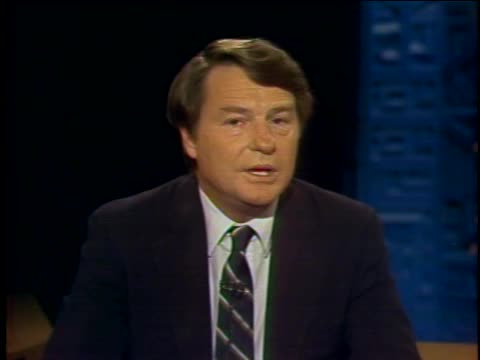
- Transcript
[Tease]
ROBERT MacNEIL [voice-over]: George Balanchine, the choreographer who died on Saturday, is considered in his field one of the great artists of the 20th century -- as creative as Picasso or Stravinsky. Tonight, the nature of Balanchine's genius.
[Titles]
MacNEIL: Good evening. There was a memorial mass today in a Russian orthodox church in New York for George Balanchine, who died at the age of 79 on Saturday. Balanchine is credited with revolutionizing European classical ballet and giving it a distinctivelyAmerican form. His creativity in dance covered a wide range, from the most austere classical to highly popular pieces for Broadway and Hollywood, just as the music which inspired him ranged from Stravinsky to Gershwin. Scores of his ballets are being danced today by companies in the United States and around the world, while his famous number "Slaughter on 10th Avenue" is currently running on Broadway in a revival of the Rodgers and Hart musical, "On Your Toes." Tonight, a look at the work of George Balanchine. Jim?
JIM LEHRER: Robin, George Balanchine was a defector, among the first of many Russians in the world of dance and music to seek personal and artistic freedom in the West. Balanchine made his move in 1924 when he and fellow members of a touring dance company refused a Soviet government order to return home from Germany. Shortly afterward, at the age of 21, he became choreographer for the most famous ballet company in the world, the Ballet Russe in Monte Carlo. Nine years later, in 1933, he immigrated to the United States at the behest of Lincoln Kirstein, a wealthy Boston man interested in ballet. Together they formed the School of American Ballet, from which eventually came the New York City Ballet Company in 1948. Balanchine was born in St. Petersburg, now Leningrad, in 1904. He entered the Imperial Ballet School when he was 10, became a member of a professional ballet company when he was 17. He was married and divorced four times, all four wives having been ballerinas for whom he created ballets. One of the four was Maria Tallchief, the famed American Indian dancer from Oklahoma. Balanchine, who became a naturalized U.S. citizen in 1939, took very much to America, particularly the west, inspiring some of his work and even his dress, which went more to open-necked shirts and kerchiefs rather than coats and ties. Robin?
MacNEIL: It is rare that any creative artist gets a full-page obituary. Balanchine did in a number of newspapers. The one in The New York Times was written by dance critic Anna Kisselgoff. Here are her impressions of the significance of Balanchine's work, interspersed with scenes from some of his creations.
ANNA KISSELGOFF, The New York Times: The individual contribution, which is the personal contribution, is that George Balanchine really redefined what ballet was, and he taught the audience how to look at ballet in a totally new way. He extended the dance vocabulary. By that I mean every little girl in Oklahoma takes the same ballet class that every little girl in Moscow does, but then what do you do with the same steps that everybody performs? You have to put them together in a new way. And he did this in a way that was previously just unimaginable.He uses the same steps that people used in the 19th century, but his dancers dance in a way that is totally modern, and in effect he extended the language of dance. Very few people have done that.
When George Balanchine first came to the United States in 1933, you have to remember that there was no tradition of really sound theatrical dance in the United States. It was on an entertainment level, which was the level, by the way, that he was very interested in. He gave an interview in 1934 in which everything he said has come true.And what he wanted was to bring dance to the masses. Now, of course there aren't as many people watching ballet as there are in sports stadiums yet, but he felt it was a form of entertainment in the highest sense.
The most interesting thing about George Balanchine is that he had the widest range and background possible. I think this is now a thing of the past. No choreographer that is ever going to come up is going to have the background that he did. Even when he was in Russia he played in nightclubs, and therefore when he came to the United States he certainly didn't look down upon the idea of going into popular art forms. He did choreography for English musical reviews, and he worked in musicals, and he worked in Broadway musicals; he worked with operettas, and he did the choreography for some of the Goldwyn films.
[clip from "Goldwyn Follies"]
Ms. KISSELGOFF: One thing I'd like to stress about George Balanchine is that he is a very radical innovator, but unlike many innovators, he departed from a traditional base and he never never -- George Balanchine never rejected the tradition in which he was trained, which was the tradition of classical ballet. George Balanchine said, "This 400-year-old vocabulary is the vocabulary I'm going to use, and I'm going to use it in a way that nobody else has before."
[clip from "Jewels"]
Ms. KISSELGOFF: A lot of people feel they can't quite get a handle on something when they're looking at pure dance, and he said, "Just look at it in terms of what you see, which is movement in time and in space." And I think that actually he's attracted many more people to dance than other people have because he's broken down the barriers. There is nothing to worry about. There are no symbols. You just look at the beautiful dancing or, in fact, it could be ugly dancing that could disturb you and stir you up.
[clip from "Prodigal Son"]
Ms. KISSELGOFF: I really do think there is room for difference of opinion. You don't have to like Picasso's works, but you do have to say, "Yes, he is a great artist and an innovator." And this is true of George Balanchine, that he created a whole new style, a whole new aesthetic, a whole new company, a whole breed of dancer that didn't exist before, and breed of dancer that is generally regarded as a specifically American type of dancer -- fast moving, speedy, athletic, full of energy.
[clip from "Violin Concerto"]
Ms. KISSELGOFF: He's left this extremely rich heritage of works.Lincoln Kirstein, who worked with him since the very beginning, and who invited him in the 1930s to the United States, said George Balanchine was creating the classics of the future.And he's left this entire treasure house of ballets, which will be seen throughout the world. I would like to say, by the way, that I don't think that you have to have his ballets performed only by his company. He has, actually, very generously given them to other companies throughout the world, and he has left this treasure house of ballets. Of the kind that will serve everybody as a repertory.
[clip from "Apollo"]
LEHRER: When most of us think of dancing in the movies, the picture of Gene Kelly quickly appears. This afternoon Mr. Kelly took a break from shooting a television film in Hollywood to say a few words for us about George Balanchine. He said them in an interview with Mary O'Donnell of public station KCET. in Los Angeles.
GENE KELLY: His contributions dancewise -- historically I don't think they'll ever be surpassed, whether it's American dance or any other kind of dance. And I'm talking about the classical ballet, but George ran far afield. He was a man of great daring and ingenuity.
REPORTER: What influence did he have on you?
Mr. KELLY: Well, I don't think that he had a direct influence on me, but I think he influenced every dancer living because of the nature of his work and the cleanness and the quality and the high-powered kind of people that he had around him.It's bound to influence you some.
REPORTER: The New York Times yesterday, in his obituary, put him in the company of Picasso and Stravinsky as among the great 20th century artists. What were his contributions? What really made him great?
Mr. KELLY: Well, like Picasso and Stravinsky he broke ground, and like the two aforementioned gentlemen, he was that cliched word, a genius. He could do anything and everything, and when I say break ground, he's often forgotten more than any of the rest of us have learned. He's a giant of a man, and his legacy will remain forever, no matter what happens.
MacNEIL: We hear now from an American dancer who was trained by Balanchine and was a principal with his company for 20 years. He is Edward Villella, now artistic director of the State Ballet of New York. You just heard Gene Kelly say he was a genius. Other people have said that. Someone in the company, I read in the newspaper, said it was like having Mozart around. Do you agree with that, and how did it feel?
EDWARD VILLELLA: Well, certainly I agree with it.His invention is unparalleled in history, I think. To work with him was something else again. He was the kind of person who was not only a genius, but totally and completely prepared. He was a craftsman as well. He would spend 10 years on a score before he would attempt it. And it was the same with his dances. He got to know his dancers through his school, the School of American Ballet, where we would train on an average from five to seven years before we would join the company. He would follow us there; he would then follow us through the company for a couple of years, and then he would do a work for you. And that work was like a master tailor designing the most incredible wardrobe for you, the one you felt elegant and wonderful. And, number two, it never exposed awkward parts of you. It was only to show you in the very, very best light.
MacNEIL: Meaning he wouldn't want a dancer to do something that dancer couldn't do?
Mr. VILLELLA: Absolutely. Absolutely. Like everything, every dancer has particular strong points and other points that are not quite up to those levels, and he would never expose people in those areas, never.
MacNEIL: You mentioned working 10 years on a score. Is it true that he was unusual as a choreographer in his knowledge of music? He was trained in the conservatory as a musician and could have been a pianist, I understand.
Mr. VILLELLA: I think he had wanted to be at one point, to be indeed a pianist. Fortunately for us he did not. He did train for three years, and that background gave him this incredible insight into scores. And that's really what we see. We see the structure of a score. He illuminated -- I like to refer to him as an incredible illuminator. For instance, when I first joined the New York City Ballet he was doing "Agon." And I just couldn't hear that music. I couldn't hear what it was all about. And not until the ballet was put together and I had an opportunity to see it did I understand the score. He had a way of balancing the score -- physicalizing it and then illuminating it to you.
MacNEIL: What was he like to work with, just as a man?
Mr. VILLELLA: He was an incredible man, the most generous, awesome kind of person. He had such a charisma; he had such an aura about him. When he walked into a room he filled that room. But he also filled it with an incredible humanity. He wasa wonderful raconteur, and he was full of wit, wit not only as an individual and a person to work with, but also within his works. Nothing was solemn to him. He just loved life. He was life itself, but he was also a giver. He just gave to us. He gave us not only the ballets and the technique, but he gave us a style; he gave us a quality to our lives.He gave us an understanding of elegance, and the more I think about it the more I am convinced that what he did was he established not only an American style but an American nobility. We have spent all of our years imitating the 19th century European nobility, and now it's reversed. Now we have the Europeans and the Soviets imitating an American elegance, an American nobility, and that we owe to that man, George Balanchine.
MacNEIL: He was often quoted as saying -- and it came out in all the obituaries -- "ballet is woman," and that his inspiration was always the ideal woman. Now, as a male dancer, did that make you feel somehow second-rate or left out?
Mr. VILLELLA: Well, in the first year that I joined the New York City Ballet he was particularly perturbed at the boys, and he said to all of us -- he said, "You know, you really are nothing but porters. That's all you do. That's all you should have to worry about. You just carry women and you present women." However, if just look back at some of the roles that he's created for men, it is singularly the most incredible, most challenging repertoire in history. People talk about Albrecht in "Giselle" as being the Hamlet of the dance world. I differ with that; I think if you look at "Apollo", you will --
MacNEIL: The bit we just saw.
Mr. VILLELLA: Absolutely. -- you will understand that. If you look at "Prodigal Son." And these he did in 1928 and 1929.And then you carry forth -- some of the things that he did for me I think were -- that I had the privilege of premiering -- Oberon in "Midsummer Night's Dream," the "Ruby" section of "Jewels," "Tarantella," "Bugaku." These were incredible areas for male dancers.
MacNEIL: Meaning difficult to do and challenging?
Mr. VILLELLA: Very difficult, very challenging stylistically as well as musically and technically. I think that his inspiration came from woman. That indeed was his way to function, his way to indeed be inspired. But I think again we have this incredible repertoire that belies that.
MacNEIL: How would you -- you heard what other people have been saying. How would you sum up his contribution to the dance?
Mr. VILLELLA: Well, what I would think is that he took us from the 19th century into the 20th century. He changed the face of the art form. He established what we now know as neo-classicism. But not only did he do that; he will also take us into the 21st century, and my estimation is that those works will still be alive and well, and will be introduced into the century after that. It's that kind of expanse. It's that kind of prolific endeavor. To be able to do well over 200 major works -- major works, in addition to doing 19 -- well, 23 in all between film and Broadway, it just gives you an idea of the breadth of that man.
MacNEIL: So you would agree with Anna Kisselgoff who said he's created the classics for the future?
Mr. VILLELLA: Absolutely. There is no doubt. Not only that, he has created a way to move. It is now an accepted style; this quickness, the attack, the vitality of dance now is Balanchinian, and it's no longer the soft, 19th-century romantic idea. It is American, linear, sharp qualities.
MacNEIL: Well, thank you. Jim?
LEHRER: Finally, a few words now from Alan Kriegsman of The Washington Post. Mr. Kriegsman won the Pulitzer Prize for criticism in 1976, the first and only dance critic ever to be so honored. Mr. Kriegsman, you closed your story Sunday about Balanchine by saying "his death has opened a creative chasm in the dance world that may take decades to fill, if it is ever filled." Why did you say that?
ALAN KRIEGSMAN: Well, one reason I said that is because geniuses of Balanchine's dimension don't come along every day or every year, and we have been fortunate enough to live through a time in which we had someone of this caliber. This is not to say that there aren't other choreographers of even genius, but I think Balanchine was on another level, though -- to my mind the level of a Shakespeare, of a Milton, of a Dante, of a Bach or a Beethoven. And I think that, I suppose mainly because it's not just the range of dance forms and media that he dealt with and transformed and enriched; it's that he was universal in the sense of having been able to translate all the important areas of life experience into dance movement from joy and love and sorrow and fear -- all the universal experiences that a Shakespeare and a Milton and a Bach have dealt with. In a ballet like "Prodigal Son," which we saw earlier, which comes from the Bible, he dealt with relation of father to son and generation to generation. In a ballet like "Serenade" he deals with the feelings of romance. In a ballet like "Bugaku" he deals with exoticism and eroticism. In a ballet like "Midsummer Night's Dream" he deals with the infinite varieties of human love and how they manifest themselves from every class of society up to royalty and gods.
LEHRER: You compared him with Shakespeare. Every person, no matter where they are, particularly every American, has heard of Shakespeare, and yet there are millions of Americans probably have never heard of George Balanchine until they saw on the front page of your newspaper, The New York Times and every other newspaper in the country that, "Hey, this genius, George Balanchine, died." Does his life or his work have anything to say to the non-dance world, in your opinion?
Mr. KRIEGSMAN: Well, in a sense I think it imparts a lesson about the significance of human movement as an expression of the human spirit. And I think more than anyone in the history of that art he has conveyed this lesson to millions and millions of people. There may be many people who are not aware that they have seen Balanchine, but may have seen a movie like Goldwyn Follies. I mean, a man who can choreograph for circus elephants, which he did, as well as severe abstact ballets to very abstruse kinds of music, can speak to a tremendous variety of people. This lesson I speak of, the lesson of the meaning of human movement, is simply the lesson that movement is life, and when movement ceases, life ceases. And every movement, every human movement is expressive of something. We trudge in sorrow; we march with pride in a parade; we extend our hands in welcome or in greeting; we bow our heads in sorrow. These are all movements. Ballet takes these movements, codifies them, stylizes them, and builds them into a system of beautiful expression. No one understood this better than Balanchine.
LEHRER: Thank you. Robin?
MacNEIL: Mr. Villella, Mr. Kriegsman, thank you. Good night, Jim.
LEHRER: Good night, Robin.
MacNEIL: That's all for tonight, and, finally, this weekend, when dancers in Balanchine's company were mourning his death, one of them said, "Mr. Balanchine used to say that Americans were terrible about death. He said that in Russia they toast the health of the guy who died." We end with Balanchine himself proposing a toast to his friend, the composer Stravinsky, accompanied by Lincoln Kirstein, the man who brought him to America. It was Balanchine's last public appearance, in June, 1982.
GEORGE BALANCHINE: I want to say something he forgot to say, that at the end of the performance we will have a table set for everybody. As you go out you can have a hooker.
- Series
- The MacNeil/Lehrer Report
- Episode
- Balanchine Obituary
- Producing Organization
- NewsHour Productions
- Contributing Organization
- National Records and Archives Administration (Washington, District of Columbia)
- AAPB ID
- cpb-aacip/507-2f7jq0tc94
If you have more information about this item than what is given here, or if you have concerns about this record, we want to know! Contact us, indicating the AAPB ID (cpb-aacip/507-2f7jq0tc94).
- Description
- Episode Description
- This episode's headline: Balanchine Obituary. The guests include EDWARD VILLELLA, State Ballet of New York; ALAN KRIEGSMAN, Dance Critic. Byline: In New York: ROBERT MacNEIL, Executive Editor; In Washington: JIM LEHRER, Associate Editor; LEWIS SILVERMAN, KENNETH WITTY, Producers; GORDEN EARLE, Reporter; BRUCE KAUFMAN, KATHRYN OLSON, Researchers; Videotape: Anna Kisselgoff and Gene Kelly: BOB LONG, DAN WEBB, Camera; RAY WALKER, GERRY SAAVEDRA, Audio; BILL STEPHAN, Editor; MARY JANE O'DONNELL, Reporter
- Created Date
- 1983-05-02
- Rights
- Copyright NewsHour Productions, LLC. Licensed under a Creative Commons Attribution-NonCommercial-NoDerivatives 4.0 International Public License (https://creativecommons.org/licenses/by-nc-nd/4.0/legalcode)
- Media type
- Moving Image
- Duration
- 00:29:59
- Credits
-
-
Producing Organization:
NewsHour Productions
- AAPB Contributor Holdings
-
National Records and Archives Administration
Identifier: 97182 (NARA catalog identifier)
Format: 2 inch videotape
If you have a copy of this asset and would like us to add it to our catalog, please contact us.
- Citations
- Chicago: “The MacNeil/Lehrer Report; Balanchine Obituary,” 1983-05-02, National Records and Archives Administration, American Archive of Public Broadcasting (GBH and the Library of Congress), Boston, MA and Washington, DC, accessed October 4, 2026, http://americanarchive.org/catalog/cpb-aacip-507-2f7jq0tc94.
- MLA: “The MacNeil/Lehrer Report; Balanchine Obituary.” 1983-05-02. National Records and Archives Administration, American Archive of Public Broadcasting (GBH and the Library of Congress), Boston, MA and Washington, DC. Web. October 4, 2026. <http://americanarchive.org/catalog/cpb-aacip-507-2f7jq0tc94>.
- APA: The MacNeil/Lehrer Report; Balanchine Obituary. Boston, MA: National Records and Archives Administration, American Archive of Public Broadcasting (GBH and the Library of Congress), Boston, MA and Washington, DC. Retrieved from http://americanarchive.org/catalog/cpb-aacip-507-2f7jq0tc94