New Mexico in Focus; 1016; New Mexico Symphony Orchestra
- Transcript
New Mexico's symphony orchestra emerges from near disaster. Tonight their latest performance leaves audiences mesmerized and a newsmaker interview with orchestra conductor David Lockington. Will the classics live on in New Mexico? Find out next on in focus. Hello and welcome to in focus, Amarci Chapa. It was a night to remember the New Mexico symphony orchestra performs Beethoven's 9th Symphony
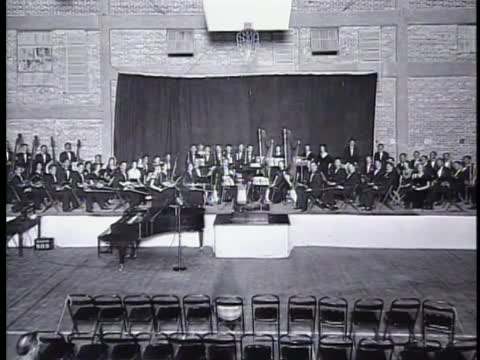
to a sold out crowd and receives a long and heartfelt standing ovation. Is this a sign that the New Mexico symphony orchestra is no longer in danger of extinction? Or are there still troubles ahead? Joining us in a moment to answer these and other questions is the orchestra's conductor David Lockington. That first is background report. On a Christmas November evening in 1932 an orchestra made up of students, teachers, housewives and business people performed the first concert of the Albuquerque symphony. This volunteer orchestra conducted by Grace Thompson Edmester, one of the first women
conductors in the country, served as a catalyst to what is now one of New Mexico's great cultural jewels, the New Mexico symphony orchestra. In its 65 year history the New Mexico symphony orchestra has gone through many highs and lows. Many of the great strengths of the symphony, its touring and education programs, the pop concerts, the guest artist and the many professional musicians employed have evolved over many years under the leadership of different conductors. Today the New Mexico symphony orchestra is led by music director and conductor David Lockington and is the largest professional performance ensemble in the state. About 12 years ago the board and the orchestra made a real leap of faith, kind of quantum leap in the kind of organization that the New Mexico symphony was to be. And that was to make the commitment to go from being this part time semi-avocational sort
of organization to being a first rank professional orchestra and to offer the kind of artistic quality that the orchestra is known for today. And that, as in almost every area of artistic endeavor, came with a price tag attached to it. It meant offering musicians the kind of wages, annual salaries that would enable them to move here to New Mexico to play for the symphony. As with many businesses and corporations, the free spending days of the 1980s brought significant growth in the New Mexico symphony. The orchestra grew, salaries increased and programs were expanded. 1990s brought the reality of huge debts and a shrinking pool of contributors. As recently as last summer, the New Mexico symphony seemed to be minutes from dissolution.
Many donors grew weary of hearing the symphonies plea for funds. While the orchestra clearly has had financial difficulties for a number of years, and it dates back to that quantum leap that we were talking about earlier, when the leap of faith was made that a professional high quality orchestra could exist in Albuquerque in New Mexico. Some of the projections for how much money could be raised and how much could be sold in terms of ticket revenue were a bit optimistic. But placing that in the context of what was happening around the country at the time, there are a lot of orchestras that got into trouble at that time. Remember that was before the big recession, and everybody was expecting that there would be just growth, growth, growth on into the future. So beginning 12 years ago, the orchestra started accumulating debt because of this leap into a new kind of stature of organization.
The story for the last 12 years has been the orchestra digging itself out from underneath that debt. In the summer of 1997, a miracle happens. A generous donor made a gift of $200,000. Its contribution, not only saved the New Mexico symphony orchestra, it gave the board and staff a foothold towards financial recovery. Within a few weeks, the symphony had received almost $400,000 in pledges for a new endowment fund. Currently, the endowment has climbed to $1.3 million towards a $3 million goal. The endowment has climbed to $1.3 million in pledges for a new endowment fund.
That's the exciting thing about what's happened in the last nine months. We have, through the campaign that began last August, August of 1997, completely eliminated all of the orchestra's debt with the exception of the debt that runs back quite a number of years to the University of New Mexico for Pope Joy Hall rental, and that's in the process of being negotiated. So the first time in many years the New Mexico symphony is debt free.
Part of the plan also was to create a cash reserve so that we wouldn't need to spend a head on next year's season ticket money, and we're well on our way to doing that. We have been completely current on all payrolls all year long, and expect to be into the future. The New Mexico symphony orchestra now has a joyous song to sing. The hard work, patience, and perseverance have paid off. Most recently, the New Mexico symphony orchestra performed Beethoven's ninth symphony with
the choral finale appropriately known as The O to Joy. We see it in Pope Joy Hall was full and an enthusiastic audience cheered Maestro Lockington and choral director Roger Malone, and especially the orchestra and chorus. It was a victory of the triumph not only of the human spirit that Beethoven celebrated in his final symphony, but also for the New Mexico symphony orchestra, Albuquerque, and New Mexico. Joining us now is conductor David Lockington. David, thank you so much for joining us today. So now after years of all the struggling, are you now going to be able to start dreaming and making plans for the future for the orchestra?
Well that's the nice thing about being able to put some of the financial things behind us. As artists we're always dreaming, but how much we can achieve really depends on the support that we get. I think what I would like to focus on and my colleagues as well is really expanding the program of bringing music to life, bringing music to people's lives in New Mexico. We are called the New Mexico symphony orchestra, and I think that it's very important that we're able to reach as many people as possible. So one of the things that we are able to and will continue to expand is our touring program. Also education is a really vital part of sustaining an appreciation and a love for the arts, and so we're going to be finding ways to expand our outreach into the schools, and also adult education. There are a lot of adults who played something when they were younger, and then they moved on to other things, and perhaps in their 30s or early 40s, find themselves interested
in rekindling some of that early enjoyment. And so I think adult education is a very important part of our program too. Now we just saw the performance that was just incredible. How did you feel that night after you got the standing ovation? Did you feel we finally made it? Our troubles are over. Do you still have to worry a little bit? Well our troubles are not entirely over. Each year the challenges are still there to raise, you know, we have to raise over a million dollars in annual fund campaign every year. So the challenges are always there, and as industry changes with corporations coming and going from town and to town, we have to adapt to the changing times. But it was a great feeling to get through this enormous piece with a feeling that we've all been on a journey together.
We've been through hard times, and I've really come at the end of the hardest times. The musicians and the staff, the chorus have seen terribly difficult times, and it's a wonderful feeling to know that we are appreciated. Our audience loves the New Mexico Symphony Orchestra, and the community wants a really high quality orchestra. If we're talking about vision, really what we've got to do is maintain the highest possible level of this orchestra, because it's a jewel. What do you feel that classical music is still appreciated, and particularly in New Mexico? Well, that was something that I questioned when I came here. You know, is there a depth of tradition? And as you know, this year is our 65th anniversary. And through all these changes in the organization, the community has displayed a real love for classical music. And even when times have been hard, people have stepped up to the bat and given money
so that we wouldn't go down. Last summer, I didn't know if we would be doing this season, and it's so wonderful now to be planning for next season. And knowing that we have our subscriptions away up, we're going to have wonderful crowds, and hopefully financially everything will just be fine. Now the headlines we're reading that the Mexico Symphony Orchestra has made a miraculous financial turnaround. How bad did it get, and are you out of danger now? I would say it got to the point where we were seriously considering having to close down the orchestra last summer. And I think that having an endowment campaign established, and I think we've got about $1.3 million pledged to this endowment campaign now for a $3 million goal, having endowment established sends a message to the community that we're here to stay, and it really sends
also a message of security to the business community that you're not going to be pouring money down a black hole. And I think that's the sort of the chicken and egg situation, the vicious circle that we've had to break. You can't succeed without money, but if you're in a crisis, you've got to have money, but you don't want to give it if it's just going to disappear. If the orchestra's going to go down, why help it with a little extra money? Are you out of danger now? I think we are out of danger. I think we are out of danger, the musicians who have stuck with us all through this difficult time, taking late payrolls. They're all paid up. The staff is all paid up, and this is a terribly important sign of health and very important morale boost for the orchestra. Everybody that's got the board that, through a labor of love, they don't get paid, they're sitting on this board, and just out of love of the orchestra and music, they have to
go out and ask their colleagues and their friends for money. And I think that that whole process is now much easier because of the security of the orchestra. Including myself as part of an audience that would watch the New Mexico Symphony Orchestra, why would the symphony be important to me and in particular to Albuquerque or New Mexico? Well, I think that what makes a really great community is the extraordinary diversity that's the foundation of it. I treasure the diversity of cultures that we have here and in other large cities. And I think artistically, too, it's very important to have a fantastic cauldron of bubbling artistic growth and excitement and experimentation. And I think the symphony is a part of that. I think the symphony, what it points to historically, what it can point to for the future, I think can be the backbone of the artistic life of a community.
I think also for economic growth, people look to communities to move their businesses that have high quality music making, which includes an orchestra, as well as all the other wonderful diverse activities that go on. Well, I know that you were the assistant conductor of the Denver Symphony Orchestra and you had experienced budgetary cuts and I think your position was eliminated. Is there job security now for musicians? Are we going to be able to keep that wonderful orchestra here? Are you going to have the musicians continue to play in the orchestra? Right. We have a really fine orchestra because of the vision of the leaders of the orchestra in the early 80s. And they changed the orchestra from an amateur orchestra to a professional orchestra. They attracted a lot of really fine musicians and despite the hard times those musicians have stayed, now we're in the situation where when we have auditions that we're getting really high quality musicians come to audition and we're able to offer them a secure salary.
It's not a great deal of money compared to say the Boston Symphony on New York Philharmonic. But there are ways of supplementing the income, teaching the musicians reach over 2,000 students every single week. So that's a very important part of the sort of tapestry that makes up the community. But people love this region, I love this region. People want to live here and if they can make a living, they'll come in audition and stay. And as I say, we've got wonderful musicians coming to audition now. And there's Good Moral. It's a joy to conduct the orchestra when people are feeling good about themselves. Knowing that the community is behind them rather than feeling that the orchestra is somehow a liability that they've got to look after. Now people are proud of this orchestra and the musicians feel that they play with pride.
That electricity generates a tremendous amount of goodwill in the community. That's a great introduction to get into that performance that you had recently. So can we roll that so we can see the musicians and then hear this wonderful piece, the Beethoven Sites Symphony, thanks. And his music starts with such an incredible sense of struggle. And I can't help thinking that symbolically this follows the course of what the New Mexico
Symphony has gone through. The end of the symphony, of course, with the ode to joy is so incredibly revivifying. We feel so alive and joyful at the end. I see you can't help yourself.
You're sitting here watching the music and conducting with your eyes and then your head. How do you go about bringing the music to life when you're rehearsing with the orchestra? How do you bring it to life? You've got to be the music, rather like a dancer, you have to embody the emotions. And obviously you've got to dig deep into your own well spring of emotions. But you're also an emotional anthropologist in a way, looking at the emotions of people throughout time, throughout history. It's one of the most fascinating things for me is looking at the historical side of the music, the way it came from, and the whys, and the house. But in rehearsal, you have to look after the details, obviously, make sure all the teas
are crossed and the eyes are dotted. But ultimately it's about inspiring the musicians to really draw their emotions out so that you can bridge the gap between the stage and the audience so that they can bring the music alive for the audience, so that the audience can then take that wonderful experience from the symphony concert out into the world. And that's where it starts to make a difference, the ripple effect of a concert through the community, I think, is really quite profound. You were telling me earlier that you were exposed to classical music at an early age, and I know that that's probably one of the most important roles for the New Mexico Symphony Orchestra. And that is to expose classical music to younger children. And what is the NMSO's role in education in New Mexico? Well, for a long time, we have sent musicians in small ensembles out to the schools, all
the different families of the orchestra represented when they go out. We have done a series of concerts in the spring, a week of concerts for young people. And what I'm thrilled about is we're expanding that program. We're going to do a series of concerts in the fall, we'll be covering the fourth and fifth grades. We're also going to be helping the teachers with their recruiting efforts so that our musicians will be there performing with different middle school bands when the teachers are recruiting kids in fourth and fifth grade to start instruments. The best way to reach a child is to have them actually study a musical instrument. And the benefits that they gain from that study are absolutely enormous. One of my daughters, when I asked her why she liked to play music, she said, well, it makes me feel free.
And I think that's a testament to music. It's a wonderful tool for learning discipline. It's a wonderful way of sharing something with another person. The Albuquerque Youth Symphony is one of the most extraordinary examples of young people sharing great music and loving it and presenting it with pride to the community. It also is an incredible way of, I mentioned, disciplining the brain, but in terms of performing, you're put in such a heightened state of awareness and self-consciousness and dealing with that kind of pressure is incredible. You can see the connections that are being fired off in the brain when you see a kid performing for other people. It's a very exciting process and what they learn playing music will be able to stimulate them and help them in the whole of their adult life.
The lessons are the same. That's incredible. And hopefully you'll be able to make that contribution to the schools here in New Mexico. But we're almost out of time, but I want to know what your dreams are for the future. What do you want now for an MISO and for you? Well, I mentioned the touring education, ultimately what I would like is for us to touch as many people in Albuquerque and in the state as possible. I'd like the orchestra to be a reflection of the community in terms of our repertoire, in terms of who comes to the concerts. I'd like to be able to expand the size of the orchestra for certain works to be able to do incredibly exciting works, you need a certain number of players. We have started recording. We did our first CD, bringing music to life last year and we're hoping to do a recording each year. I'd like to take the orchestra on tour.
When people out of state hear us, they have blown away, that we have such an incredible musical resource here and I'd like to be able to share that with broader community. Thank you so much and we are very lucky to have you here in New Mexico. And have the New Mexico Symphony Orchestra. Thank you all. Thank you so much. And that's our report for this week from all of us at KNME, Amarci Choppa. Thank you for joining us. If you would like to contact us here at Infocus, you can reach us on our website at www.pbs.org-knME. We are at our email address at Infocus at knME1.unm.edu. I'd like to thank you all for joining us here at Infocus at knME2.unm.edu.
- Series
- New Mexico in Focus
- Episode Number
- 1016
- Episode
- New Mexico Symphony Orchestra
- Producing Organization
- KNME-TV (Television station : Albuquerque, N.M.)
- Contributing Organization
- New Mexico PBS (Albuquerque, New Mexico)
- AAPB ID
- cpb-aacip-4d628742e38
If you have more information about this item than what is given here, or if you have concerns about this record, we want to know! Contact us, indicating the AAPB ID (cpb-aacip-4d628742e38).
- Description
- Episode Description
- Background report looks at the NMSO struggle to stay in the black. One-on-one interview with Conductor David Lockington. Guests: David Lockington.
- Created Date
- 1998-05-15
- Asset type
- Episode
- Genres
- Talk Show
- Media type
- Moving Image
- Duration
- 00:30:35.122
- Credits
-
Interviewee: Lockington, David
Producer: Purrington, Chris
Producing Organization: KNME-TV (Television station : Albuquerque, N.M.)
- AAPB Contributor Holdings
-
KNME
Identifier: cpb-aacip-f790c02f2f7 (Filename)
Format: Betacam
Generation: Dub
Duration: 00:29:25
If you have a copy of this asset and would like us to add it to our catalog, please contact us.
- Citations
- Chicago: “New Mexico in Focus; 1016; New Mexico Symphony Orchestra,” 1998-05-15, New Mexico PBS, American Archive of Public Broadcasting (GBH and the Library of Congress), Boston, MA and Washington, DC, accessed June 9, 2026, http://americanarchive.org/catalog/cpb-aacip-4d628742e38.
- MLA: “New Mexico in Focus; 1016; New Mexico Symphony Orchestra.” 1998-05-15. New Mexico PBS, American Archive of Public Broadcasting (GBH and the Library of Congress), Boston, MA and Washington, DC. Web. June 9, 2026. <http://americanarchive.org/catalog/cpb-aacip-4d628742e38>.
- APA: New Mexico in Focus; 1016; New Mexico Symphony Orchestra. Boston, MA: New Mexico PBS, American Archive of Public Broadcasting (GBH and the Library of Congress), Boston, MA and Washington, DC. Retrieved from http://americanarchive.org/catalog/cpb-aacip-4d628742e38