Biography Hawaiʻi; Koji Ariyoshi; Interview with Roger Ariyoshi 7/21/04 #2
- Transcript
that we were going to talk about later, now we don't have to, because it's there, and like for example, that story of him heading right there at the end of the story, from heading off. He said a number of things about your father's character, but I know Biggie is really cool, and that's fine. It doesn't matter where this stuff comes from, because it's, you know, it's just your father wouldn't be wanting to talk about it, whatever the business in hand was, that would be the thing. Yeah. Well, you know, I think it's kind of nice that he even talked about it a few times, oh no, I, hey, I'm, I am true. Given that Nancy and I were so, I mean, top, I mean another one of those hard places, argument that father talked about his decision to voluntarily enlist, go into the military. I think it was, well, I can recall him telling me briefly, was the camp was somewhat divided. Those who supported Japan, and it was usually the older generation, and those of my father's
generation were US citizens, this is our country, in our government, so even going out, they organized the farmers, helped to help the farmers pick potatoes and things like that. And then, so when the opportunity came up for them to join the army, he did enlist. He, and he tried to encourage others in the camp to enlist with him, and I think quite if you did sign up for the army. And he was sent to camp savage in Minnesota, was a language school, whereas I understand he learned proper Japanese. I've talked to a couple of people who had been with him in the camp savage at that time, and they said, you know, your father was one determined person, and he said, he'd be the only one sitting on the latrine, late at night, studying his Japanese, because that
was the only place that the light was on, you know, and I said, you mean the stench of it, he says, that's where he studied, so he could learn, you know, proper Japanese and reading and writing and so forth. That's one of the things that stuck in my mind, you know, he's just very focused on certain things, and when he's determined to do something, he'll do what he, you know, he'll set out to do what he wants to do. And I think all through life, you know, he had certain goals, though, he never sat me down and said, this is my goal in life, this is what I want to do, or what is your goal in life, and what do you want to do, type of thing, it was, you could tell by how he lived his life, and the things he got involved in, that was his goal, to educate people about
different perspectives of looking at the same thing in life, and different social systems, how it works in one country where it might not work in another, I think that's what really intrigued him with China. He saw China back in the 40s, and again early 70s, when he did go back, he saw a tremendous change, and it made another deep impression on him, you know. He talked about flying into China from Burma, over the hump, in a propeller plane, you know, over the Himalayas, and landing, I think, in Kunming first.
But you know, he didn't talk too much about when he was in different parts of China just mostly when he was in Yangon, I guess, in that area where he would have to go out and make some investigations, you know, of the who's fighting, who, the conditions of the people, who do the people support, things like this, and it couldn't be anywhere that he had traveled in China during that time. He said such a sparse land, you know, life is very hard, very futile in a sense, you know, the system that the people lived under, and so when he saw how the communist lived in Yangon, you know, the structure, and how they moved about the country and liberated areas where they didn't take from the people, they shared with the people, they worked
beside the people, I think it had a very deep impression on him, you know, how people working together can make change, you know, better their lives, and for such a huge country with such a large population as China had, you saw it, you know, it would be a very difficult task, but for what the communists were doing, that's why I think he supported, you know, and felt very strongly that they were doing the right thing there as opposed to what Umandang at that time was doing. He, you know, would just talk about, oh, he saw this, you know, a sparse land, no food, interviewing village people, you know, find a mother and daughter being raped by 60 soldiers or, you know, things like that. I said, what, what else? You
know, I mean, what did you do every day? And he said every morning, and this was also told to me by someone else that he would walk from his cave across the valley to where the leaders, the Chinese communist leaders would live and go into the caves and have discussions with them. What was discussed? No one really knows, and I've looked through some of his diaries and things of that sort, which just gives brief descriptions of someone's name or a place, and nothing makes sense, you know, because it's all in his own head. As for reports, he wrote, you know, some were declassified, which we tried to get later, but he never really talked about exactly what he did there, except for writing reports. I think it was general
Hurley, Ambassador Hurley, yeah, the Texas Orgman. When he arrived, that was one time my father talked about it, and he says he arrived and got in the car and gave out a big Yahoo! Well, the Chinese didn't know what that was about, right? So my father had to explain to me he's from Texas, you know, and it's just the greeting. The other occasion was my father was lectured by him. He was called to my father. My father was called to his room, and I said, for what? And he says, there he was standing in his cowboy boots and his underwear, and shaking his finger at me, yelling, telling me, young man, the kind of reports you are writing are not good. You've been brainwashed by these communists here, you know, and so forth, because my father
would try to explain the situation. He just wouldn't hear any of it, you know, and just cut my father's shirt, but just the description of, you know, the situation there being lectured by him, was one that I think my father even saw a little bit of humor in it, you know. Sir, yes, he didn't make the father have much of a sense of humor. I guess he did, but you know, certain things struck him funny in a certain way, and I've never heard him really bust out laughing out loud, very rarely. But once he told me, you know, he was at, because we were talking about it, and I asked him, I said, you never really laugh out loud. I mean, you know, a real boisterous laugh, and he said, so I do. And I said, well, I like when? And he said, well, he was at a funeral service of, I believe, it was his father, or any way a family member, and he started to chuckle. Each time the
Bonsang would hit the gong, you know, and he tried to concentrate, the more he tried the concentrate, the louder he laughed. Each time the Bonsang hit the gong. Finally, he just bust out laughing so loud he had to go out and embarrass the whole family, you know, but he asked him, what was it? He says, I don't know, it just struck a funny bone in me, you know, he says, and when I chuckled the first time, the Bonsang looked me directly in the eye, and he hit it again and got worse, I just laughed more. He says, he says, that was the time I let out a big laugh. He says, I don't know, it just struck a funny bone in me, and I thought, it was so odd for my father, you know, I mean, very always pretty much in control of himself, you know, and I said, they must have struck some funny bone in you with that Bonsang looking at you directly in the eye
that way. He says, to this day, you know, he didn't know what it was that set it off, you know, what thought or anything, he just started laughing, you know, and I've all places in a funeral, but aside from that, he'd laugh, you know, just off the cuff, but always quite serious, I think, you know, he knew out of joke, I guess, he couldn't tell a joke, he couldn't understand a joke, let me put it that way, you know, but most of the time, you know, quite a serious person, or most people took him that way, even when we're growing up, I guess my sister didn't have all that much time with him, he was always at meetings and things, and she didn't meet him until she was, I think, three years old, you know, and I said, well, because I was curious, you know, my sister never talked about it, and I asked my father and he said, yeah,
first time she was three years old when I met her, and I could tell she looked at me like, who's this strange man, who's, he's my father, you know, and she said, one thing my sister did say though is that she says, you know, your father used to kiss me good night, every night in New York, and she said, and one time she says, I'm glad he did it quick, because I could smell beer, and the next thing I know, he was throwing up, she said, you know, that could have been all over me, and we laughed about it, but I asked my father and he says, gee, I really don't remember, you know, he sort of, you know, shunned off those kind of things, so I'm sure it did happen, you know, my sister remembers very vividly, growing up myself, he spent time taking me fishing on occasion, I think, I think a lot at the
prodding of my mother, but, you know, to spend time with me, or coming home to play baseball with me after school once in a while, you know, which I thought was very strange, from my father to come home at this hour and want to hit some balls with me, you know, but he did do that on occasion, but it didn't bother me, it was the way all our parents were working, right, so the neighborhood kids, we just play with ourselves, you know, play among each other, never thought I was short-changed in that way, you know, growing up, everything was okay, you know, I got to do what I wanted to do, my, all I know is my parents were always working, morning to night, you know, if they came home, I think by seven or eight, that was a miracle, that was when they were running the paper and things,
and some nights, I guess, when it was press time, I never saw my father, you know, but it was just my daddy's working, you know, when he was arrested in Halava, I was just a baby yet, but I don't know, just the sight of a picture in my mind is this big, big man standing in a doorway, and my father's sitting on the toilet, using the toilet, and I, we talked about it in later years, and I said, well, what was that guy doing? And he said, well, they came to arrest him, but he said he had to go to the toilet first, so the guy said, go to the toilet, but I'm going to watch you, so he said, there he was sitting on the toilet with the FBI guy standing in the doorway, and that's what I remember from the back, you know, and then off he went, and the next thing I remember was seeing my father in jail, how they all hang on the bars, he and Jack Holland,
well, all seven of them, and I remember tugging on my dad's pants, and I guess he was talking to my mother, but they were in jail, and then I went home to tell everybody in the neighborhood, my daddy's in the chicken coop, you know, that's all I remember, for my sister I think was harder, she was older, and parents of her friends would tell her, don't play with that girl, their family is no good, and I think in Halava housing there was a manning family who all through the years, and always kept in contact with us, and they never shunned our family during that time, if I remember, I remember playing with their brother and sister, you know, I'm so does my sister, you know, it's a good time in our lives, you know, in that way. I'll jump to, did you find a talk about what impressed him about those major, major figures he came to know
about? He would talk in general terms about them, for example Mao was a great leader, a great theoretician, things of that sort, nothing on a very personal level in that sense, even for Premiere Joe, he would refer to him as a very skillful diplomat, very smart, you know, and it amazed him how much they pushed themselves to work, you know, and applied themselves, because even when my father went back in 71, he met Premiere Joe something like two o'clock in the morning,
I think it was, and they talked them to like five o'clock in the morning, you know, and he says, even for his age, you know, they trained themselves, and you know, that's how they work, and that's how they do things, you know, and their mind works that way, so he says, and for him, what they were doing is leaders of a country, he found it, you know, such a seemingly insurmountable task, and how would they accomplish all these things, but it was, I guess, you know, stage by stage, bit by bit, because even my father when he tried to accomplish anything, it was never, it's going to be accomplished overnight, everything takes time, but certain things have to be pushed
and moved a little faster, and you help it along, I think those kinds of thoughts, you know, maybe he was impressed by talking and seeing what they were doing in China, you know, which he related to his own life, you know, Madam Sun, Sun Qing Ling, I think just the struck a friendship which lasted over the years, and I, even I'm still quite puzzled as to how such a deep friendship lasted that long, she met my father several times enough from 44 to 46, she was introduced to him by Dr. Mahadeh, who had written a letter on my father's behalf, and he
met her, I think, the first time in 1944, the last time he saw her in China was in 1946 in Shanghai when he left China, other than that, I remember he used to write letters to her and also get some magazines from China Reconstrux, which Madam Sun's organization used to publish, for the, when my father was arrested, she sent her mother's gift of a wedding dress, a Chinese wedding dress, which was given to Madam Sun to have my father sell it, to raise money for his legal defense. I didn't find out until later in, you know, we talked about it in the 70s, he still had it, so when he went back in 1971, when Madam Sun invited him back, he did take that
dress back. When he came home three months later, he still had the dress, so I said, what happened? You didn't see her or he said, no, she saw the dress, she said, I gave it to you, you keep it, it's yours, so that's why he brought it back, you know, but I didn't find out till I think it was in the 80s, after my father had passed away, exactly how he got a hold of that dress, how it was brought to him, and Roy Takumi gave me a call, and he said, Roger, there's this woman here named Margaret Stanley, she's a nurse who is a friend of Madam Sun's and came to Hawaii, you know, during the 50s to see her father, and so I, I like to meet her, and she showed me a picture of the house that they had lived in at that time in Kaimaki, I believe it was, and I know
must be her, I mean she's, you know, she knows my, and she said, you know, at that time we were talking, I said, did you bring any package or anything, she said, for my father from China, she said, yes, I did, I don't know what was in it, but it was a fairly good-sized package, and I did do that, it must have been the dress, and that's how it was given to my father, you know, when my father passed to in 1976, so after Madam Sun passed away in 1981, I decided, I should return the dress to China, it belongs back there, so I gave it to one of his friends, Liao Jingjun, who is his father and Dr. Sun Yatsun, were close compatriots in the Chinese 1911 revolution, so he accepted it, and he didn't really know what was in it, I just gave him a box, and I told him this is a dress which was given to my father by Madam Sun, and so he said,
okay, and then later he opened it, it was quite old, so he headed to the Madam Sun's residence, which is now a memorial hall, you know, of Madam Sun, and so they have it on display there, actually now they have a copy on display, because I go there often, and I have a look, and I said, this is not the same dress one day, you know, I took a good look, and I said, this is not the same dress, and the girl said, what's so different, I said, no, the tassels should be a little more tattered, this looked like new, and she just smiled, and she says, yeah, we have, we have the original, put away, and see if keeping, this is a copy, I said, okay, as long as you still have it, you know, Madam Sun, I guess the, always sent magazines to my father, wrote letters, and I said, did you ever get them? He said, yeah, I did get them months and months later, and I guess they were
opened, you know, and inspected, and things coming from a communist country at the time with no relations, you know, with the US. In later years, they wrote frequently to each other, you know, they, I guess, helped my father, had a lot of respect for my father, just the kind of life that he lived, and things he got involved in, even in later years, they would ask, you know, is everything okay, because he ate, I said, what happened in China, who did you see, and so forth, and he said, he met some friends, and they don't want to know, how's things going, are you, are you still in the flower business, and how's your wife, and we're quite concerned, even when he was ill in the hospital, the Chinese liaison office chief of the liaison office, in Washington passed through, they stopped, and they said, we, we have to see your father,
and I said, well, he's quite ill now, they said, we want to see him, so I did take him to the hospital, they told him, you should come to China, come to China and rest, and do nothing, you know, and my father's reply to that was, no, I have, I have still some things I have to do, maybe later, you know, that was it, that was his reply to a lot of things that way, even in the hospital, he'd be getting calls all the time, or he was in the phone to call out, so I said, I knew it bothered my mother, that, you know, he was interrupted, you know, when he should hopefully get some rest, but I didn't tell my father, but I cut the phone calls, he could call out, but nobody could call in, you know, so one day in my mother, when my mother was there, I said, oh, how's everything, okay, she just smiled, you know, and my father said,
something wrong with the phone, I'm not getting any calls, I just, I lifted the phone, I said, it's working, you can, you can call anybody you want, he goes, oh, okay, now what's that, outside in the hallway, my mother said, did you stop the phone calls, I said, well, just for a little bit, I think he needs a little rest, and she goes, yeah, I think that was a smart decision that time, but I think you better put it back on tomorrow, you know, she knew it was, it bothered him, I mean, like, laying down, my father still had to do something, you know, it's idle time, that's how he lived, you know,
- Series
- Biography Hawaiʻi
- Episode
- Koji Ariyoshi
- Raw Footage
- Interview with Roger Ariyoshi 7/21/04 #2
- Contributing Organization
- 'Ulu'ulu: The Henry Ku'ualoha Guigni Moving Image Archive of Hawai'i (Kapolei, Hawaii)
- AAPB ID
- cpb-aacip-1e7154b55cb
If you have more information about this item than what is given here, or if you have concerns about this record, we want to know! Contact us, indicating the AAPB ID (cpb-aacip-1e7154b55cb).
- Description
- Raw Footage Description
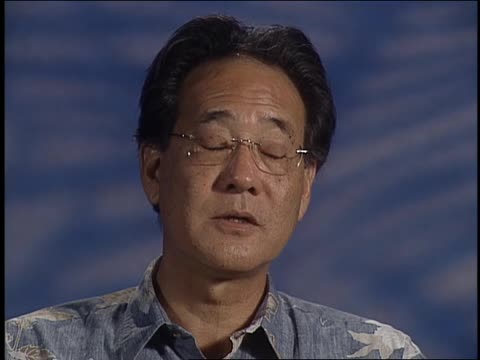
- Interview with Roger Ariyoshi, son of Koji Ariyoshi, recorded on July 21, 2004 for Biography Hawai'i: Koji Ariyoshi. Topics include Koji's voluntary enlistment in the U.S. Army during WWII; his initial impressions of China and his experiences there as an army intelligence officer; his "serious" personal demeanor; his relationship with his children; Roger's childhood memory of Koji's arrest by the F.B.I. & Koji's recollections, impressions & friendships with various members of the communist Chinese leadership.
- Created Date
- 2004-07-21
- Asset type
- Raw Footage
- Subjects
- Hawaii -- Politics and Government -- 1900-1964; Industrial Relations -- Hawaii -- History; Ariyoshi, Koji 1914-1981; Labor Movement -- Hawaii; Hawaii -- Social Conditions; Japanese Americans -- Hawaii -- Biography
- Media type
- Moving Image
- Duration
- 00:26:59.685
- Credits
-
- AAPB Contributor Holdings
-
'Ulu'ulu: The Henry Ku'ualoha Guigni Moving Image Archive of Hawai'i
Identifier: cpb-aacip-41c13e91f2e (Filename)
Format: Betacam: SP
If you have a copy of this asset and would like us to add it to our catalog, please contact us.
- Citations
- Chicago: “Biography Hawaiʻi; Koji Ariyoshi; Interview with Roger Ariyoshi 7/21/04 #2,” 2004-07-21, 'Ulu'ulu: The Henry Ku'ualoha Guigni Moving Image Archive of Hawai'i, American Archive of Public Broadcasting (GBH and the Library of Congress), Boston, MA and Washington, DC, accessed October 12, 2026, http://americanarchive.org/catalog/cpb-aacip-1e7154b55cb.
- MLA: “Biography Hawaiʻi; Koji Ariyoshi; Interview with Roger Ariyoshi 7/21/04 #2.” 2004-07-21. 'Ulu'ulu: The Henry Ku'ualoha Guigni Moving Image Archive of Hawai'i, American Archive of Public Broadcasting (GBH and the Library of Congress), Boston, MA and Washington, DC. Web. October 12, 2026. <http://americanarchive.org/catalog/cpb-aacip-1e7154b55cb>.
- APA: Biography Hawaiʻi; Koji Ariyoshi; Interview with Roger Ariyoshi 7/21/04 #2. Boston, MA: 'Ulu'ulu: The Henry Ku'ualoha Guigni Moving Image Archive of Hawai'i, American Archive of Public Broadcasting (GBH and the Library of Congress), Boston, MA and Washington, DC. Retrieved from http://americanarchive.org/catalog/cpb-aacip-1e7154b55cb