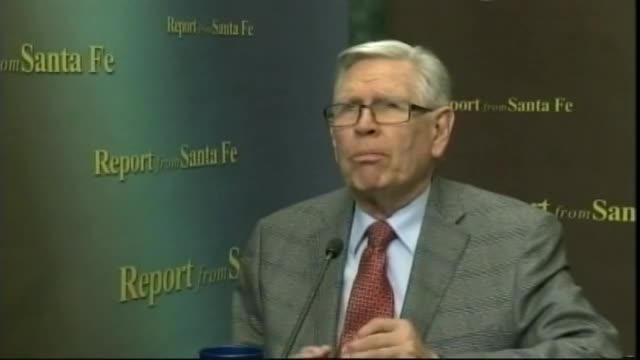
Report from Santa Fe; Art Schreiber
- Transcript
The National Education Association of New Mexico, an organization of professionals who believe that investing in public education is an investment in our state's economic future. And by a grant from the Healey Foundation, Tows, New Mexico. Hello, I'm Lorraine Mills and welcome to report from Santa Fe. Our guest today is really a legend in broadcasting in New Mexico. Art Shriver, thank you for joining us. Well, thank you, Lorraine, and good seeing you. Well, you are a broadcaster, a journalist, a public servant. You've been a champion for the blind. We'll get to that in a minute. But this very year, last month, you won the Arizona New Mexico Book Award for the best inspirational book in New Mexico.
And here it is. It's called Out of Site, Blind and Doing All Right. And here's actually the award. This wonderful award. Talk to me. How do you feel? Well, it feels wonderful and I'm very happy for how Simmons, a good friend of mine, a lawyer who represents the broadcasters as well as the Press Association. He and I talked for years about doing a book. And finally, we did it, met every Monday at 3 o'clock in the afternoon for over a year. And this is the result. And I hope it helps people who are losing sight or are going blind. Well, it helped me tremendously, Art. We'll come back to your career. But let's just talk about this book now because it's changed so many lives. I admit I've always been afraid of losing my sight. And I take vitamins, special eye vitamins and everything. But the subtitle, Blind and Doing All Right, you went from being the general manager of K-O-B with a long broadcast career we'll talk about in a minute to suddenly waking up
on vacation and thinking the lights were out. But it was your lights. Tell us about that experience. Yes. It was on vacation. And I woke up and I could not see. I really thought my life was over. But the best thing that ever happened to me was I had a great friend, Lair Jerry Landy, who worked for ABC, CBS. He was working for then the old Charles Corral Sunday morning. And he had just done a feature on a reading machine. And he called and the nurse happened to be there. And I gave her the phone to take the number down. And he said, you got to call this man. This is a machine you got to get. And I had just been blind for a few months. And I called David Tiki and Boston, who manufacture the Kurzweil reading machine. And I didn't know it was $35,000 in the size of a small washing machine.
And he said, wait a minute. I kept saying, I want this machine. And he said, wait a minute, how long you've been blind? I said three months. He said, my friend, you better learn to function as a blind man before you get a reading machine. Best at once. I've ever been given. I came back to Albuquerque. I went going through 14 eye surgeries. But the great thing was that KOB owned by Hubbard Broadcasting at that time, the radio stations. The Stan Hubbard and his wife, Karen, never gave up on me. They believed in me. And I got training and what you got to do. And I survived and have done very well since. Well, you certainly have. So one of the things that I learned from this book is that there are, is it the Elimogordo School for the Blind and Italy and the Cannes?
Well, there is a school for the blind, which is a wonderful school to have run a superintendent Linda Lyle, but also the commission for the blind, of which Tony and I appointed me the first chair when we, when the commission became a law in 1986. Tony and I appointed me the first chairman and Bill Richardson appointed me again after I was out for a few years with Gary Johnson's administration. Bill Richardson appointed me and I'm still the chair. And the commission is wonderful. We have an orientation center in Elimogordo near the school for the blind, where we train adults who are either have lost their sight or are going blind. And that's where I went for six months. And it is just wonderful. The commission, the federal government ranks the commission for the blind in New Mexico,
one of the top three in the United States. Wonderful. We're pretty proud of that. Yes. In the book out of sight, you talk about how you do train, how you move from being cited to being blind. And I was fascinated, even something like pouring hot coffee. This is precarious, even if you've got two hands and you can see. Yes. But if you learn to put your index finger, of course I'm left handed, so I pour with my left hand, but you put your index finger on the inside of the glass, don't try it with hot water first, but pour and then you'll learn, feel the heat against the finger and you'll know that you've got enough in the glass or the cup. Yes. And you even talked about, sometimes you put a ping pong ball in there and you feel it. Yes. That's how I first started with a ping pong ball and then you put your hand over the glass like this.
And when you feel the ball touching the palm of your hand, you know, you've got it off. Well, you describe some, you know, sometimes there'll be construction and you've been walking on a sidewalk for months and suddenly there's a six-foot hole there which you have encountered. Oh, yes. You ended up in a ditch that does treatle on, had been dug out and I had just come from the cleaners, but I point out in the book, Lorraine, that my trainer, a wonderful man by the name of Jose Sanchez, who is retired now from the commission for the blind. But he told me, he said, now art, I had just had one lesson of learning to go from my apartment by condo to the studio and back. And he said, just practice that, don't do anything else, just practice that. No Saturday came and I thought, well, I got to get to the cleaners and I remember where the cleaners is around the corner.
Well, I didn't know that they had dug out the treatle on and I get my cleaning, I walk across, step up, you should take your cane and make sure what you're stepping on, but I didn't, I just stepped up down into the ditch, I go with my cleaning and I finally dug my way up out of there and I go back to the cleaners with my dirty cleaners and they said, Mr. Shriver, what's going on? I said, I've been in that hole over there for a half hour and you better redo my cleaners. Well, you know, you have a, you point out that having a sense of humor is really, really important when you make this kind of life adjustment and you still clearly have your sense of humor. I hope so. Yes. Well, I would like to take a moment and look back at your background because you, as radio grew, as broadcasting grew, you were there. And so talk about growing up and listening to the radio as a kid and then kind of give
us a synopsis of your career because you interviewed, you were with some amazing people. Well, my father who managed a farm, a big farm in Ohio, 2,000 acres, that's not big farm in New Mexico, but that's a big farm in Ohio. And he managed it and was a preacher at a country church. And all we got was what was in the collection plate on a Sunday morning and the most we ever got between 1932 and 1939 was $3.50, but parishioners would bring food and leave it in the vestibule of the church, a live chicken and a gunny sack, and that's how we survived. But my father then was asked to manage this large farm and every day he would first listen to the eight o'clockness in the morning and I sat with him.
As I can, I guess I was six, seven, eight years old and I listened. I didn't know what I was hearing in the sense of what the news was doing, but I wanted to do that. And I lived with that the rest of my days and when I got fortunately, got to college, majored in speech, got thrown out of the speech department told by my major advisor to get out of the department, get into something I could make a living at. Well, I majored in Bible philosophy and psychology, but when I graduated from college, I said, I'm going to get a job in radio and I did. Yes. And then I got in the news business. I wanted to do news. And I was lucky that I got a big break, I got in Cleveland, a big station in Cleveland. And from there, I went to a large company, Westinghouse, broadcasting company, own stations across the country.
And then they assigned me to civil rights, politics, and man space. And so that's how I covered Jack Kennedy before he ever was president, when he was fighting it up with Hubert Humphrey, the senator from Minnesota, he was fighting it up with Hubert Humphrey for the nomination. And I traveled with Jack and Jackie through Wisconsin, then West Virginia. And that's when Hubert Humphrey threw in the towel and Kennedy then went on to become president. Unfortunately, I had to cover his funeral. And then I was assigned civil rights. I remember I was covering Gordon Cooper's first flight, first flight was a 17 orbit flight or 24 hours. So we had been up for days, covering that story in Cape Canaveral.
And then over the loudspeaker and our trailer came the bureau chief's voice. And he said, you've all done a great job. I want you to lay in the sand for two days. And I, oh, we all applauded. And he said, but I want our driver to call it by landline. And I called him and he said, Steinbock, his wife is sick. He's covering Birmingham. It's burning up. Get over there as fast as you can. And that was my meeting with Bull Connor, the famous police chief of Birmingham, Alabama. He later became the head of the highway patrol. And later the head of the Alabama Democrat delegation at the convention in Atlantic City in 1964. I learned, I knew all those people. And then I met Martin Luther King, traveled with them through the South.
I was with him when he spoke to 25 people in a small country church in Alabama. And I was with them at the Washington Lincoln Memorial, where he spoke to a quarter of a million. And then I got to travel with the gold, covered the astronauts. John Glenn became a good friend because he was from Ohio and I was from Ohio. So just I traveled with gold, water, and 64 with Lyndon Johnson. It was just a wonderful career. Became bureau chief for Westinghouse, Broadcasting Company. And I headed the Washington and foreign news services for the company, established bureaus all over Europe, Saigon, Hong Kong, and other places that I can't remember at the phone. For you to be a newsman during the time and have the beat of civil rights, politics, and
man space. That was one of the most exciting times in American history. And he were and I witnessed all that. And it wasn't always serious, you know, two of those men, you know, Martin Luther King and Kennedy were assassinated. It wasn't always serious tragedies like that. And you know, I was assigned to cover the Beatles in 1964 and John Lennon, who I became good friends with, John Lennon always wanted to talk about, not about music, but he wanted to talk about Martin Luther King. He had met Kennedy and he couldn't understand why he had been killed. And of course later Martin Luther King was assassinated. And John Lennon himself was a victim of an assassination. Well we're speaking today with Art Shriver, a pioneering journalist and an author of a new book called Out of Science.
I'd like to hear a little more about the Beatles tour because you were one of two Americans that did three weeks of their first North American tour in 1964. And you would play Monopoly with John Lennon and George Harrison. And you have a very cute clip we're going to run this. This is Paul McCartney on the phone to you. You say this clip saves your job. Give us a little short version. And well when we play the clip we'll look at a couple of pieces from your beautiful scrapbook about your life with the Beatles, some pictures of them, press passes and things like that. Well the bureau chief who I reported to was not happy that I was covering the Beatles because and he insisted on I cover the Democratic Convention on Atlantic City. At the same time it was at the same time the Beatles tour started. So the compromise was that I covered the Democratic Convention, joined the Beatles in New York at the Old Forest Hills, tennis complex, where they performed for two performances.
And so I joined them and that's where I met them. And John Lennon said to me the second night on the tour that I was on the tour. He said, do you play Monopoly? I said, well play with my kids. He said I got a board. And he said, George and I play, these other guys won't play. And so I played with Monopoly with John and George. But we had made a pledge never to ask for autographs because we were constantly asked by very important people in our hometowns and in our places of work to get an autograph. And so my bureau chief called me and said, I want autographs. I said, Jim, I can't do it. And he hung up on me. We were on our way to New York. The Beatles were to perform that night at the Paramount Theatre. By the way, I have a ticket to that theater and it's $2.50.
And anyway, that was going to be their final performance the next day they were back to England. And I, Jim hung up on me when I couldn't get him autographs. I knew my career was in jeopardy. We were on the plane and you can hear what I asked Paul McCartney. Well let's just give him a minute, we'll listen to this clip of you and Paul McCartney. And meanwhile we'll also show some of the pictures from your scrapbook. Let's give it a minute and listen. Well on the plane, almost to New York and Paul McCartney is beside me and this interview is for Margaret Anzanyter Paul. She saw you in Baltimore. She waved to you and she thinks that she saw you waved to her. Of course, of course I did. I remember her now very well. Margaret Anzanyter there, she was looking at picture, looking like a vision.
And she waved and I thought, that's Margaret Anzanyter, I thought shouting. So I thought, well, I'll be a wave back, hadn't I? And with a gave wave of my hand, I waved back. Of course I'd recognize her anywhere. She's the girl with a long fur herd and I've got a little black pen knife. I know her anywhere. Yes. Paul, I know that she'd like to see you in New York, but you're going to have to leave tomorrow. So I'll bet she'll even be waving from Baltimore when you're leaving from New York. Well, I'll tell you what, I'll wave from New York and as you wave from Baltimore and might see each other on telly. Fine, and if I, if I see her, I'll be sure and then send my, your personal message to her, right? Okay, give her my love then, I'll also love Margaret Anzanyter. Goodbye, and I'll see you. Well, what a wonderful sense of humor he has. That's absolutely delightful.
He just played right along with it. That must have been the happiest little girl in America. Well, when I got back home, I had that put on a cartridge and I sent to my pure chief, Jim Snyder, and a week later he called me and he said, we had a babysitter last night. I took the babysitter home and when I came back, I went by Margaret Anzram. I thought I heard something and I pushed the door open. She was laying there with the tape recorder by her ear and she looked up at me and she said, he said my name, he said my name, and that saved my career. Oh, good. Well, let's, we're going to move on to other parts of your career, although it just is so striking how different things were than now everyone's taking selfies, everybody's giving autographs everywhere, but there was a lot, there was a distance between the entertainer, the star, and there were stars, nobody of that magnitude in a long time. That's right.
And, you know, just think today I have no photographs with me and the Beatles. Well, if today everybody had a cell phone, everybody be taking pictures. It's the same going back to the Kennedys. When I was with Jackie Kennedy one night we were waiting for her husband to come out of the television studio and I looked down and Lorraine, you, I know you're not old enough, but women who are old enough remember nylon hose and they got a runner in them and then sometimes they got filled with air and your leg looked like a balloon and I looked down and Jackie Kennedy had a long runner in her hose and it was ballooning out and she saw me look, she said, art, quit looking and I said, if I only had a camera today that it would be, there'd be a million on Facebook, Twitter, and every place else. Well let's come back to your, you went from a reporter to being a station manager and
you ended up at KOB, Albuquerque after many other stops. You, I just have to say this, truth in disclosure here, that you were inducted into the broadcasters Hall of Fame here in 2010. I know you through my late husband Ernie Males, he was in the broadcasters Hall of Fame in 2003 and you each were named broadcaster of the year in different years, you in 1991, he in 1995, but you've seen so many changes in radio. What do you think, what do you, into it might be coming in the future, we've got satellite radio now, we've got, yeah, I, I worry that people are getting trained. I mean, in journalism, it really trained. Now everybody can have a block and that doesn't mean that everybody is a good journalist. And that concerns me a great deal.
I love the fact that people like, that are really good news people, Jim Bellshaw for example, although Jim, I don't think as a blog, I want him to. But those are the kind of people that ought to be writing. And I know there are some today that are. But radio, when we lost the fairness doctrine and for television too, we, that, that hurt broadcasting in my opinion, we, we need the fairness doctrine because we need as the communications act used to say, all sides of important issues, of public importance. And, and, and that's what was, but who knows, with Twitter, with the way communication is today, I'm not bright enough to see what it's going to be, but I know it's certainly not like the good old days that I and Ernie and, and you, we spent where you really wanted
to check out a story before you ever put it on the air or an imprint. But today, we put it on the air, unfortunately, without checking it out very well. Now, you know, in, with the advent of your blindness, you were able to really through the support of, of, of KOB. You were able to use your radio and broadcasting expertise to so vastly improve the quality of life for blind people, the newsline for the blind. Yeah. That's such a gift. Tell us what it is. Well, it, by telephone, you, I have access to over 350 newspapers around the world in this country, most of them, obviously, in this country, plus over 40 magazines, all accessible by touch-tombed telephone, free of charge through the commission for the blind and the
National Federation of Blind. That is just an incredible opportunity for blind people. Blind people used to have to wait until somebody read something to them. And now, you can just pick up a touch-tombed telephone. And if you're signed up with the commission for the blind, and you can have instant news, and you don't have to wait for someone else to read it, it is read to you by computer voice in Albuquerque. We still have local newsline with the Albuquerque Journal and other newspapers around the state read by volunteers. So we have both in Albuquerque and New Mexico. But that is a fabulous opportunity. Blind people today are reading newspapers for the first time in their lives. That's incredible.
And that is always a result of the National Federation of Blind, which started it. And I would like to acknowledge that last year, you got the Jacobus 10 book, it's a Dutch name, I think. Jacobus 10 book was the first president of the National Federation of Blind. And they give out a very prestigious award, and you got it last year for your humanitarian efforts to improve the quality of life for blind people. Yes. It touched me very deeply. I'm very grateful. I've devoted the rest of my life to helping people who are losing sight or who are blind. Well, you have received so many humanitarian awards because we only have a minute and half left. I'm not going to go over them all, but the best book, the best inspirational book for out of sight. I'm going to hold it up here again. This is your book that you just won the award for out of sight, blind and doing all right. This is such a gift.
Give me a one minute summary. What you want people who are blind or who are concerned about blind is what they need to know based on your courage and your experience to just living a full life, even though you were stricken with this disability. They need to understand that life isn't over. There is life after blindness, and they do need to know that they need training. I liken it. If someone is an alcoholic or a drug abuser, you and I can tell them or their loved ones can tell them, oh, you need help, go get some help, but they have to do it. And we who are losing sight or blind, we have to come to grips with it ourselves. We have to say, I need help. And the commission for the blind is there to help. The National Federation of Blind is there to help. And there are available access to individuals, but they need to come to grips with it and just accept the fact that we can't see, but we can still live a full life.
Well, we have to come to grips with the fact that we're out of time. Our guest today is Art Shriver, a legendary broadcaster, journalist, public servant, humanitarian, and author. So Art, thank you for taking the time to be with us today. Thank you. And I'm Lorraine Mills. I'd like to thank you, our audience, for being with us this week on Report from Santa Fe. We'll see you next week. Past archival programs of Report from Santa Fe are available at the website reportfromsatafay.com. If you have questions or comments, please email info at reportfromsatafay.com. Report from Santa Fe is made possible in part by grants from the members of the National Education Association of New Mexico, an organization of professionals who believe that investing in public education is an investment in our state's economic future. And by a grant from the Healey Foundation, Tos, New Mexico.
- Series
- Report from Santa Fe
- Episode
- Art Schreiber
- Producing Organization
- KENW-TV, Eastern New Mexico University, Portales, New Mexico
- Contributing Organization
- KENW-TV (Portales, New Mexico)
- AAPB ID
- cpb-aacip-0face509d59
If you have more information about this item than what is given here, or if you have concerns about this record, we want to know! Contact us, indicating the AAPB ID (cpb-aacip-0face509d59).
- Description
- Episode Description
- This week's guest on "Report from Santa Fe" is famed New Mexico broadcaster and journalist Art Schreiber. He discusses his new book "Out of Sight," which just won the NM-AZ Book Award for the "Best Inspirational Book" of 2014. Schreiber reminisces about his journalistic adventures - traveling with the Beatles on their first North American tour, interviewing President Kennedy and Martin Luther King, and his own induction into the New Mexico Broadcasters Hall of Fame. Guests: Lorene Mills (Host), Art Schreiber.
- Broadcast Date
- 2015-01-03
- Asset type
- Episode
- Genres
- Talk Show
- Media type
- Moving Image
- Duration
- 00:28:53.666
- Credits
-
-
Producer:
Ryan, Duane W.
Producing Organization: KENW-TV, Eastern New Mexico University, Portales, New Mexico
- AAPB Contributor Holdings
-
KENW-TV
Identifier: cpb-aacip-35762081873 (Filename)
Format: DVD
If you have a copy of this asset and would like us to add it to our catalog, please contact us.
- Citations
- Chicago: “Report from Santa Fe; Art Schreiber,” 2015-01-03, KENW-TV, American Archive of Public Broadcasting (GBH and the Library of Congress), Boston, MA and Washington, DC, accessed October 10, 2026, http://americanarchive.org/catalog/cpb-aacip-0face509d59.
- MLA: “Report from Santa Fe; Art Schreiber.” 2015-01-03. KENW-TV, American Archive of Public Broadcasting (GBH and the Library of Congress), Boston, MA and Washington, DC. Web. October 10, 2026. <http://americanarchive.org/catalog/cpb-aacip-0face509d59>.
- APA: Report from Santa Fe; Art Schreiber. Boston, MA: KENW-TV, American Archive of Public Broadcasting (GBH and the Library of Congress), Boston, MA and Washington, DC. Retrieved from http://americanarchive.org/catalog/cpb-aacip-0face509d59