Newark: The Slow Road Back
- Program
- Newark: The Slow Road Back
- Producing Organization
- New Jersey Network
- Contributing Organization
- The Walter J. Brown Media Archives & Peabody Awards Collection at the University of Georgia (Athens, Georgia)
- New Jersey Network (Trenton, New Jersey)
- AAPB ID
- cpb-aacip-259-7p8tdd70
If you have more information about this item than what is given here, or if you have concerns about this record, we want to know! Contact us, indicating the AAPB ID (cpb-aacip-259-7p8tdd70).
- Description
- Program Description
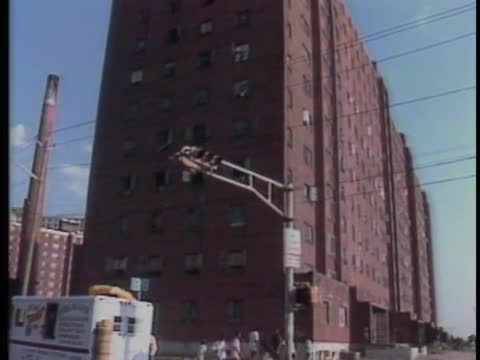
- "For the last two decades, Newark, New Jersey has been a national symbol of urban decay. But now Newark officials like to claim that the city has 'turned around,' that the old stigma is out of date, that Newark is 'coming back.' In NEWARK: THE SLOW ROAD BACK, both the old image and new claims come under scrutiny. "Using riot footage never aired before, Producer/Director Sandra King begins the one-hour documentary with then-Gov. Richard Hughes and his harsh appraisal of a city rocked by riot. As we hear Hughes tell it: 'This City is Dying.' By the end of the hour, we know that Newark managed to survive. As one Central Ward resident explains: 'When the land in the Central Ward is worth $250,000 an acre, ain't no way you're dead.' But the documentary also makes clear that Newark is still a city with more problems than it [can] handle. "Yes, there is renewal downtown -- the new office buildings look like progress, the yuppies rush off the trains each morning as the business climate continues to look up and there are even new luxury condos on what was once one of Newark's roughest corners. "But THE SLOW ROAD BACK show the other side, too: the low income housing crisis that just gets more severe, the public housing residents who wait in vain for the elusive townhouse, the alienated white cops who patrol the inner city streets, the parents -- black and white -- who refuse to send their kids to Newark's troubled public schools. "This documentary has no reporter presence, no narration and no barrier between the viewer and the Newarkers who get to tell their own story. In the best Peabody tradition, it offers no easy answers, while asking the hard questions in a clear, unflinching and honest way."--1987 Peabody Awards entry form.
- Program Description
- Examines Newark's recovery starting from the aftermath of the 1967 race riots. Includes interviews with residents and notables such as Amiri Baraka, former Governor Richard Hughes, H. Rap Brown, and Steve Adubato (Senior).
- Broadcast Date
- 1987-12-03
- Asset type
- Program
- Media type
- Moving Image
- Duration
- 00:59:05.776
- Credits
-
-
Director:
King, Sandra
Producer: King, Sandra
Producing Organization: New Jersey Network
- AAPB Contributor Holdings
-
The Walter J. Brown Media Archives & Peabody Awards Collection at the
University of Georgia
Identifier: cpb-aacip-7bf3b90409a (Filename)
Format: U-matic
Duration: 00:59:00
-
New Jersey Network
Identifier: cpb-aacip-0f6b14549bb (Filename)
Format: Zip drive
Generation: Master
If you have a copy of this asset and would like us to add it to our catalog, please contact us.
- Citations
- Chicago: “Newark: The Slow Road Back,” 1987-12-03, The Walter J. Brown Media Archives & Peabody Awards Collection at the University of Georgia, New Jersey Network, American Archive of Public Broadcasting (GBH and the Library of Congress), Boston, MA and Washington, DC, accessed August 25, 2026, http://americanarchive.org/catalog/cpb-aacip-259-7p8tdd70.
- MLA: “Newark: The Slow Road Back.” 1987-12-03. The Walter J. Brown Media Archives & Peabody Awards Collection at the University of Georgia, New Jersey Network, American Archive of Public Broadcasting (GBH and the Library of Congress), Boston, MA and Washington, DC. Web. August 25, 2026. <http://americanarchive.org/catalog/cpb-aacip-259-7p8tdd70>.
- APA: Newark: The Slow Road Back. Boston, MA: The Walter J. Brown Media Archives & Peabody Awards Collection at the University of Georgia, New Jersey Network, American Archive of Public Broadcasting (GBH and the Library of Congress), Boston, MA and Washington, DC. Retrieved from http://americanarchive.org/catalog/cpb-aacip-259-7p8tdd70